 FlashBoards Learn
- Learn
- Lenses, Focus & Exposure
- Long Exposure
Lenses, Focus & Exposure · Film language
Long Exposure
Also called: long exposure photography, slow shutter, light trails
A long exposure keeps the shutter open far longer than the subject needs, from a second to many minutes. Anything fixed stays crisp while anything moving smears: headlights become light trails, water turns to mist, crowds fade to ghosts. It shows the viewer time passing inside a single image.
- What it does
- Turns motion into shape: streaks, ribbons and silky surfaces around a sharp, still world.
- Use it when
- Night cities, traffic, water, stars, dreamlike or disoriented moments, time passing in one image.
- Watch out
- The camera must be locked down, and at 24 fps a single frame can't expose longer than 1/24 s.
- Try this prompt
Tripod long exposure at night, 20-second shutter, red and white light trails of traffic under a sharp, still bridge
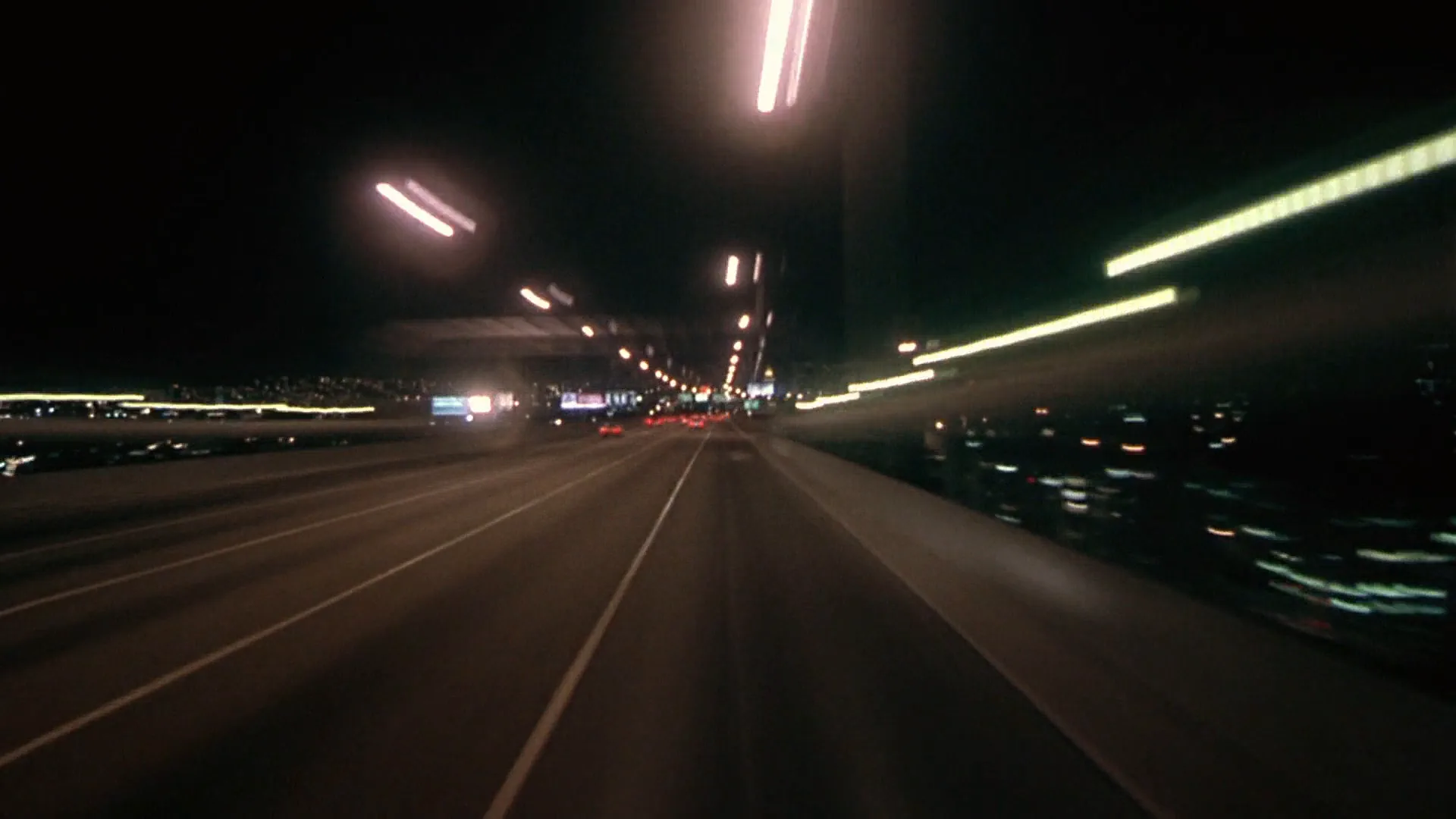
What is long exposure?
Long exposure is a way of using shutter speed: the sensor collects light for a long stretch instead of a sliver of a second. A street at 1/500 s freezes a cyclist mid-pedal. The same street at 15 seconds erases the cyclist, keeps the buildings sharp and paints every moving lamp as a continuous line.
A static object sends light to the same spot on the sensor for the whole exposure, so it builds up sharply. A moving object spreads its light along its path and thins into a streak, or vanishes if it is dim and fast. Headlights and torches survive as trails; pedestrians become faint ghosts.
Why filmmakers use the long-exposure look
On screen the long-exposure look does three jobs:
- Speed. Streaked practicals in a night drive say the world is rushing past faster than the eye can hold.
- Time passing. Light trails flowing through a city in a time lapse show hours going by, as in the night traffic of Koyaanisqatsi (1982).
- Altered perception. Smeared light around a readable face suggests memory, exhaustion or a mind slipping, as in the step-printed smears of Chungking Express (1994).
The extreme case is the Star Gate in 2001: A Space Odyssey (1968), built with slit-scan: each frame was a long exposure made while artwork moved behind a narrow slit.
How to shoot a long exposure
For stills and plates:
- Lock the camera. Heavy tripod, remote release or 2-second timer, stabilization off.
- Stop down, drop ISO. ISO 100 at f/8 to f/11 keeps depth sharp and the shutter open longer.
- Add ND in daylight. A 10-stop ND filter turns 1/125 s into about 8 s.
- Match time to motion. Car trails: 10 to 30 s. Waves and waterfalls: 1/2 to 4 s for silky texture. Star trails: 20 minutes and up, or stacked 30 s frames.
For motion pictures, the frame rate caps the exposure: at 24 fps even a 360° shutter gives only 1/24 s. To go longer, drop the frame rate. At 4 fps with a 360° shutter each frame gets 1/4 s, and played at 24 fps the action runs six times faster with heavy trails. A time lapse with 1 to 2 s exposures per frame gives the flowing highway; frame blending in post fakes it.
How to capture light trails
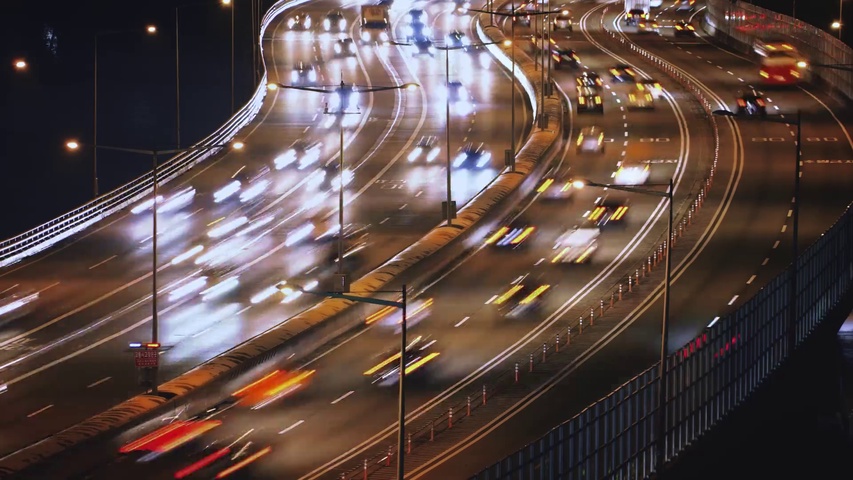
Find a footbridge or overpass so the lanes run into the frame as leading lines. Use a wide or normal lens, focus manually on the road and start the exposure just before a car enters. White trails are headlights coming toward you, red are tail lights going away. Shoot in blue hour, 20 to 40 minutes after sunset, so the sky keeps detail; buses add a second, higher line of light.
Long exposure vs. motion blur
Motion blur is any smear left while the shutter is open, and a little is in every normal frame: a 180° shutter at 24 fps softens a running actor just enough to read as natural movement. Long exposure pushes the time far past the length of the motion, so moving things become lines, fog or nothing. The test: in motion blur you still recognize the object; in a long exposure you mostly see its path. Both come from the same corner of the exposure triangle, a thread that runs through all of lenses, focus and exposure.
Long Exposure examples in film
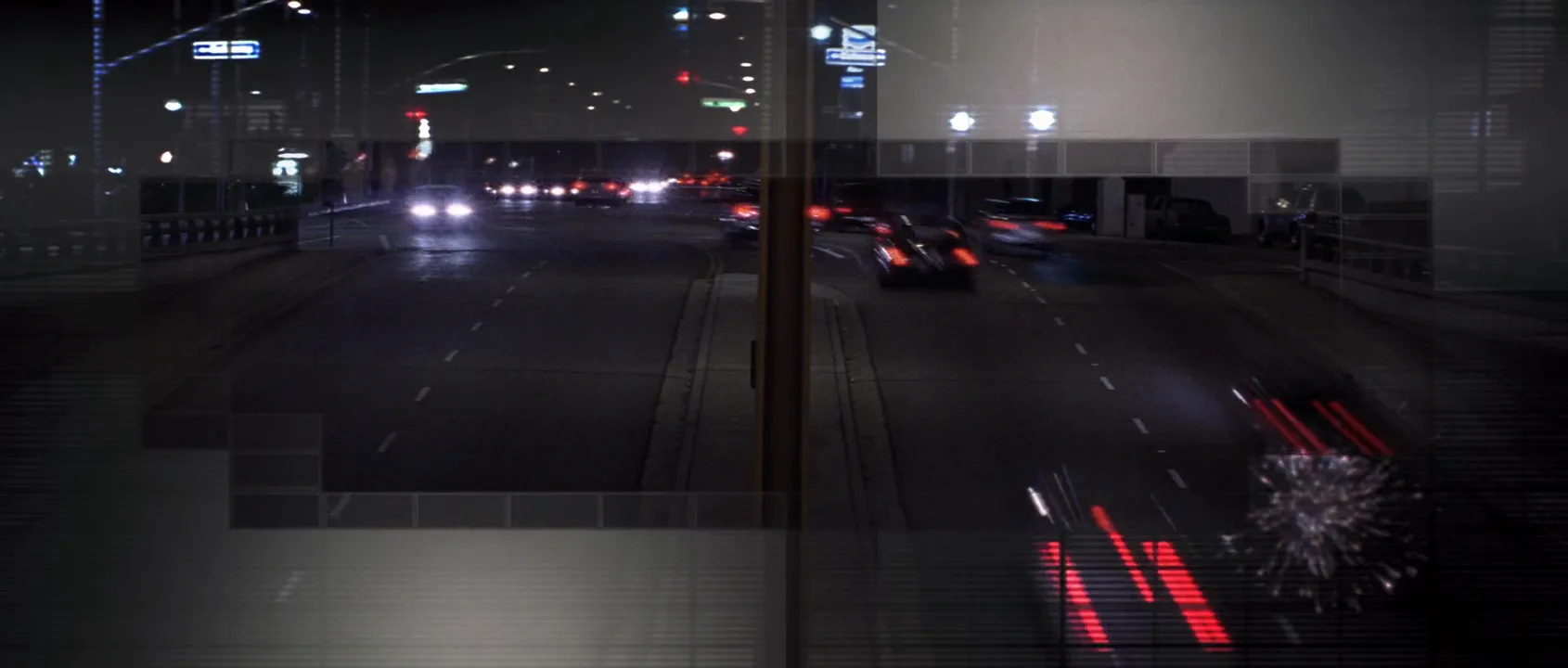
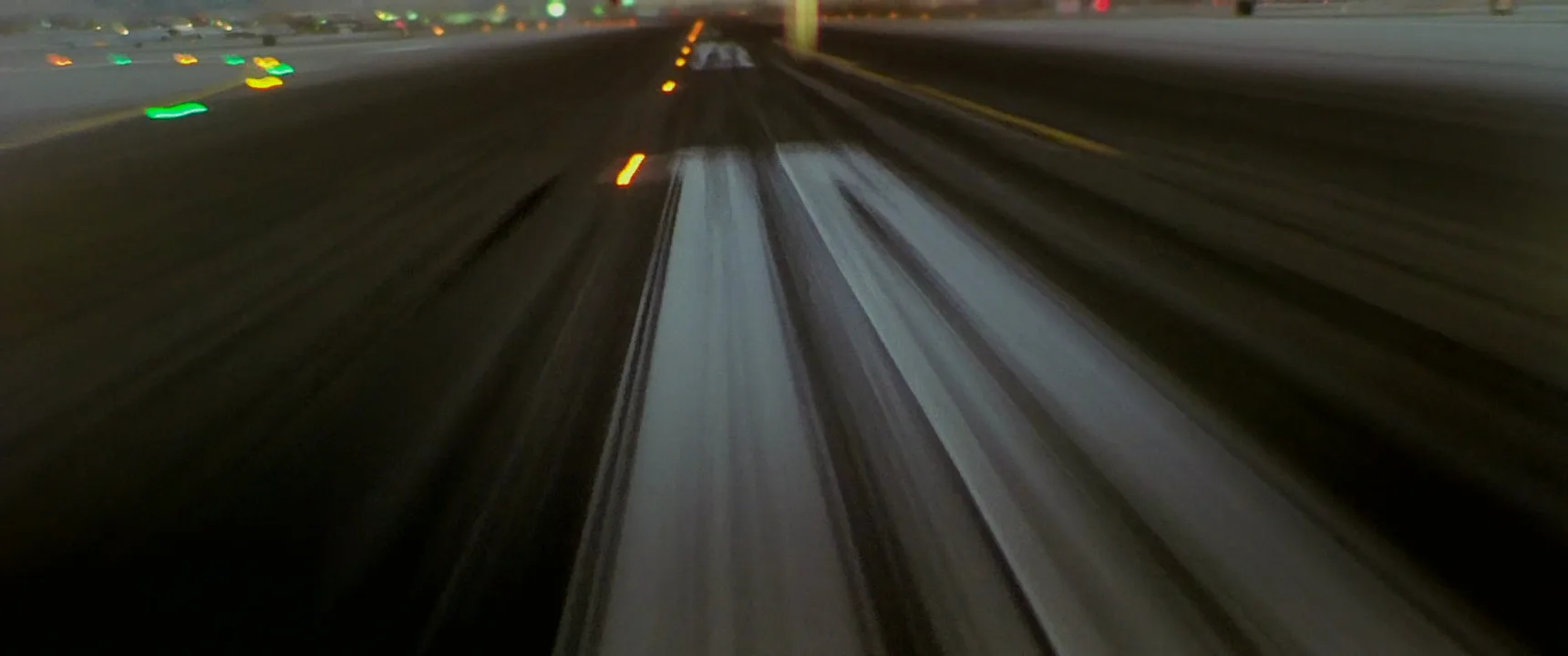
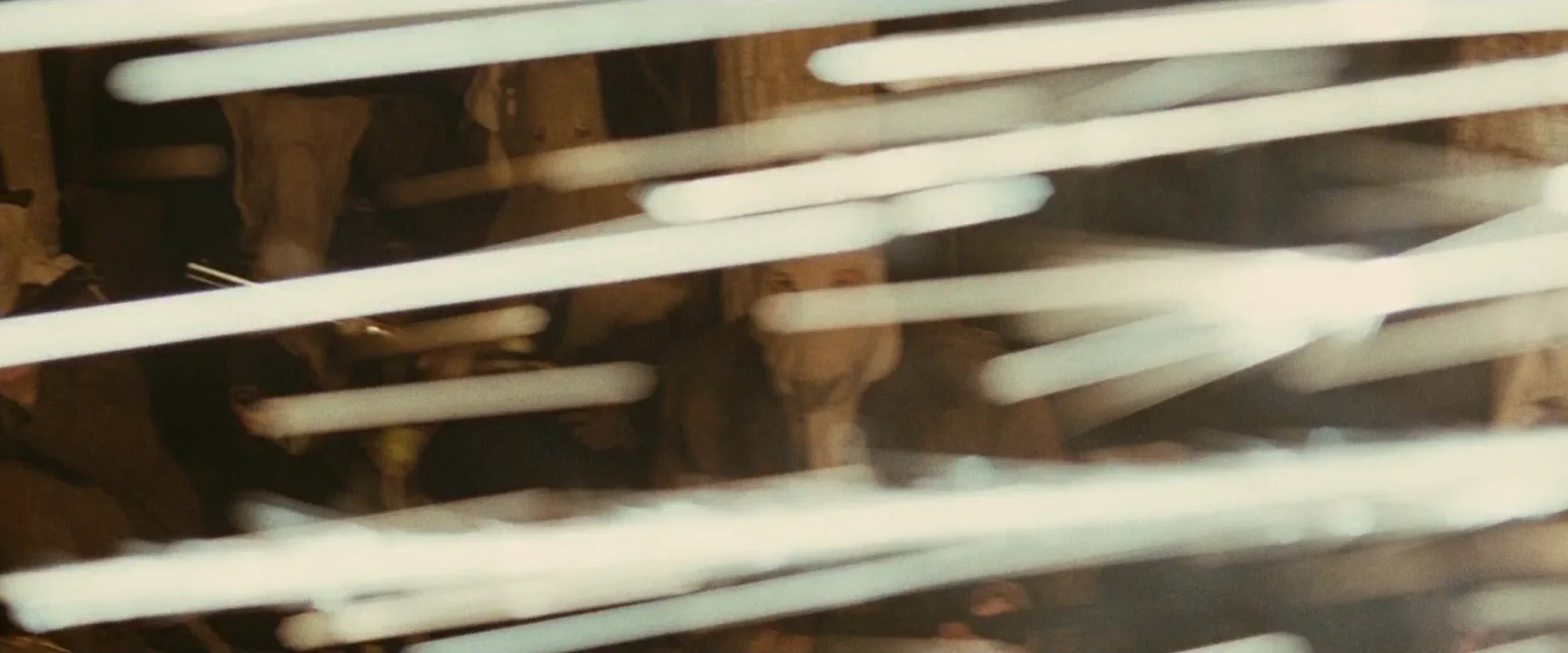
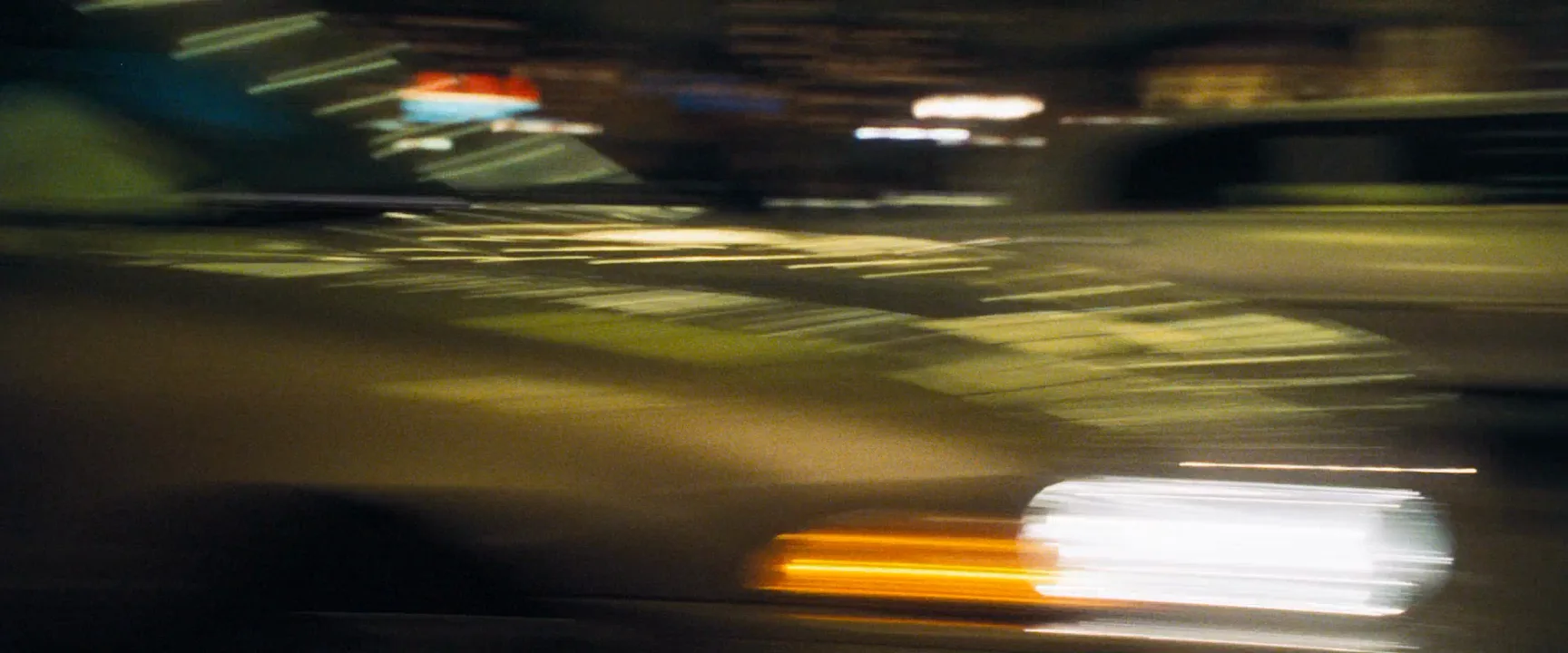
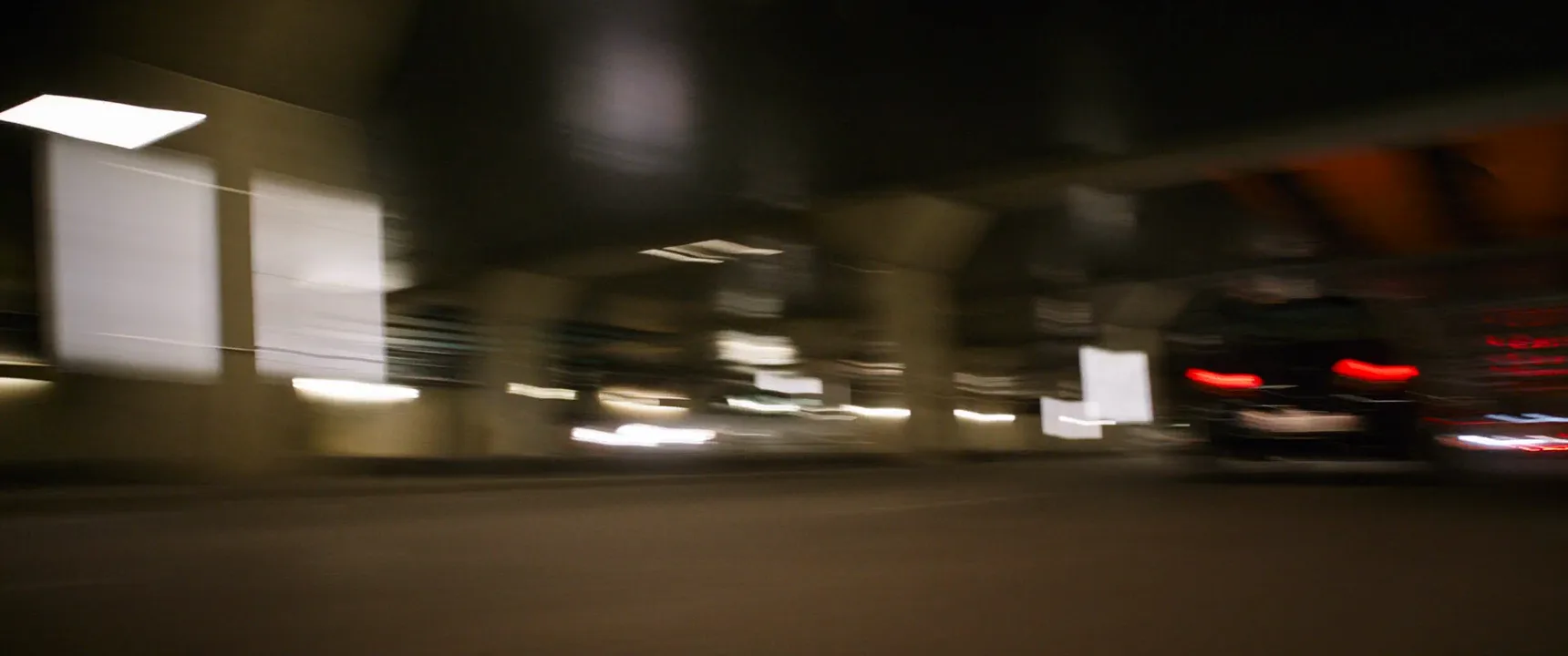
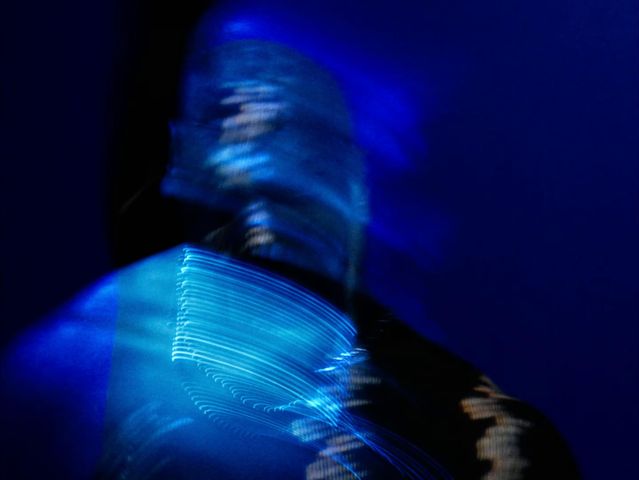
8 framesFrames where lights stretch into streaks while the rest stays readable: the long-exposure look as films use it, mostly at night.
How to create a long exposure with AI
4 promptsImage models know the long-exposure look when you describe it as a photograph with a shutter time and a locked camera, and name what moves and what stays still. Keep the film references and every take on one FlashBoards board to compare them side by side. The fourth prompt re-shoots a real film shot from a text description alone, and the original plays next to the result so you can compare.
Cinematic night wide shot, long exposure photograph, camera on a tripod, 20-second shutter, 24mm lens at f/11. A woman in her thirties with a cropped silver bob, a long mustard wool coat and black gloves stands perfectly still at the railing of a concrete footbridge, sharp and motionless. Below her a six-lane highway curves into the city; the traffic has become continuous red tail-light trails on the left lanes and white headlight trails on the right. Blue-hour sky, sodium streetlamps, wet asphalt reflecting the trails.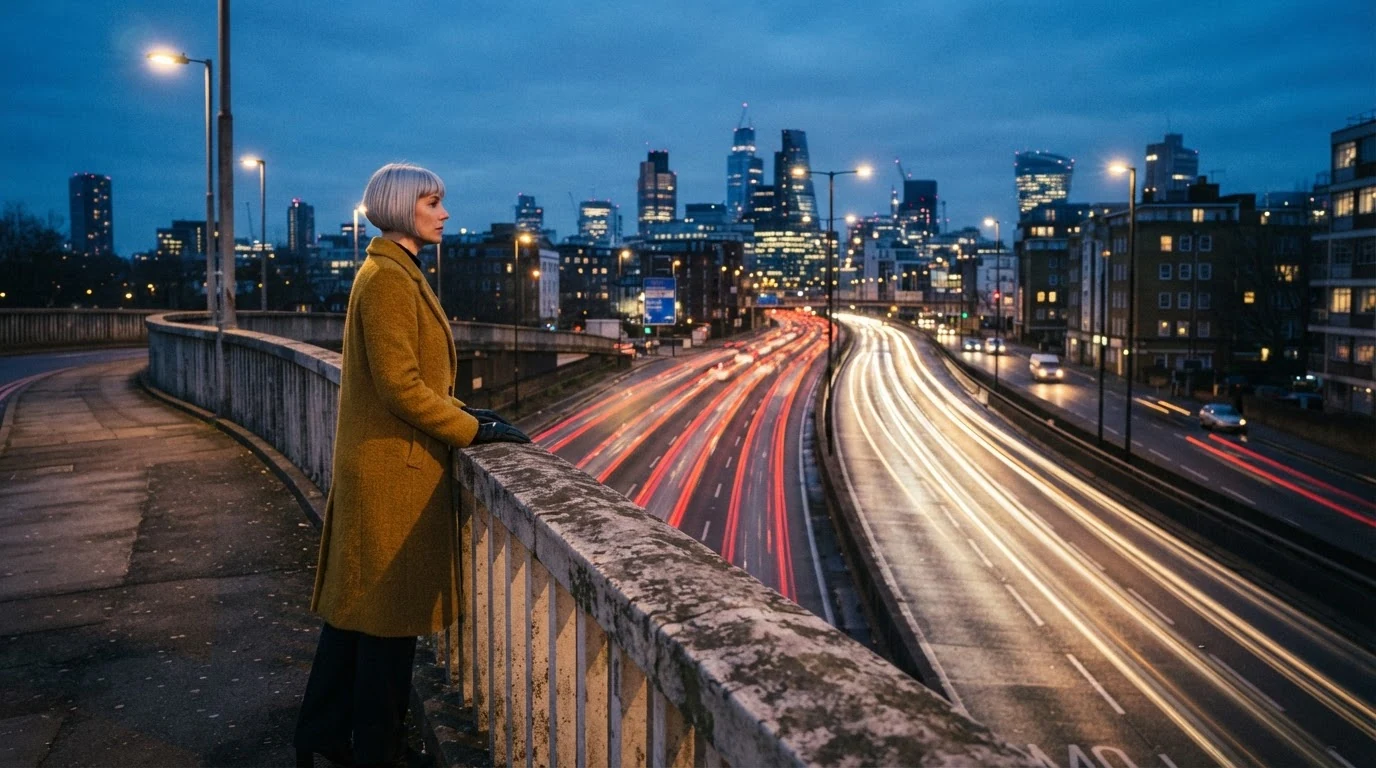
Long exposure photograph, tripod, 20-second shutter asks for a photographic look, not a blur filter. Perfectly still, sharp and motionless protects the person; red trails left, white trails right gives the trails logic.
Open FlashBoardsAnamorphic widescreen long exposure at dawn, 10-second shutter with a 10-stop ND filter, camera locked on a tripod, 35mm lens. A broad-shouldered man in his sixties with a white beard, a bright yellow fisherman's slicker and red rubber boots stands still on black basalt rocks at the edge of the sea. The waves around the rocks have turned into smooth milky mist, the low clouds stretch into soft streaks across a pale pink sky, and the man and the rocks are tack sharp.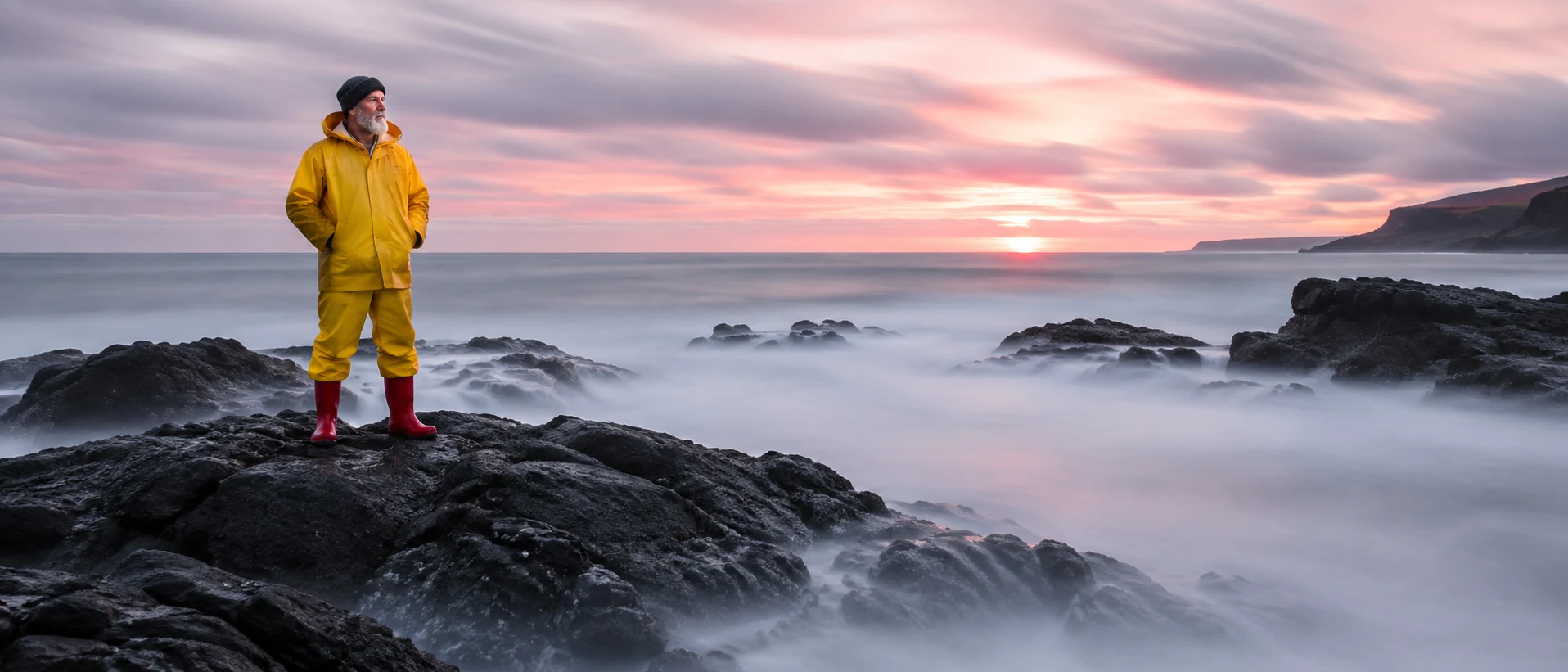
The second take moves from light trails to water. 10-stop ND explains a daylight long exposure, and milky mist and clouds stretch into streaks say what time does to each moving element.
Open FlashBoardsCamera: fixed on a tripod for the whole shot, perfectly steady. Action: from the first frame the red and white light trails on the highway flow continuously like liquid ribbons, pouring along the curve and into the city. In the middle the woman turns her head slowly toward the traffic below while her coat stays still. At the end she rests both gloved hands on the railing as the trails keep streaming beneath her.Flow continuously like liquid ribbons starts motion in the first frame and keeps trails from turning back into cars. The steady tripod and her small gestures keep a still subject against a moving world.
Open FlashBoards{
"output": "Full-screen live-action night footage from its very first frame, a city plate from Serendipity (2001): two shots joined by one hard cut. Every frame is a long-exposure photograph that moves: an undercranked camera with a shutter held open for a long time, so every lamp, every sign and every car light is drawn as a long continuous glowing line and the cars themselves dissolve into those lines, while the dark road and the towers stay readable. Deep black sky, sodium amber and cold white lamps, ruby red and white light lines, cyan-white office lights, early-2000s 35mm grain.",
"characters": {},
"shots": [
{
"shot": 1,
"camera": "plate camera mounted low on a car hood in the centre lane of an elevated city highway, eye-level wide lens, pushing straight forward very fast; lane lines converge to a vanishing point in the centre of the frame, distant skyline glitter low on the horizon, a concrete barrier wall along the right edge",
"voice": "silence: nobody speaks in this shot, no voice at all",
"action": [
"BEGINNING: alive from the first frame, the camera already rushes forward; three or four overhead lamps are stretched into long white-amber streaks across the upper half, each pointing toward the vanishing point, while a low red streak of tail lights hugs the lower left; the whole frame is motion-smeared.",
"THEN: new lamp streaks keep peeling off the vanishing point and whip outward past the top edge of the frame; a pale cyan smear slides along the right barrier.",
"THEN: a long ruby red ribbon of tail light slides backward along the left lane and leaves frame at the lower left.",
"END: an overhead green highway sign rushes over the camera and exists only as a smear: a tunnel of long green light lines across the top left and top centre, while one white lamp streak burns at the top right."
],
"dialogue": []
},
{
"shot": 2,
"cut_at": "00:01.080",
"camera": "long-exposure time-lapse from high above, looking straight down, steady with a slow push in; one single straight avenue, uninterrupted, crosses the frame as one diagonal band from the top left corner to the bottom right corner, with a continuous wall of dark office towers and their rows of lit cyan-white windows filling both sides",
"voice": "silence: nobody speaks in this shot, no voice at all",
"action": [
"BEGINNING: the traffic is already pure light: the left half of the avenue is a thick braid of fine white head-light lines, the right half a looser braid of fine red tail-light lines, dense glowing threads running the whole length of the avenue, with amber street lamps dotted between them.",
"THEN: the white lines and the red lines keep flowing along the diagonal in opposite directions, like two streams of liquid light, while the towers and every lit window stay perfectly sharp and still.",
"END: the river of white and red light keeps streaming from corner to corner as the view drifts slightly closer."
],
"dialogue": []
}
],
"sound": {
"ambience": "rushing wind and tyre roar on the highway, then the distant hum of city traffic far below",
"speech": "no words in this video; the only human sounds are breaths and movement",
"never_spoken": "no narration and no voice-over: the descriptions, performance notes and step words of this prompt are never spoken aloud",
"music": "a film score under the scene, always below the voices: bright, driving romantic strings over a quick pulsing rhythm, like a race across the city at night",
"subtitles": "none"
}
}Remakes the Serendipity (2001) night plate: a fast run down a highway under smeared lamps, cut to a top-down avenue of white and red light trails.
Timing lives only in cut_at, so the cut lands on the original's beat. Shutter held open and cars dissolve into lines ask for trails, and the score and silence are written out.
Common mistakes
- Trails turn back into cars. Write the traffic has become continuous light trails and describe lines, not vehicles; naming cars brings them back.
- Everything blurs. Without tripod and sharp, motionless the model smears people and buildings too.
- Random colors. Say white headlights coming toward camera, red tail lights going away.
- Black sky. Ask for blue hour to keep separation above the skyline.
Keep the reference frames, prompts and every generated take side by side — images and video in one canvas.
FAQ
4 questionsWhat is long exposure photography?
Long exposure photography uses a slow shutter speed, usually one second or longer, with the camera on a tripod. Static parts of the scene stay sharp while moving parts are recorded along their whole path, so car lights become trails, water turns silky and passers-by fade or disappear.
What shutter speed do you need for light trails?
Start around 10 to 30 seconds at ISO 100 and f/8 to f/11. Ten seconds gives short trails on a busy road; thirty seconds fills the lanes with continuous lines. Blue hour keeps detail in the sky, and buses or trucks add higher lines of light.
Can you shoot long exposure on a video camera?
Not directly: at 24 fps no frame can be exposed longer than 1/24 s. Filmmakers lower the frame rate with a wide-open shutter angle, shoot a time lapse with one-to-two-second exposures per frame, or blend consecutive frames in post to build light trails.
What is the difference between long exposure and time lapse?
Long exposure is about how long one image is exposed; time lapse is about how far apart images are taken. Combined, a time lapse where every frame is a long exposure turns traffic into flowing ribbons of light instead of cars jumping between frames.
Related terms
5- Motion BlurLenses, Focus & Exposure
Motion blur is the smear a moving subject leaves when it travels during the exposure of a frame; its amount depends on shutter speed or shutter angle, and it makes movement feel smooth, fast or, when exaggerated, frantic.
- Shutter SpeedLenses, Focus & Exposure
Shutter speed is how long each frame is exposed to light; on cine cameras it is often set as a shutter angle, and it controls both brightness and how much blur movement leaves.
- Time LapseCameras & Capture
A time lapse captures frames at long intervals — one every few seconds or minutes — and plays them at normal speed, so clouds race, cities pulse and flowers open in seconds.
- HyperlapseCameras & Capture
A hyperlapse is a time-lapse in which the camera also travels a long distance between frames, so time and space rush past together — sweeping through cities or landscapes in a few seconds.
- Slit-ScanCameras & Capture
Slit-scan exposes an image through a narrow moving slit, so each strip of the frame records a different moment; the result stretches and smears space and time — most famously in the Star Gate sequence of 2001: A Space Odyssey.
Further reading
Ansel Adams, The Camera (1980). Blain Brown, Cinematography: Theory and Practice.