 FlashBoards Learn
Lighting · Film language
Neon Lighting
Also called: neon cinematography, neon noir look
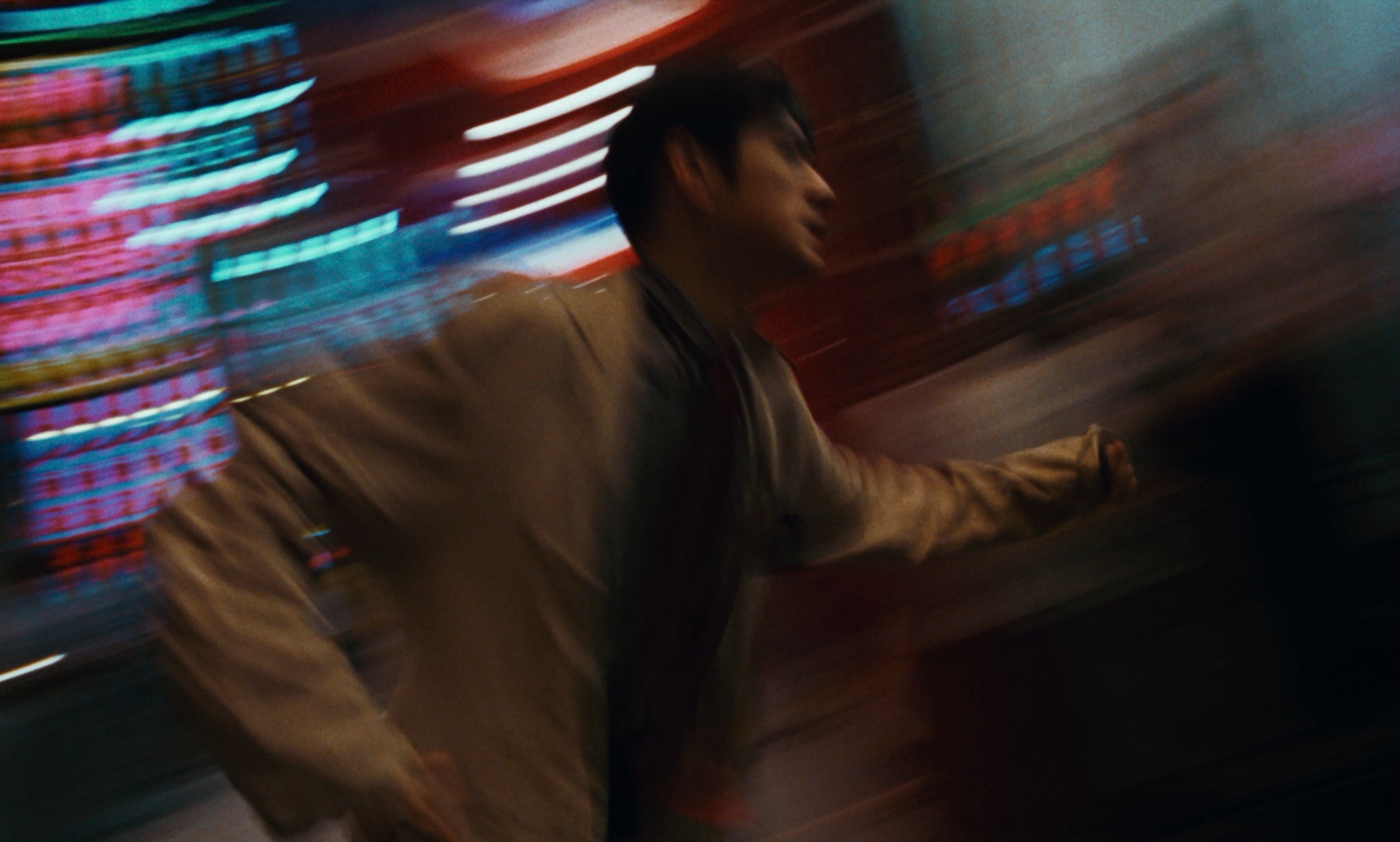
Neon lighting builds a scene from saturated colored sources — signs, tubes, shop windows in pink, cyan, red and green — set against deep shadow and often doubled in wet streets. It turns a city at night into mood: seductive, lonely, feverish. It is a signature look of Hong Kong cinema and neo-noir.
- What it does
- Paints faces and streets with pure, saturated color from visible signs, so the night city itself sets the emotion.
- Use it when
- Night exteriors, bars, clubs, arcades, neo-noir and crime, dream or fever states, any scene about isolation in a crowded city.
- Watch out
- Saturated reds and blues clip fast and swallow skin detail; keep real blacks between the colors or it turns into flat purple haze.
- Try this prompt
neon lighting, night street after rain, magenta neon sign as key from frame left, cyan shop light as rim, wet asphalt reflecting both colors, deep black shadows
What is neon lighting in film?
Neon lighting is night cinematography in which the dominant light comes from saturated colored sources: neon signs, LED tubes, lit shop windows. It is one branch of film lighting, and when the signs sit in the frame it overlaps with practical lighting. What sets it apart is color: the frame is built from two or three pure hues that no white balance can neutralize.
Three ingredients work together: the colored sources, deep shadow between them so each hue reads as its own pool, and reflective surfaces — wet asphalt, puddles, glass — that repeat the colors. Remove the shadow and you get a nightclub flyer; remove the reflections and the city goes flat.
Why do filmmakers use neon lighting?
Blade Runner (1982, DP Jordan Cronenweth) made neon, smoke and rain the image of a crowded commercial future. In Wong Kar-wai's Chungking Express (1994) and Fallen Angels (1995), shot by Christopher Doyle, signs smear behind characters surrounded by people and still alone.
In neo-noir the light turns dangerous. Nicolas Winding Refn's Drive (2011), Only God Forgives (2013) and The Neon Demon (2016) use red, blue and magenta as emotional code: a red room reads as threat or desire before anyone speaks. For the viewer, neon makes a place feel nocturnal and specific, lifts reality toward dream or fever, and hides as much of a face as it shows — which is why it pairs so well with film noir.
How to shoot neon lighting
Sources. Real signs are bright enough at ISO 800–1600 and T1.4–T2, but rarely where you need them. Crews add RGB LED tubes dressed as signs, or saturated lighting gels on soft fixtures standing in for an off-screen sign. Match the face light to the sign behind it.
Exposure. Saturated red and blue clip a single channel before the image looks bright, and skin turns to plastic. Keep the brightest sign just under clipping and let the rest fall 3–5 stops under. It is low-key lighting in color: the black between sources makes each hue read.
Color. Set white balance around 3200–4300K and let the signs be what they are. Pair complementary hues — magenta with cyan, red with teal. A warm tungsten doorway against the neon is mixed lighting on purpose.
Reflections. Wet the street with a water truck or rain towers; puddles give moving reflections when cars pass. Light haze makes tubes bloom, and a long lens wide open turns distant signs into colored bokeh.
The neon noir look
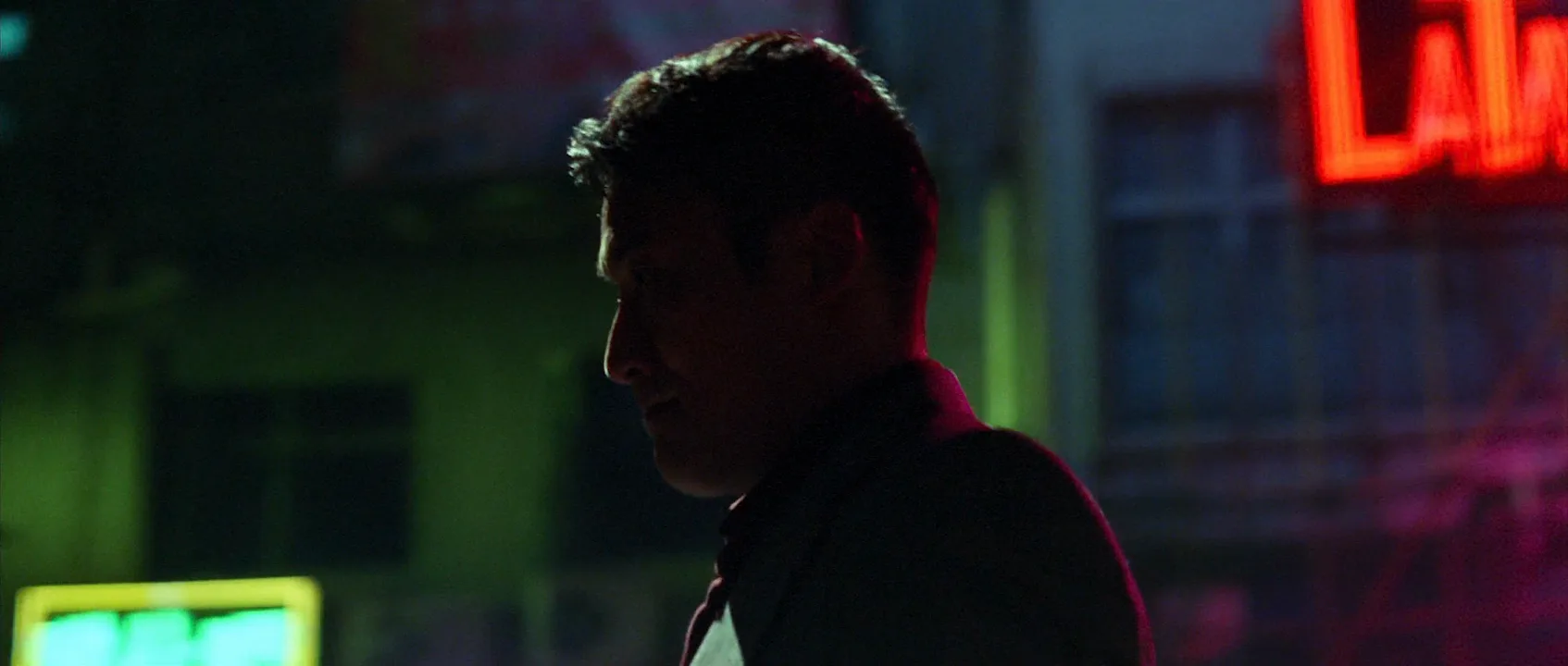
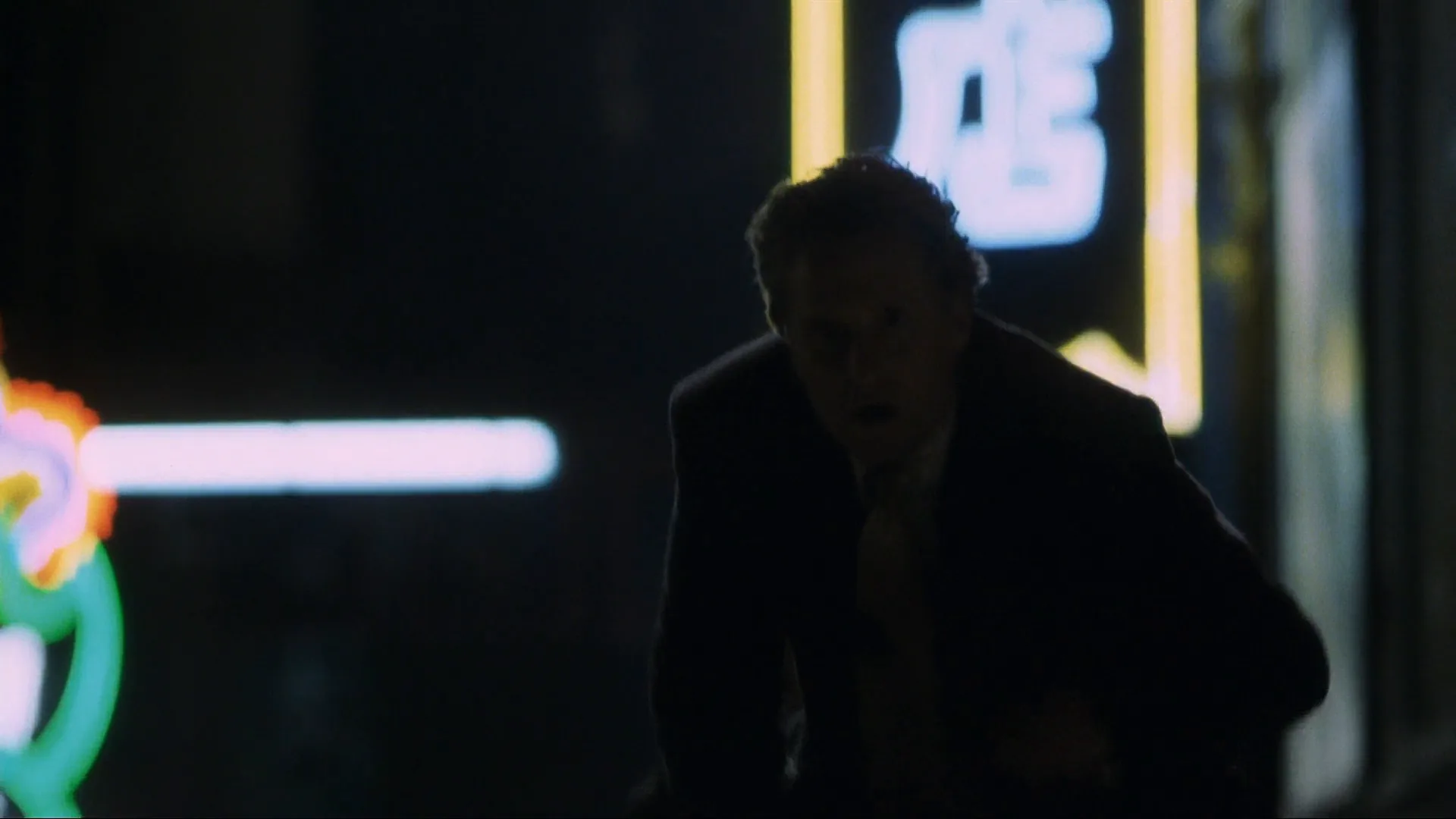
Neon noir is crime and thriller storytelling in this light: classic noir structure — night, compromise, a lone protagonist — in saturated color. Hard sources and large areas of black stay, but each source carries a hue. Faces split between magenta and cyan or become silhouettes against a sign, and rain replaces venetian-blind shadows.
Neon lighting vs. practical lighting
Practical lighting is defined by visibility: the lamp or sign appears in the shot. Neon lighting is defined by color. They overlap when a sign in frame really lights the actor, but a practical can be a plain white lamp, and a neon look can come entirely from off-screen gelled fixtures. Often both combine: a real sign in the background, a matching colored light off-screen doing the work on the face.
Neon Lighting examples in film
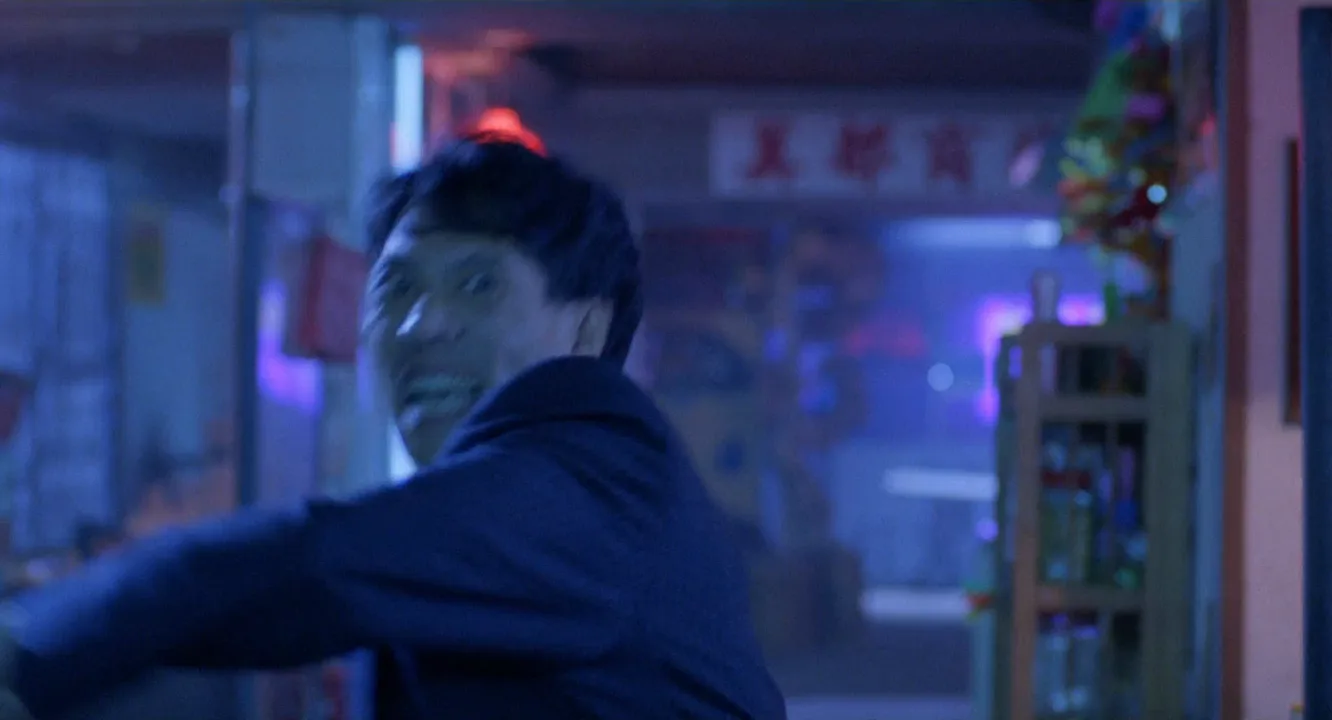
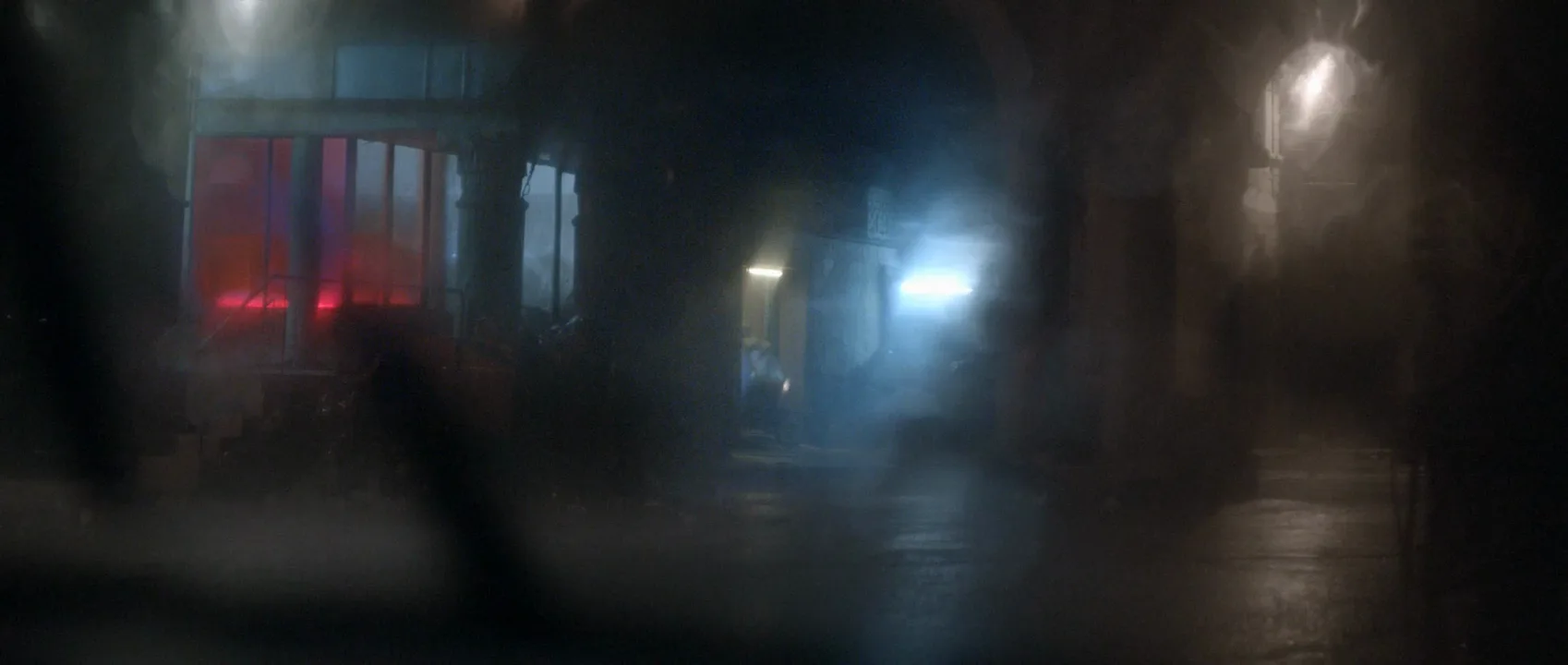
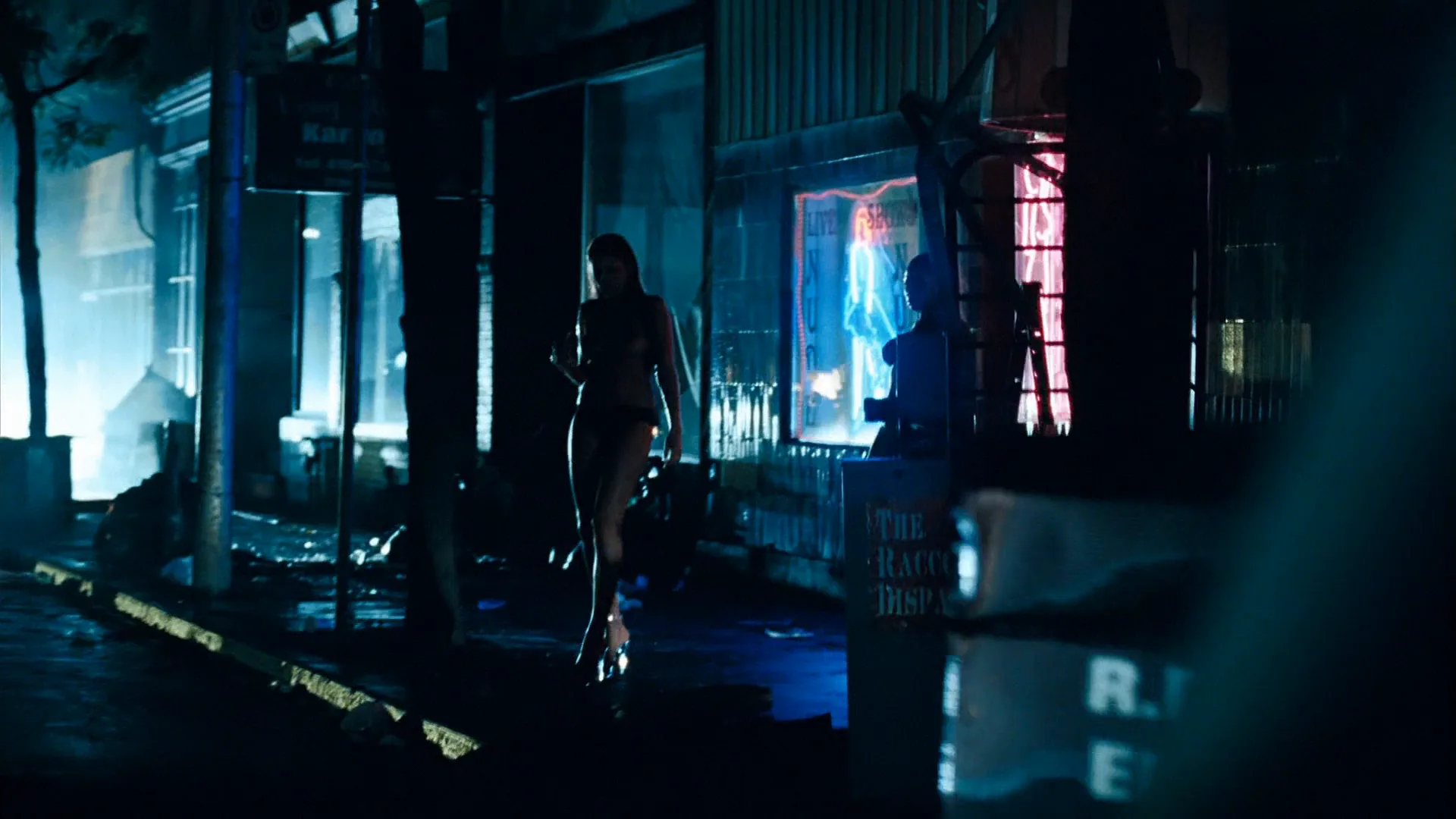
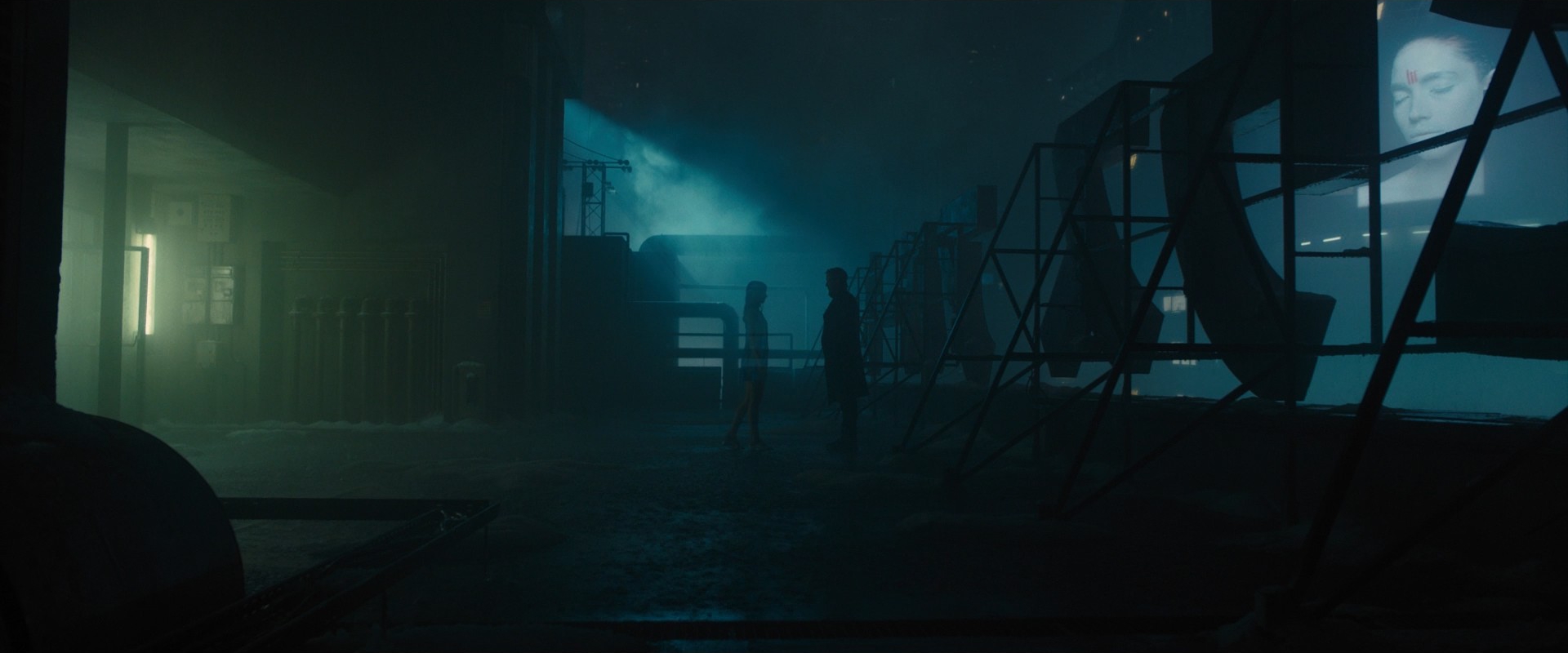
7 framesSeven frames from Hong Kong cinema, thrillers and science fiction. Watch where the color comes from and where the black stays.
How to create a neon lighting with AI
4 promptsLeft alone, image models flood the frame with purple haze and generic cyberpunk. Direct them like a gaffer: name each colored source, its side, what reflects it and where the black stays. Keep the film frames and every take on one FlashBoards board to compare them side by side. The fourth prompt re-shoots a real film shot from a text description alone, and the original plays next to the result so you can compare.
Cinematic film still, neon lighting, narrow city street at night after rain. Medium close-up at eye level, 50mm lens. A fictional woman in her early thirties with a sharp black bob, straight bangs, a thin scar through her right eyebrow and an olive-green bomber jacket stands by a brick wall. A magenta neon sign of abstract looping tubes at frame left is her key light; a cyan shop window behind her gives a thin cyan rim on her hair. Light rain falls through the colored light, steam rises from a street grate, wet asphalt reflects magenta and cyan. Everything else falls to deep black. Film grain.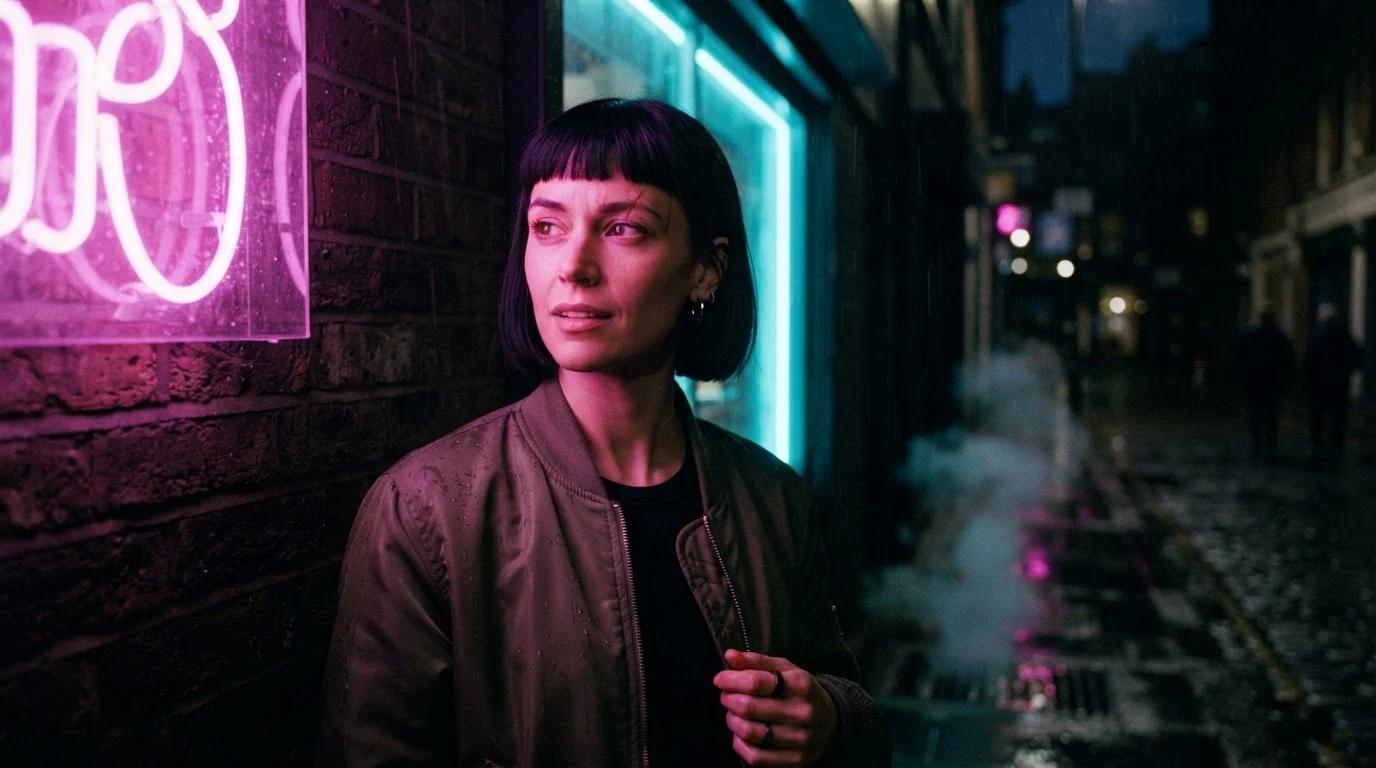
"Is her key light" and "cyan rim" give each color a job and a side, so the face splits into two hues instead of a purple wash. "Abstract looping tubes" avoids garbled lettering; rain and steam are there for the video.
Open FlashBoardsWide cinematic frame, neon noir, an empty all-night noodle bar, 35mm lens at seated eye level. A fictional wiry man in his sixties with a grey handlebar mustache, a bald head and an orange windbreaker sits alone at a steel counter with a steaming bowl. A red neon tube outline of a bowl on the window behind him lights his shoulders red; a drinks fridge at frame right throws teal light on his face. The rain-streaked window reflects both colors. Deep shadows under the counter, saturated red and teal only, melancholy.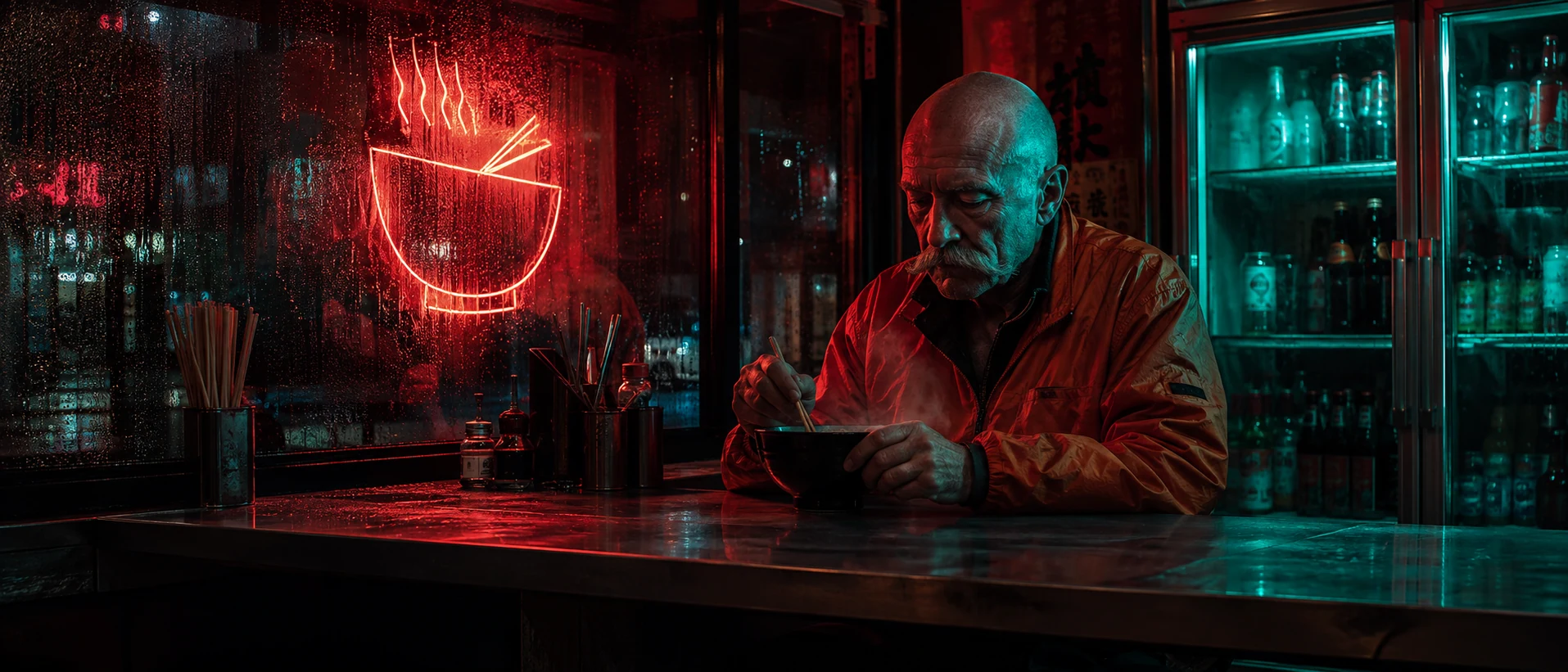
The second take moves indoors to a red-teal complementary pair. Two motivated sources justify each color, and "red and teal only" with "deep shadows" stops a neutral fill from killing the look.
Open FlashBoardsCamera: a slow, steady push-in from medium close-up to close-up on her face, starting immediately. Action: rain streaks fall through the magenta and cyan light and steam drifts left across the frame. She turns her head from the street toward the camera. The magenta sign flickers twice, leaving her face lit only by the cyan rim, then glows steady again. Ripples spread through the colored reflections on the asphalt.Rain, steam and reflections already exist in the start frame, so the shot moves from the first moment without inventing anything. The flicker is the neon beat: dropping to the cyan rim proves the sign is the real source.
Open FlashBoards{
"output": "Full-screen live-action scene from its very first frame: one single continuous shot from Throw Down (2004). Hong Kong night street, 35mm film look, deep black shadows with no fill light at all. The only light comes from neon signs: a long red neon sign of tube lettering, soft and out of focus high on a building behind the man, bathes the facade, the fire escape and the haze in hot red-magenta; further left a pale green wall and a glowing yellow-green neon box sign at the lower left wash the scene green. One small warm bulb high on screen right. Faces are dark shapes with coloured rims; saturated red, magenta and acid green against black, fine grain.",
"characters": {
"S1": {
"name": "the man in the dark suit, a character not identified in the corpus",
"look": "Chinese man in his thirties, short thick dark hair, dark suit jacket over a dark shirt with a thin pale collar edge; seen almost entirely in silhouette, a red-magenta rim of neon along the back of his head and his shoulder on screen right",
"voice": "silence: he does not speak"
},
"S2": {
"name": "the young attacker, a character not identified in the corpus",
"look": "Chinese man in his twenties, short dark hair, dark jacket; his face catches the red neon full on when he rises into frame",
"voice": "silence: he does not speak"
}
},
"shots": [
{
"shot": 1,
"camera": "handheld, low angle looking up, medium close-up of S1 from the chest up; the camera follows him with a steady pan left at walking pace; the neon signs behind him stay soft and out of focus",
"action": [
"BEGINNING: alive from the first frame, S1 is just right of centre, profile facing screen left, head bowed, eyes down toward the ground ahead of him, walking left; his face is a black shape, only a red-magenta rim on his hair and shoulder on screen right; the red neon sign glows high behind him on screen left.",
"THEN: he keeps walking left at a steady pace, head still bowed; the camera pans left with him, so the red sign slides behind his head to screen right, red haze still filling the upper right of frame.",
"THEN: the red sign slides out of frame on screen right; a pale green wall and the glowing yellow-green box sign enter from the lower left; the light on his shoulders turns green while the red rim stays on his back on screen right.",
"THEN: he stops, raises his head and swings his shoulders round toward screen left, his near arm lifting; the camera pan settles so he now stands on screen right.",
"THEN: S2 surges up into frame from the lower left, head low, face suddenly lit bright red, eyes fixed on S1.",
"THEN: S1 shoots his arm straight out to screen left and grabs S2 by the collar, locking him at arm's length; S2 twists against the grip, his face turning toward S1.",
"END: the two grapple, S2 on screen left lit red, S1 on screen right as a black silhouette with a red rim, the yellow-green sign glowing between them in the background."
],
"voice": "silence: nobody speaks in this shot, no voice at all",
"dialogue": []
}
],
"sound": {
"ambience": "night street hum, the buzz of neon tubes, distant traffic heard from far away, footsteps on pavement, a sharp rustle of clothing and a grunt of effort when the two men collide",
"speech": "no words in this video; the only human sounds are breaths and movement",
"never_spoken": "no narration and no voice-over: the descriptions, performance notes and step words of this prompt are never spoken aloud",
"music": "a film score under the scene, always below the voices: a low tense synth pulse with a slow brooding bass line",
"subtitles": "none"
}
}Remakes the low-angle walk from Throw Down (2004), dir. Johnnie To, DP Cheng Siu-keung: the handheld pan left from a red sign to a green one, the silhouetted man and the red-lit attacker he grabs by the collar, with no dialogue, as in the original.
The only light in the prompt is neon, with no fill, so faces stay dark shapes edged in colour. The pan left carries the man out of the red sign's glow into the green one, and the attacker's face flares red as he rises into frame, the same beats in the same order as the original.
Open FlashBoardsCommon mistakes
- Purple soup. "Neon" alone tints everything magenta. Give each color a source and side, and say where it stays black.
- Gibberish signs. Describe signs as shapes ("abstract tube loops").
- Dry streets. Without "wet asphalt reflects" you lose half the color.
- Cyberpunk by default. Name an ordinary place, like a noodle bar, or holograms appear.
Keep the reference frames, prompts and every generated take side by side — images and video in one canvas.
FAQ
4 questionsWhat is neon noir?
Neon noir is crime and thriller filmmaking that keeps the shadows and night-city structure of classic film noir but trades black-and-white for saturated light from signs and tubes. Rain, reflections and faces split between two hues define it; Drive is a frequently cited example.
What colors are used in neon lighting?
The classic neon palette is magenta or pink, cyan or teal, red and acid green against near-black. Cinematographers usually pair complementary colors — magenta with cyan, red with teal — so the two sides of a face separate clearly.
How do you get a neon look without real neon signs?
Put RGB LED tubes or saturated gels on soft lights where a sign would be, matching any glowing color in the background. Wet the ground for reflections, add light haze, and shoot a long lens wide open so distant lights become colored bokeh.
Which films are known for neon cinematography?
Often cited: Blade Runner (1982), Chungking Express (1994), Fallen Angels (1995), Drive (2011), Only God Forgives (2013), The Neon Demon (2016) and Blade Runner 2049 (2017) — neon as a crowded future, as romantic restlessness, or as a code for desire and violence.
Related terms
6- Lighting GelsLighting
Gels are sheets of heat-resistant colored film clipped over lamps: correction gels (CTO, CTB) match sources to tungsten or daylight, while saturated gels paint a scene red, magenta or blue.
- Practical LightingLighting
Practical lighting uses light sources visible in the shot — table lamps, neon signs, candles, TV screens — either as the real illumination or as the visible motivation for hidden film lights.
- Mixed LightingLighting
Mixed lighting combines sources of different color temperature or spectrum in one scene — window daylight with tungsten lamps, fluorescent with neon — either corrected with gels or kept as a deliberate warm-cool contrast.
- Color SaturationColor
Saturation is how pure a color is — how far it sits from neutral grey; raising or draining it lets filmmakers build a vivid, heightened world or a muted, weary one.
- Low-Key LightingLighting
Low-key lighting keeps most of the frame in shadow, with a strong key, little or no fill and a high lighting ratio, so only fragments of faces and objects emerge from the dark — the language of noir, thrillers and horror.
- Water Reflection LightingLighting
Water reflection lighting bounces a lamp off a moving water surface — a pool, a tray, a mirror in water — so rippling caustic patterns dance across walls and faces, suggesting water, dreams or an unstable inner world.
Further reading
American Cinematographer coverage of Blade Runner (1982) and Blade Runner 2049 (2017).