 FlashBoards Learn
- Learn
- Screenwriting
- Scene Description
Screenwriting · Film language
Scene Description
Also called: action lines, action description, scene action
Scene description, also called action lines, is the prose under a scene heading that tells the reader what we see and hear. It is written in present tense, in short visual paragraphs that read like shots, so a director, a cinematographer and an actor can all picture the same moment from the page.
- What it does
- Turns a location and a time of day into images, sounds and behavior the reader can see.
- Use it when
- Every scene: anything that is not dialogue, a heading or a transition is scene description.
- Watch out
- Unfilmable lines (thoughts, backstory) and camera directions that do the director's job.
- Try this prompt
Film still, car deck of a night ferry, rows of parked cars under orange sodium light, a woman in a paramedic's jacket checking license plates
What is a scene description in a screenplay?
Every scene in a screenplay is built from a few elements: the scene heading, the scene description, character names, dialogue, parentheticals and transitions. The scene description is everything that happens on screen that nobody says out loud: the room, the light, a gesture, a sound, a door that won't open.
``` INT. NIGHT FERRY - CAR DECK - NIGHT
Rows of parked cars under orange sodium light. Engines tick as they cool. The whole deck sways.
NADIA (40s, grey braids, paramedic's jacket) walks between the cars, checking each plate against a scrap of paper.
She stops at a green hatchback. A child's shoe sits on the dashboard. ```
It runs the full width of the page, always in present tense, because the reader should experience the scene as it happens. In screenwriting software it is the "Action" element.
What belongs in action lines, and what doesn't
The test for every sentence is simple: can a camera or a microphone record it?
Belongs: what the set looks like, the light, what characters do, props that matter, sounds that matter, and a character's first appearance. New speaking characters get their name in CAPITALS once, with an age range and one or two visible details that say who they are: That tells wardrobe and casting more than a line about her past.
Doesn't belong: thoughts, memories and backstory the audience cannot see (She remembers the day her brother left). Either find the behavior that shows it or cut it; that is where subtext lives.
Key sounds and props are sometimes typed in caps (a PHONE BUZZES) so they get caught in the breakdown. Use this lightly.
How to write action lines that read like shots
- Keep paragraphs to one to four lines. Each paragraph is one image or one beat. Dense blocks get skimmed.
- One paragraph, one shot. A new paragraph implies a new angle. She stops at a green hatchback. / A child's shoe sits on the dashboard. is a wide and an insert without either word on the page.
- Use precise verbs. Walks is neutral; limps and shoulders past are performances.
- Be specific where it counts. A car is nothing; a green hatchback with a cracked windshield is a prop list and an image.
- Write in order. Describe things in the order the audience sees them.
- Match rhythm to pace. Fragments for tension (Locked. She tries the next one.), longer sentences for calm.
Should you write camera directions in scene description?
In a spec script, mostly no. Lines like CLOSE ON her hands or the camera pans left take choices away from the director and slow the read. When one detail truly has to be isolated, ANGLE ON or a single we see is accepted, but avoid more than a handful per script.
Camera language becomes normal later, in the shooting script, where the director and cinematographer add scene numbers and shot notes. Some films are exceptions by design: 1917 (2019) plays as one continuous shot, broken only by a single cut to black, so its script had to describe the action as unbroken movement, with almost no cuts to hide behind.
Scene description example: before and after
Before:
`` We see Nadia, an exhausted paramedic who has been searching for her nephew for three days, walking slowly through the dark car deck, feeling desperate. ``
After:
``` NADIA (40s, grey braids, paramedic's jacket) moves between the parked cars, checking each plate against a scrap of paper. Her hand shakes.
A green hatchback. A child's shoe on the dashboard.
She tries the door. Locked. ```
The rewrite drops we see, the backstory and the adjectives about feelings. The shaking hand carries the exhaustion; the shoe carries the missing child. One long sentence became three shots.
From action lines to storyboard and shot list
Each paragraph becomes a candidate panel in the storyboard and a line in the shot list; a vague paragraph produces a vague frame. That makes action lines a useful test of visual storytelling: if you cannot draw a paragraph, the audience cannot see it.
In FlashBoards you can paste each paragraph onto the board as a note, generate a frame from it and set the frames in a row under the scene heading. Weak description shows up at once as a generic image.
How to create a scene description with AI
3 promptsGood action lines are already close to good prompts: concrete place, visible behavior, specific props, light. The recipes below turn the ferry scene into a start frame, an insert and a moving shot, to check whether each paragraph reads as a picture.
Film still, wide shot on the car deck of a night ferry, rows of parked cars under orange sodium lights, a woman in her forties with long grey braids and a dark green paramedic's jacket walking between the cars, holding a small scrap of paper and looking at a license plate, 28mm lens at eye level, damp floor reflecting the lights, tense quiet mood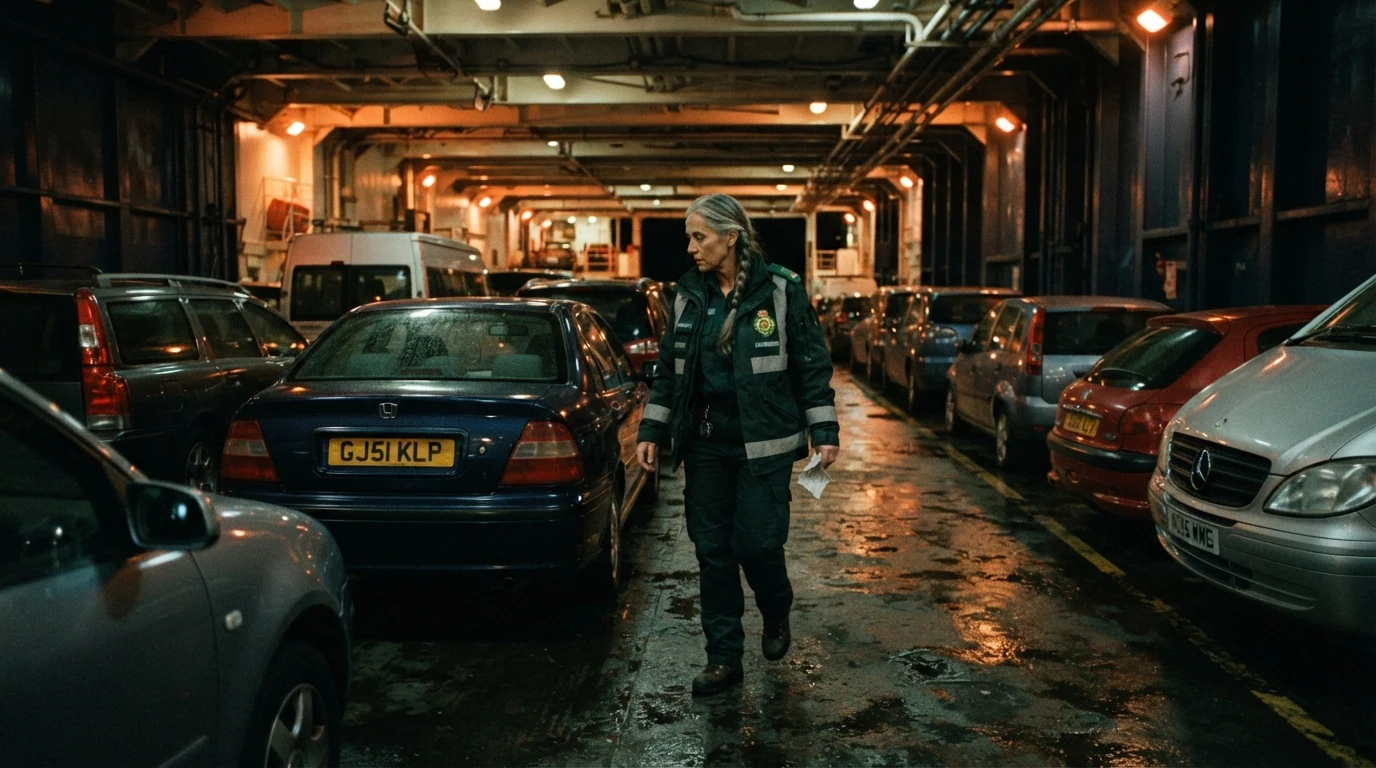
The prompt is the first two paragraphs of the scene with the story removed: car deck of a night ferry, sodium lights, the costume details from the character introduction, and one visible action, looking at a license plate. Nothing in it is a thought.
Open FlashBoardsFilm still, close-up through the dusty windshield of a green hatchback, a small red child's sneaker lying on the dashboard, orange sodium light from above, dim car deck of a ferry blurred in the background, 50mm lens, shallow depth of field, cold still mood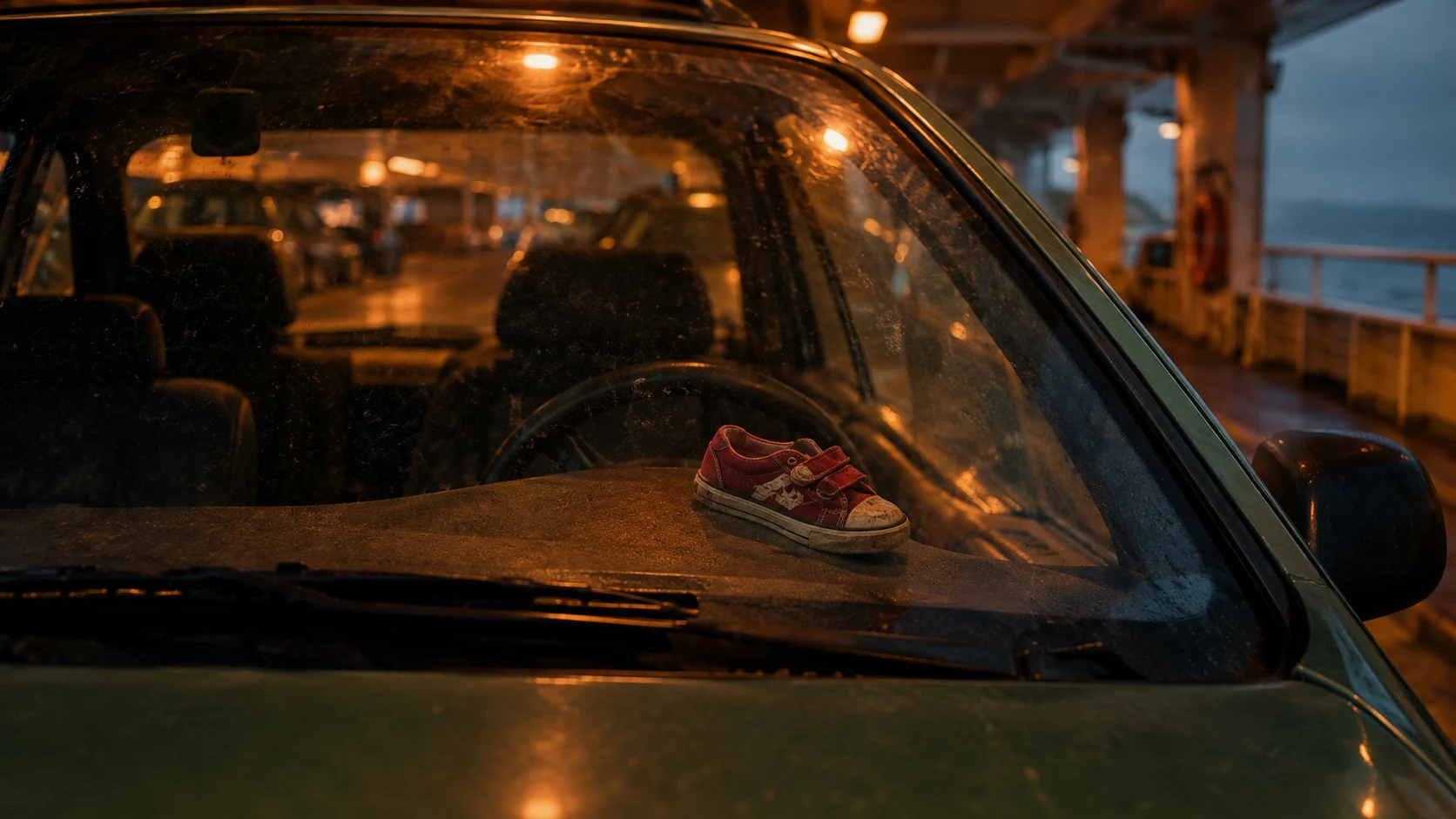
This is the one-line paragraph A child's shoe on the dashboard as its own shot. Close-up, through the windshield and shallow depth of field do the isolating that a camera direction would have done on the page.
Open FlashBoardsCamera: a slow handheld follow behind the woman at walking pace, keeping her at the same size as she moves down the row of cars. Action: she is already walking, glancing from the paper to each license plate. She slows, looks at one plate, shakes her head and keeps walking. At the end of the row she stops and stares at a car ahead of her.The action lines become the action block almost word for word: moving, checking, stopping. She is walking from the first frame, and the move has a clear speed and framing.
Open FlashBoardsCommon mistakes
- Emotional adjectives from a script (desperate, exhausted) give models stock expressions; describe the behavior instead, like a shaking hand.
- Character names mean nothing to an image model; paste the visual introduction (age, hair, costume) every time.
- A whole scene in one prompt produces a crowded frame; one paragraph per image, as on the page.
- Reuse the setting's wording between takes, or the deck changes from frame to frame.
Keep the reference frames, prompts and every generated take side by side — images and video in one canvas.
FAQ
5 questionsWhat is scene description in a screenplay?
Scene description is the prose under each scene heading that describes what the audience sees and hears: the setting, the light, what characters do, important props and sounds. It is written in present tense, in short paragraphs, and is also called action or action lines.
How long should action lines be?
Most working writers keep each paragraph to one to four lines and give every new image or beat its own paragraph. Dense blocks of five or more lines get skimmed, and since a page is roughly a minute of screen time, overlong description misrepresents the running time.
Are action lines written in present tense?
Yes. Scene description is always in present tense, because the reader should experience events as they happen on screen: She opens the door, not She opened the door. She runs also reads faster than She is running.
Should I use "we see" in scene description?
Sparingly. We see is a mild camera direction and usually adds nothing: We see a car pull up reads better as A car pulls up. It is acceptable when the audience must notice something a character doesn't.
How do you introduce a character in action lines?
The first time a speaking character appears, write the name in capitals, followed by an age range in parentheses and one or two visible details: NADIA (40s, grey braids, paramedic's jacket). After that the name is in normal case.
Related terms
5- Scene HeadingScreenwriting
A scene heading, or slugline, opens every scene in capitals: INT. or EXT., the location and the time of day — the line that production breaks down and a storyboard starts from.
- DialogueScreenwriting
Dialogue is the spoken exchange between characters; good screen dialogue reveals character and conflict while leaving the most important things unsaid.
- Visual StorytellingStorytelling
Visual storytelling conveys story, character and emotion through images — framing, blocking, light, color, objects and cuts — instead of dialogue; it's the core skill behind every storyboard and AI-generated shot.
- StoryboardFilmmaking Process & Crew
A storyboard is a sequence of drawn or generated panels, one per planned shot, showing framing, action and camera movement with notes — a visual draft of the film before anything is shot.
- ScreenplayScreenwriting
A screenplay is the written blueprint of a film in a fixed format — scene headings, action lines, character names, dialogue and transitions — where one page roughly equals one minute of screen time.
Further reading
Syd Field, Screenplay: The Foundations of Screenwriting. David Trottier, The Screenwriter's Bible.