 FlashBoards Learn
- Learn
- Screenwriting
- Parenthetical
Screenwriting · Film language
Parenthetical
Also called: wryly, actor direction
A parenthetical is a short note in parentheses under a character's name in a screenplay, telling the reader how a line is said, to whom, or what small action goes with it. Writers call it a wryly. Used rarely, it clears up a line that would read wrong; used often, it starts directing the actor.
- What it does
- Clarifies who a line is aimed at, a small action tied to it, or a delivery the words alone would get wrong.
- Use it when
- The reader would misread the line without it: a hidden addressee, a sarcastic line, a switch of language.
- Watch out
- Adverbs on every line (angrily, sadly) read as distrust of the actor and of your own dialogue.
- Try this prompt
Medium two-shot, a woman at a workbench talks without looking up from a bicycle wheel, a young man waits in the doorway
What is a parenthetical in a screenplay?
In a screenplay, a speech is a character cue in capitals, lines of dialogue below it and, optionally, a parenthetical between them. The parenthetical is lowercase, in round brackets, on its own line, indented about 3.1 inches from the left edge of the page (dialogue sits at 2.5, the cue at 3.7).
`` NADIA (not looking up) The wheel's bent. Leave it. ``
It can also break a speech in the middle:
`` NADIA Twenty for the spokes. (finally looks at him) Forty if you want it tonight. ``
The nickname wryly comes from how often weak drafts used exactly that word; in screenwriting coverage, "too many wrylies" is a standard note.
When should you use a parenthetical?
A good parenthetical carries information the reader can't get from the words. Four jobs cover almost every legitimate use:
- Addressee. In a room with four people,
(to Theo)tells us who the line is for. The most common and least controversial use. - A small action tied to the line.
(pocketing the keys)or(hands her the envelope), when the action lands on a specific word. - Delivery that contradicts the words. "Great. Perfect." reads as praise unless
(flat)or(sarcastic)warns otherwise. - Language or register.
(in Portuguese),(whispering),(into the phone): facts the sound team and subtitler need too.
A fifth, (beat), marks a pause; see story beat. (V.O.), (O.S.) and (CONT'D) are not parentheticals but extensions, typed on the character-name line.
Why too many parentheticals hurt a script
Many actors cross delivery notes out before the first rehearsal. (angrily) above an angry line adds nothing; above a neutral line it locks one reading when the scene might play better otherwise. Choosing the delivery is the director's work with the cast, part of directing actors, not the writer's.
A stack of adverbs also signals that the dialogue isn't doing its work. If a line needs (hurt, but hiding it), rewrite it so the hurt leaks through what is avoided: that is subtext. Readers of a spec script skim fast, and every bracket slows them.
Test: cover the parenthetical and read the speech aloud. If an actor would reach the same reading without it, delete it. If they could get it backwards and that would change the scene, keep it.
How to format a parenthetical
- Lowercase, no final period; capitals only for names.
- Keep it to a few words. If it wraps past two lines, it is an action line in disguise.
- Never end a speech with one: it has nothing left to modify.
- Write
(turning away), not(she turns away). - No camera language.
- One per speech is a ceiling; many pages need none.
Screenwriting software sets the indents: in most programs, Tab after a character cue starts a parenthetical.
Parenthetical vs. dialogue vs. action line
Dialogue is what the character says, heard by the audience. A parenthetical is never heard: it is a note from writer to reader about that one speech. An action line, the scene description between speeches, holds anything longer or more visual.
If the note concerns this line only and fits in four or five words, it can be a parenthetical. If it describes movement, a new prop or another character's reaction, break the speech and write an action line.
What a parenthetical tells the camera team
For a director and cinematographer, parentheticals about address and action turn into eyelines and blocking. (to Theo) in a crowded scene decides where the speaker looks and often which over-the-shoulder setup carries the line. (not looking up) keeps the speaker's eyes on her hands, so the listener's face may carry the moment. In a shooting script such notes often are the only record of where a look lands.
In FlashBoards, paste the speech onto the board as a note, generate a frame of the staging beside it, and compare two readings of the same line before the table read.
How to create a parenthetical with AI
3 promptsA silent frame can't show tone, so stage parentheticals about address and action. Nano Banana 2 Lite builds the frame for (not looking up), GPT Image 2.5 pairs the script excerpt with its storyboard panel, and MiniMax H3 Max Turbo plays the line. Keep all three beside the speech on one board.
Medium two-shot, 35mm lens at eye level, film still. A cramped bicycle repair shop in the evening, one warm work lamp over a cluttered bench. Foreground right: a heavyset woman in her fifties with a broad freckled face, cropped curly salt-and-pepper hair, round tortoiseshell glasses and a grease-stained denim apron, head bowed, eyes fixed down on a bent bicycle wheel in her hands, mouth slightly open mid-sentence. Background left, in the open doorway: a lanky young man in his twenties with curly red hair and a yellow rain jacket, holding a helmet, watching her. Cool street light behind him, tense mood.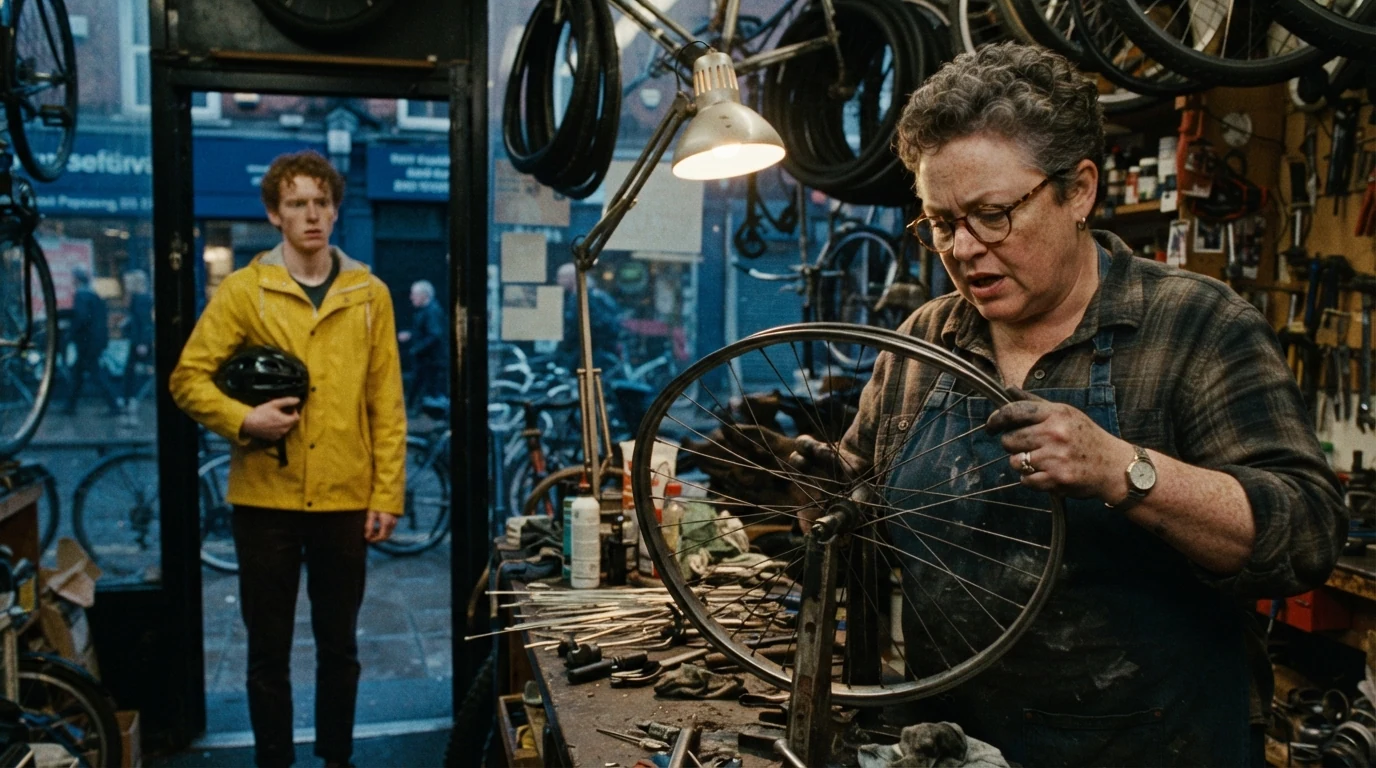
Head bowed, eyes fixed down on a bent bicycle wheel and mouth slightly open mid-sentence translate (not looking up) into a visible choice: she is speaking but withholding her eyeline. Him in the doorway gives the line its target.
A single pre-production sheet on a light gray desk, top-down. Left half: a typed screenplay excerpt in Courier on white paper, centered character cue NADIA, below it an indented lowercase parenthetical (not looking up), then the dialogue line The wheel's bent. Leave it. Right half: one storyboard panel in loose pencil and gray marker, a woman with cropped hair bent over a bicycle wheel at a workbench, a young man in a rain jacket in the doorway behind her, a thin arrow showing her eyeline down to the wheel. Sharp readable text.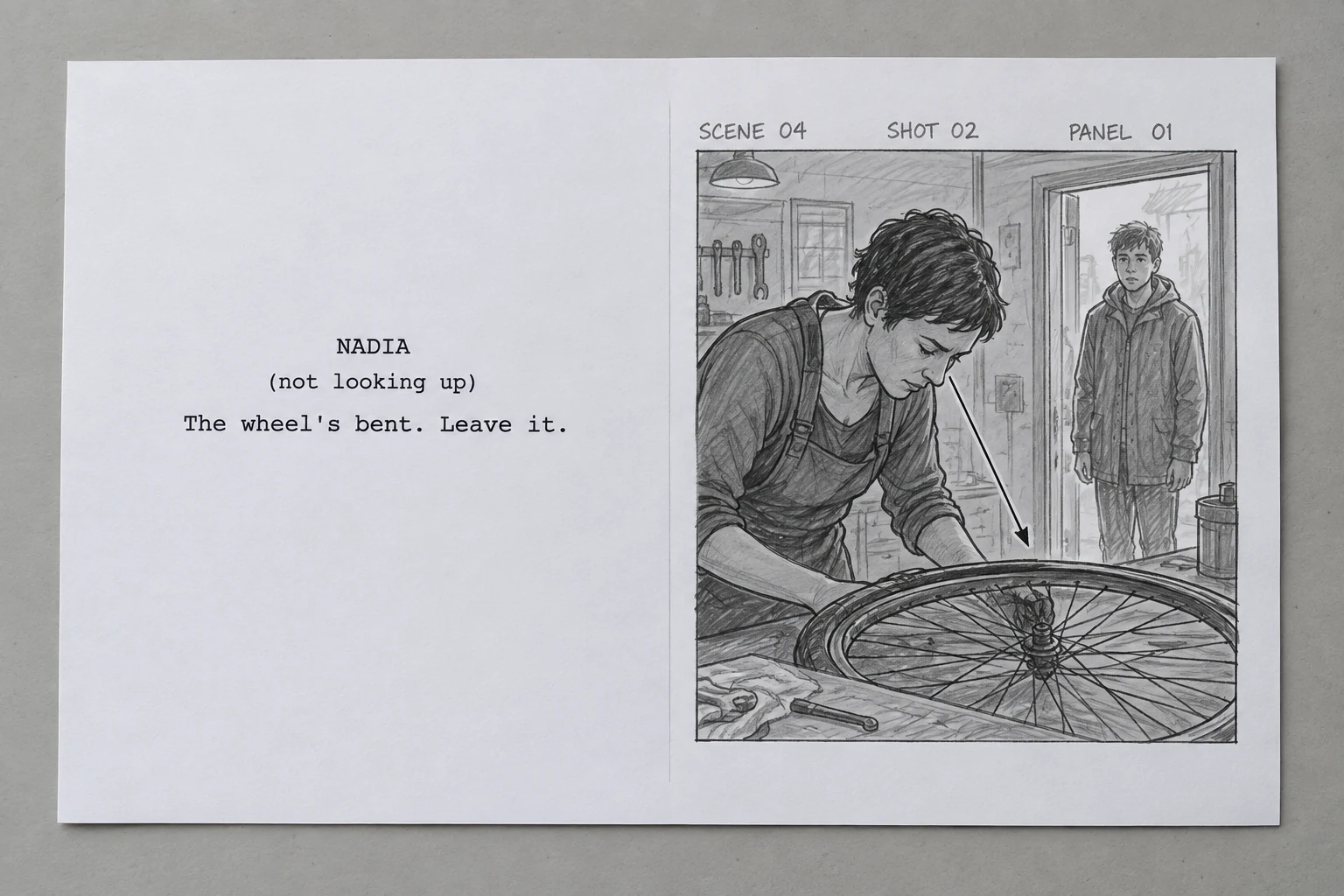
Spelling out the exact text and the word indented gets screenplay layout; the eyeline arrow shows how the note becomes staging.
Open FlashBoardsCamera: locked-off medium two-shot at eye level, then a very slow push toward the woman. Action: the woman is already turning the bent wheel in her hands and speaking a short line, her lips moving, her eyes staying on the spokes. The young man in the doorway shifts his weight and lowers his helmet. On her last word she stops the wheel and finally looks up at him over her glasses, and he goes still.Already turning and speaking make the clip alive from frame one; the look up is the mid-speech note (finally looks at him) played out.
Common mistakes
- A bracketed note pasted into an image prompt often gets printed as text. Describe the behavior: eyes on the wheel.
- Models turn the speaker to camera. Name what her eyes are on and where the listener stands.
- Tone notes like
(flat)don't survive a silent frame; visualize address and action. - In video, a still mouth reads as listening: state that her lips move.
Keep the reference frames, prompts and every generated take side by side — images and video in one canvas.
FAQ
4 questionsWhat is a parenthetical in a screenplay?
It is a brief lowercase note in round brackets, placed under the character's name or between lines of a speech. It tells the reader who the line is addressed to, a small action that goes with it, or how it is delivered when the words alone would mislead.
What does wryly mean in a screenplay?
Wryly is both a real parenthetical, asking for dry, ironic delivery, and a nickname for all parentheticals, earned because early drafts overused it. When a reader says a script has too many wrylies, they mean the writer is dictating line readings instead of letting the dialogue and the actor do the work.
How often should you use parentheticals?
As rarely as possible. Many professional pages have none; a common ceiling is one per speech. Keep the ones that prevent a real misreading, like an unclear addressee or a sarcastic line that looks sincere, and cut any that only repeat the emotion already in the words.
Can a parenthetical go at the end of dialogue?
No. A parenthetical modifies the dialogue that follows it, so placing one after the final line leaves it attached to nothing. Anything after the last line is an action line. Parentheticals can sit at the start of a speech or between two of its lines.
Related terms
3- DialogueScreenwriting
Dialogue is the spoken exchange between characters; good screen dialogue reveals character and conflict while leaving the most important things unsaid.
- Story BeatScreenwriting
A beat is the smallest unit of dramatic change in a story: a moment where an action, reaction or decision shifts the scene's direction. In dialogue, a parenthetical (beat) also marks a short pause.
- ScreenplayScreenwriting
A screenplay is the written blueprint of a film in a fixed format — scene headings, action lines, character names, dialogue and transitions — where one page roughly equals one minute of screen time.
Further reading
David Trottier, The Screenwriter's Bible. Christopher Riley, The Hollywood Standard: The Complete and Authoritative Guide to Script Format and Style.