 FlashBoards Learn
- Learn
- Storytelling
- Falling Action
Storytelling · Film language
Falling Action
Also called: post-climax
Falling action is the stretch of a story right after the climax, where the consequences of the decisive moment play out and tension winds down toward the resolution. Villains pay, survivors take stock. In a feature film it is usually short: a few scenes that let the audience breathe before the ending.
- What it does
- Turns the climax into consequences and lowers the tension so the ending can land.
- Use it when
- The main question is answered but secondary threads, costs or reactions still need to be shown.
- Watch out
- Too long and it feels like several endings; too short and the climax has no weight.
- Try this prompt
Dawn after a warehouse fire, an exhausted firefighter sits on the back step of the engine with a blanket and a paper cup, thin white smoke rising, wide shot, 35mm film still.
What is falling action?
Falling action (sometimes called the post-climax) is everything between the climax and the final settled state of the story. The dramatic question is answered; what remains is the fallout: who pays, who is freed, what it cost.
The term comes from Gustav Freytag's pyramid for five-act tragedy: exposition, rising action, climax, falling action, catastrophe. Freytag put the climax mid-play; film moved it near the end, so in a modern feature the falling action is a handful of scenes late in act three of the three-act structure. In the wider story structure of storytelling, it is the downward slope of the tension curve.
What happens in the falling action?
- Consequences land. The villain is arrested, the town counts its dead, the lovers face what they said.
- Secondary threads close. A subplot that could not be settled during the peak gets its own beat.
- Characters absorb the change. The protagonist's reaction shows whether the arc has stuck.
- Tension releases. The audience's catharsis needs room, so the rhythm slows.
It can also carry a sting: one last threat or a revelation that reframes the climax. Tension dips but need not hit zero until the final scene.
Falling action examples in film
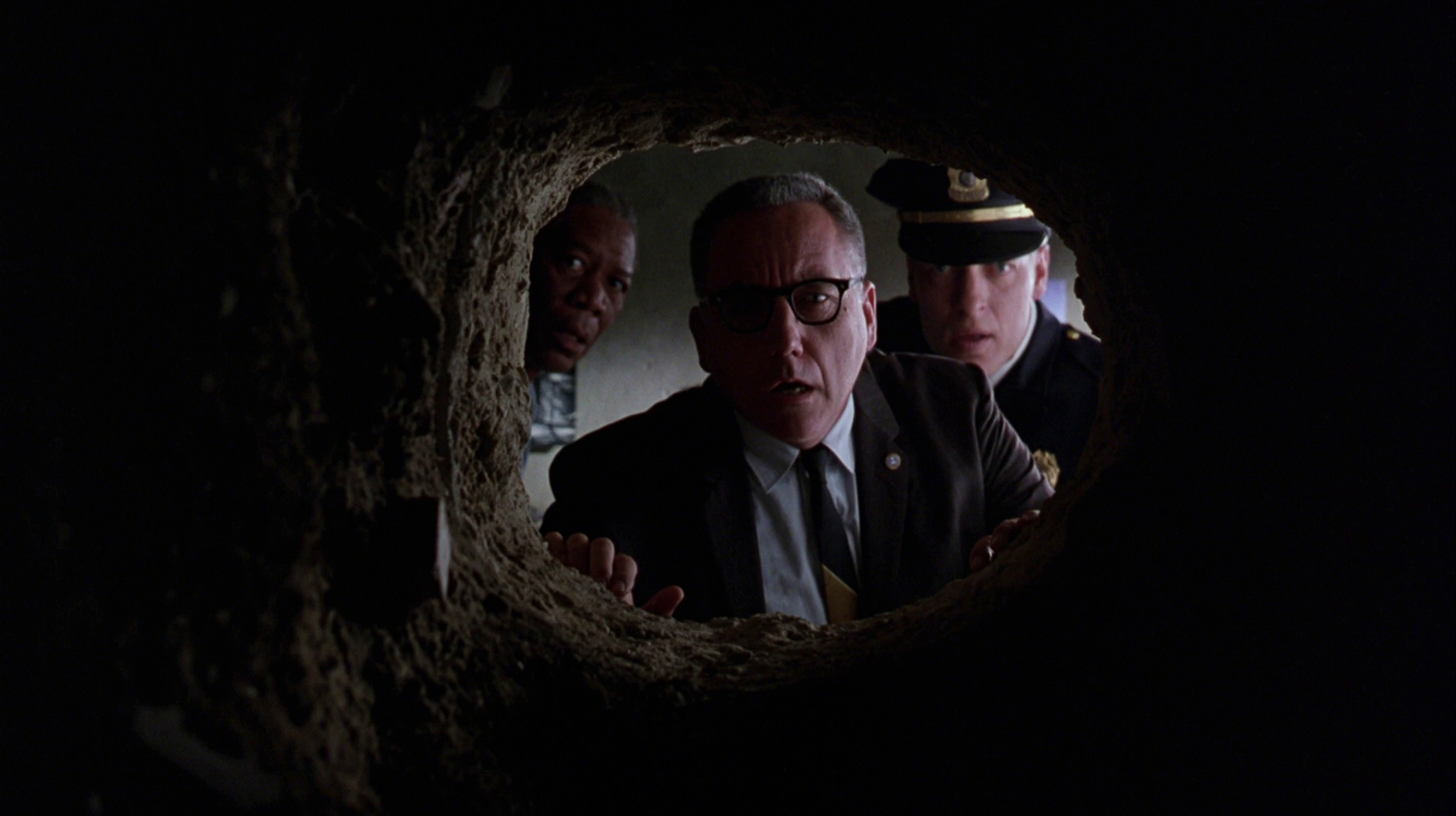
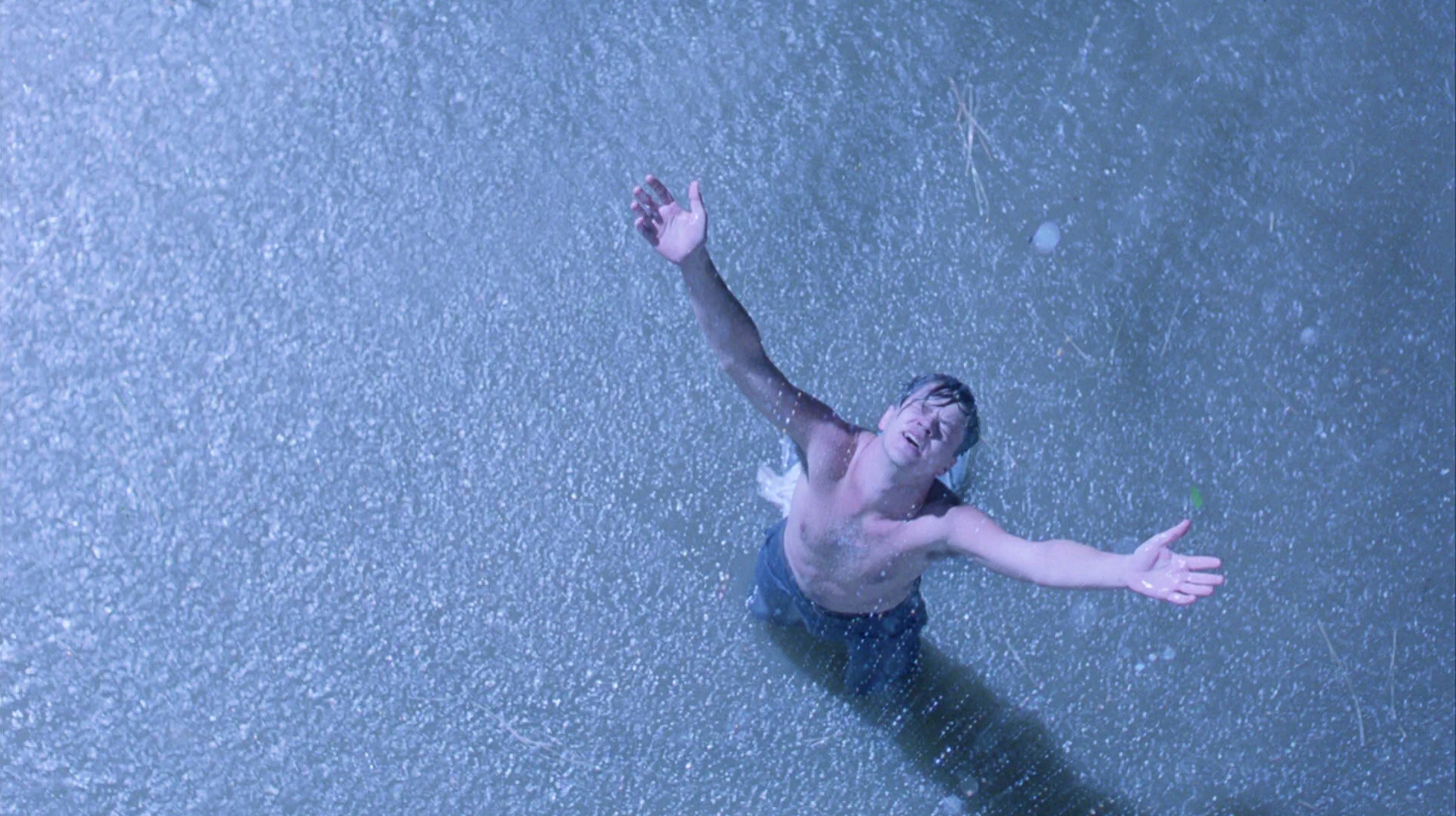
The Shawshank Redemption (1994) keeps paying out after Andy's escape is discovered: the warden's books reach a newspaper, Captain Hadley is arrested and Warden Norton shoots himself. Then Red faces the parole board again and gets out.
Die Hard (1988) is short with a sting. Gruber falls, McClane and Holly walk out, Karl bursts from the building with a gun, and Sergeant Al Powell shoots him, closing Powell's own subplot about never drawing his weapon again.
The Lord of the Rings: The Return of the King (2003) is the counterexample. After the Ring is destroyed come rescue, reunion, a coronation, the return to the Shire and a farewell, and many viewers felt it ended several times.
How to write and shoot the falling action
On the page. List every open question the climax leaves, then cut hard, and combine what survives: one scene can close a subplot and show the hero's change. The pacing decelerates, but each scene still needs a small turn.
On set and in the edit:
- Wider frames, longer takes. After tight close-ups and fast cuts, a held wide shot says the danger has passed.
- Changed light. Night turns to dawn, rain stops, smoke hangs in still air.
- Aftermath coverage. Shoot the damage, the reactions, the people who were not in the fight.
- Sound drops. The score pulls back; room tone returns.
In FlashBoards you can lay the final stretch out on one board: climax frames, falling-action beats and the closing image in a row, with references and notes beside each beat. Side by side, it is obvious when the falling action has too many scenes, or none.
Falling action vs. denouement
The difference is movement versus rest. Falling action still has events: consequences, arrests, departures, a last threat. The denouement is the settled state after them, the new balance of the characters' world.
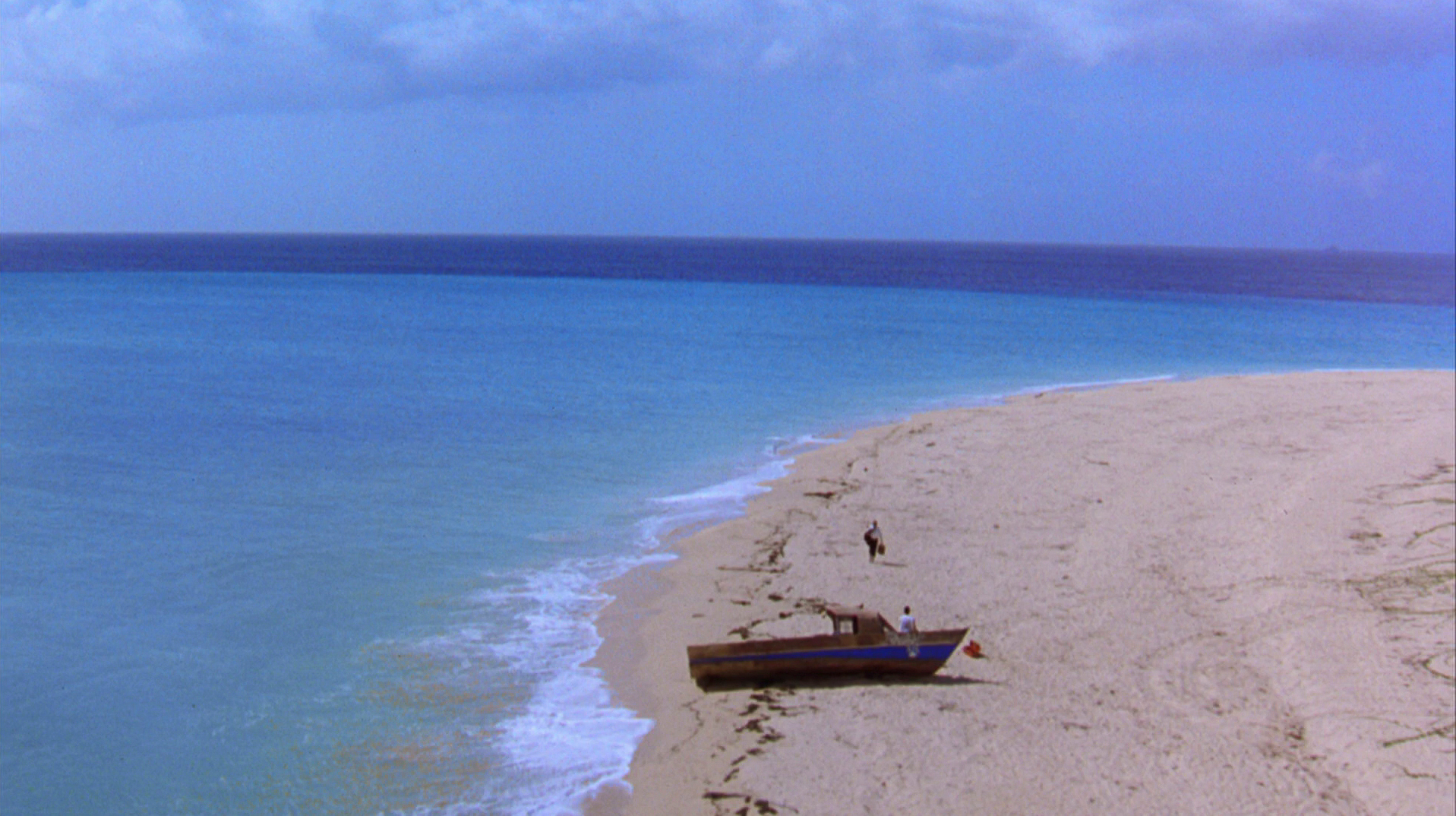
In The Shawshank Redemption, the warden's downfall and Red's parole are falling action; Red walking along the beach toward Andy is the denouement. A jump years ahead to show where everyone ended up is an epilogue.
Falling Action examples in film
4 framesThe discovery that opens the fallout, the climax it answers, and the quiet images a film reaches once tension drains.
How to create a falling action with AI
4 promptsFalling action has a visual signature: the aftermath. Describe the state after the event, not the event, and give people small, tired actions. On a FlashBoards board these takes sit next to your climax frames, so you can check the tension really drops. The fourth prompt re-shoots a real film shot from a text description alone, and the original plays next to the result so you can compare.
Aftermath at dawn, wide shot at eye level, 35mm lens: a fictional firefighter in her late forties with a grey buzz cut and a soot-streaked face sits on the rear step of a red fire engine, a grey blanket over her shoulders, a paper cup in both hands. Behind her, a blackened wooden warehouse, thin white smoke rising in still air. Wet asphalt, two firefighters in the background coiling a flat hose. Soft low-contrast light, muted ash palette, exhausted mood, 35mm film still.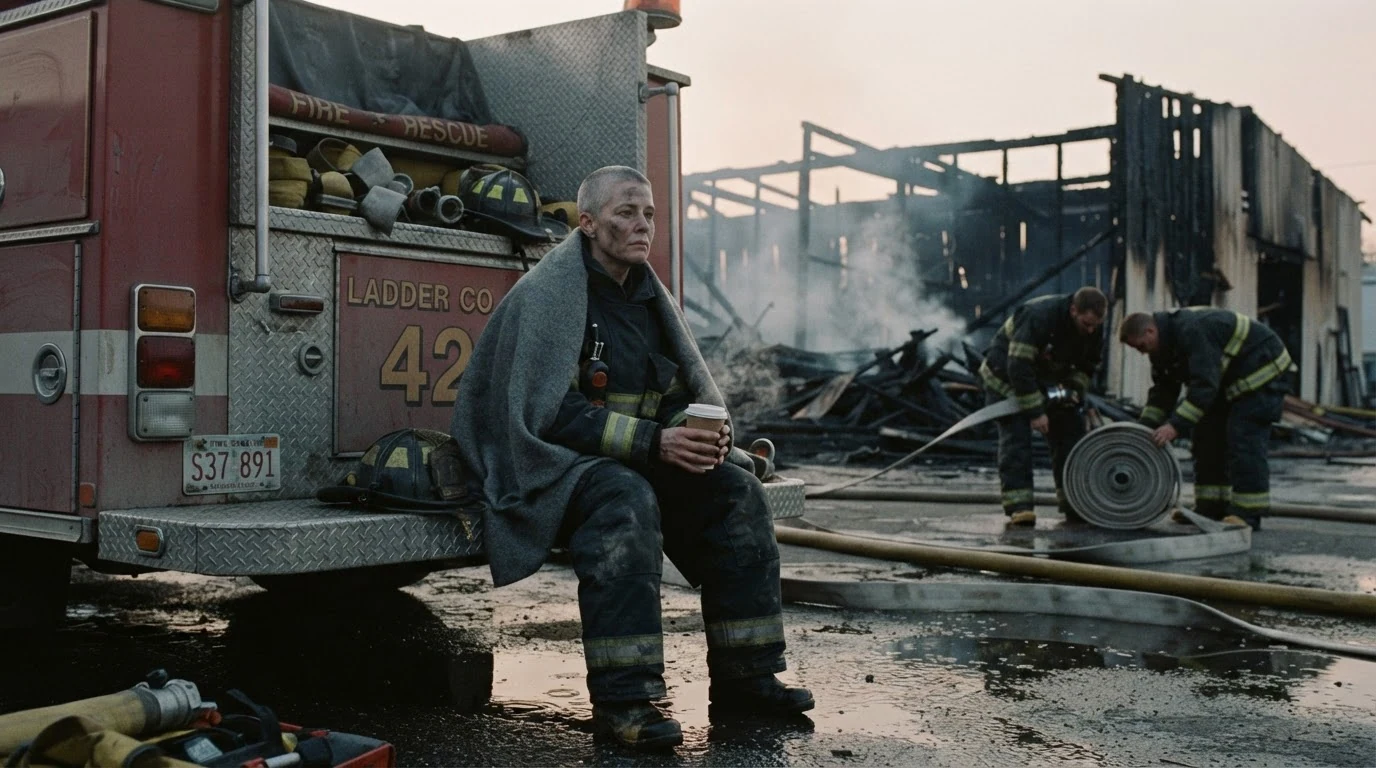
"Aftermath," "blackened" and "thin white smoke" describe the state after the peak, so the model paints consequences, not flames. The blanket and dawn light read as release and passing time.
Open FlashBoardsWide 21:9 shot from across the street, 85mm lens: the morning after a verdict. Stone courthouse steps almost empty, a few reporters walking away with folded tripods. A fictional defense attorney, a lanky man in his sixties with a white goatee, round tortoiseshell glasses and a rumpled navy suit, sits alone on the top step loosening his tie, a file box beside him. Overcast flat daylight, desaturated palette, film still.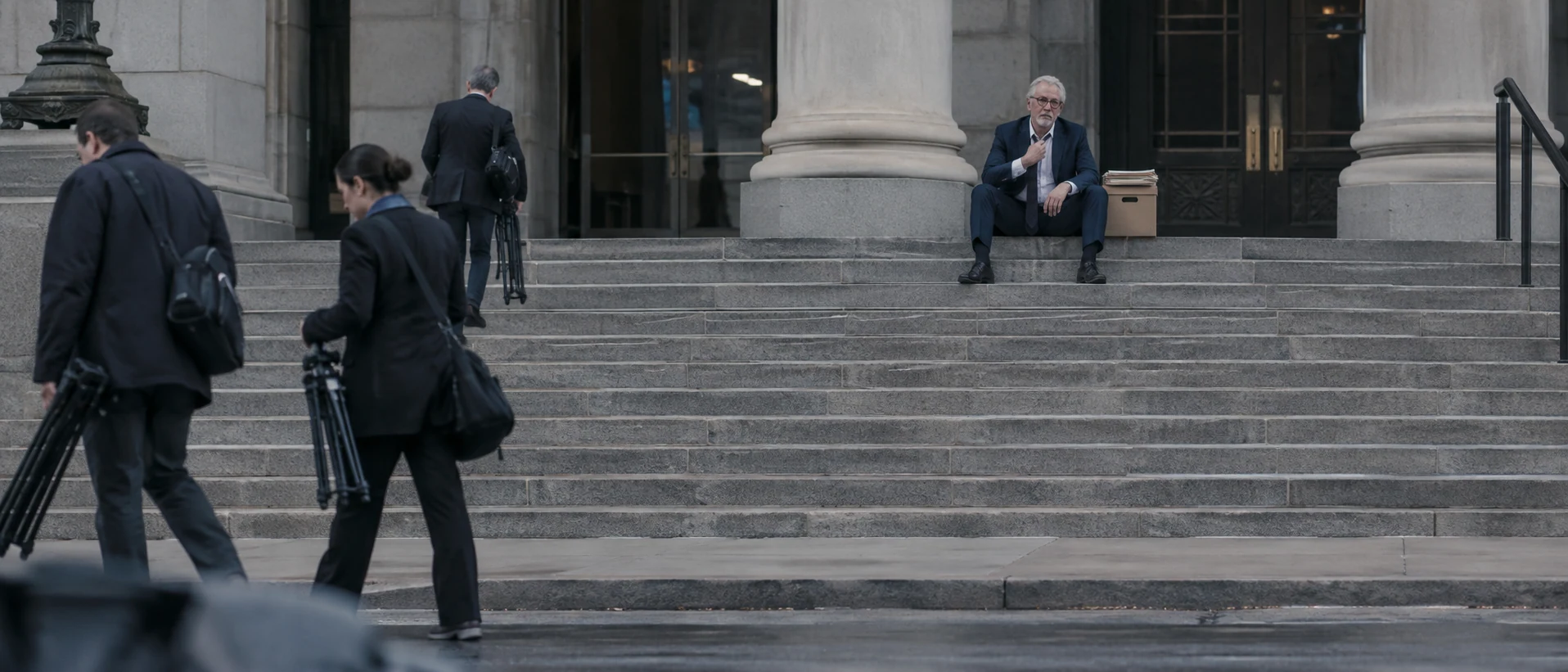
A second take in another register. "Reporters walking away" and "loosening his tie" are falling-action verbs: the event is over, people disperse.
Open FlashBoardsCamera: a slow, steady pull back and slightly up from the firefighter, starting immediately and ending on a wider frame holding the fire engine and the smoking warehouse. Action: The firefighter lowers the paper cup and lets out a long breath that fogs in the cold air, then pulls the blanket tighter. Behind her the two firefighters keep coiling the hose. White smoke keeps rising while the dawn light slowly brightens.The pull back lets the audience step away, a classic post-climax move. Every action is small and already in the frame, so the model animates the aftermath instead of inventing a new event.
Open FlashBoards{
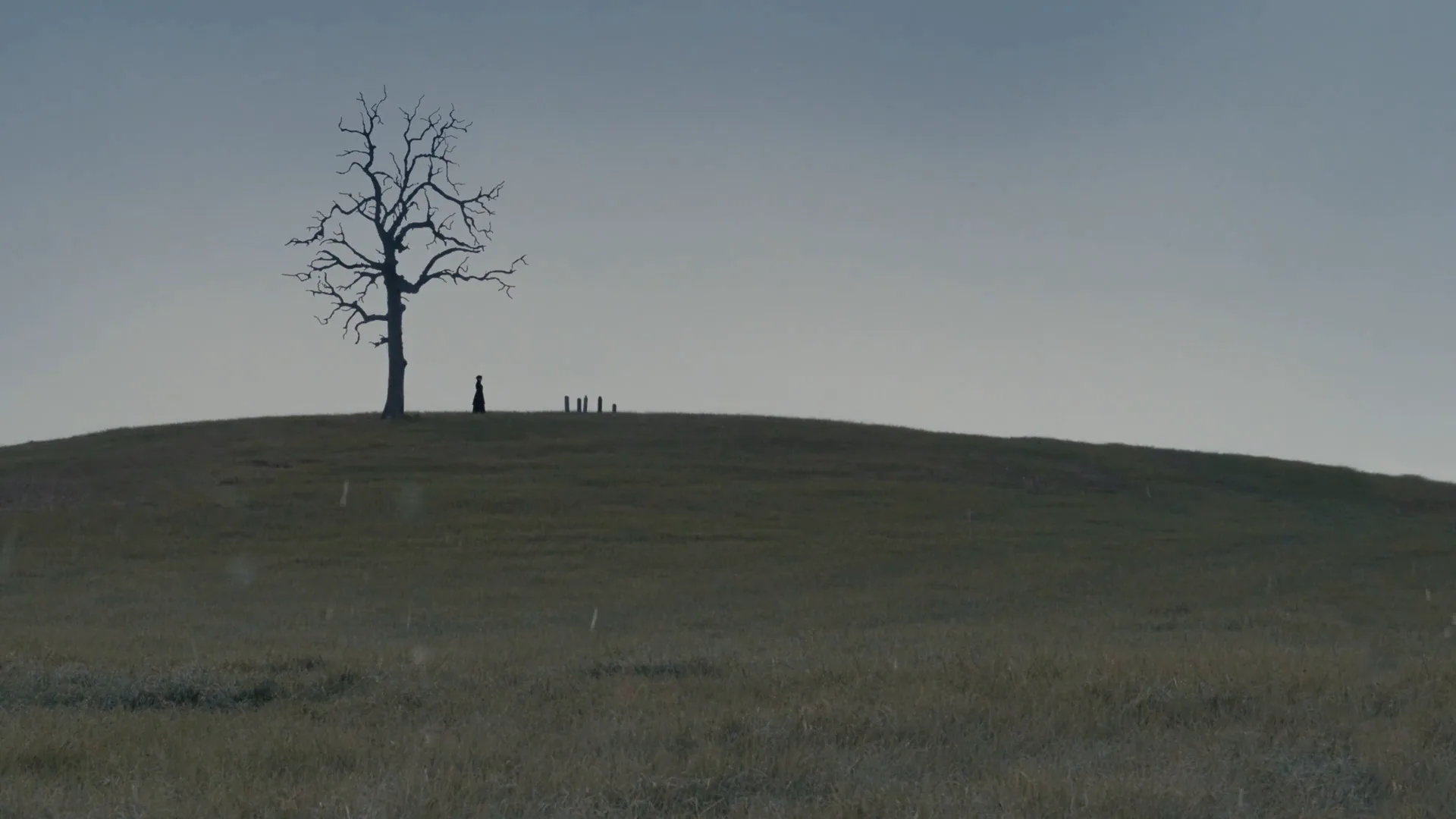
"output": "Full-screen live-action scene from True Grit (2010) from its very first frame: one single continuous locked-off shot, no cuts. Muted 35mm film look, 1900s Arkansas countryside at dusk under a flat overcast sky, soft shadowless light, palette of cold blue-grey sky and dark olive-green grass, very quiet and still.",
"characters": {
"S1": {
"name": "Mattie Ross at forty, played by Elizabeth Marvel",
"look": "slim woman in a long plain black dress to the ground and a small dark hat, seen only as a tiny upright black silhouette in profile on the far hilltop, no face detail readable",
"voice": "dry, level, unsentimental adult woman's voice, heard as a remembered narration over the scene, not from her lips"
}
},
"shots": [
{
"shot": 1,
"camera": "static, locked-off extreme wide shot at eye level from far down the slope, long lens compressing the hill; the camera never moves, pans or zooms for the whole shot. The lower half of frame is a broad grass hill whose smooth rounded crest runs across the middle of frame, sloping gently down toward the right edge; the upper half is empty pale grey-blue sky, slightly darker at the top of frame",
"action": [
"BEGINNING: alive from the first frame, a single bare leafless tree with a straight trunk and spreading twisted branches stands on the crest in the left third of frame, silhouetted against the sky; S1 stands a short distance right of the trunk, a tiny black figure in profile facing screen right toward the graves; a few steps further right on the crest stands a short row of five small weathered wooden grave markers, four taller posts and one shorter one at the right end.",
"THEN: S1 stands perfectly still with her hands down at her sides, facing the grave markers; the tree branches do not sway.",
"THEN: a few faint pale flakes drift slowly down through the air in the foreground, and the long grass near the camera barely stirs.",
"END: nothing on the hill has moved; S1, the bare tree and the row of grave markers hold in the same places under the empty dusk sky while the narration finishes."
],
"dialogue": [
{
"speaker": "S1",
"on_screen": false,
"when": "shortly after the first frame, as narration over the still hill",
"delivery": "calm, matter-of-fact, a hint of dry irony",
"line": "<d>[English] No doubt people talk about that.</d>"
},
{
"speaker": "S1",
"on_screen": false,
"when": "right after the first line, in the middle of the shot",
"delivery": "quoting the gossip in the same flat tone",
"line": "<d>[English] They say, \"Well, she hardly knew the man.</d>"
},
{
"speaker": "S1",
"on_screen": false,
"when": "near the end of the shot",
"delivery": "wry, unbothered",
"line": "<d>[English] \"Isn't she a cranky old maid?\"</d>"
}
]
}
],
"sound": {
"ambience": "soft steady wind across open grassland, very faint distant birdsong",
"speech": "exactly these spoken phrases, each said once, in this order, as S1's narration",
"never_spoken": "no narration and no voice-over beyond S1's three lines above: the descriptions, performance notes and step words of this prompt are never spoken aloud",
"music": "a film score under the scene, always below the voices: a slow, spare hymn-like melody on low strings and a soft piano, mournful and settled",
"subtitles": "none"
}
}Remakes the held wide shot from True Grit (2010), dir. Ethan Coen, Joel Coen, DP Roger Deakins: the static camera, the bare tree, forty-year-old Mattie beside a row of grave markers and her three voice-over lines carried over word for word.
The technique lives in the camera field: a locked-off extreme wide that never moves, pans or zooms. The action steps give Mattie nothing to do but stand, and the three narration lines come verbatim from the film, so the words look back while the image stays still.
Common mistakes
- Write "after a fire" and models often draw the fire. Describe the state: blackened beams, thin white smoke, wet ground.
- Faces default to peak emotion. Give one small action: an exhale, a loosened tie.
- In video, a vague prompt invites a new event. Keep actions few and already in the first frame.
Keep the reference frames, prompts and every generated take side by side — images and video in one canvas.
FAQ
4 questionsWhat is falling action in a story?
Falling action is the part of a story right after the climax. The main conflict is decided, and the story shows the consequences: secondary conflicts close, characters react, and tension decreases step by step. It leads into the resolution or denouement, where the new normal of the characters' world is shown.
What is the difference between falling action and resolution?
Falling action is a sequence of events: consequences playing out, threads being tied, sometimes a last small threat. The resolution, or denouement, is the end state those events arrive at, when nothing important is still moving. Falling action is the slope down from the climax; resolution is the flat ground at the bottom.
How long should the falling action be?
Usually a few scenes, well under a tenth of the running time: long enough to show what the climax cost and close the threads the audience cares about, and no longer. When a film keeps adding scenes after the peak, audiences feel it ending several times.
Can a story skip the falling action?
Yes. Some films cut to black at or right after the climax and leave the consequences to the audience. It works when the answer to the dramatic question is so clear that showing its effects would dilute it.
Related terms
4- DenouementStorytelling
The denouement is the final part of the plot after the climax, where loose threads are tied up and the new balance of the characters' world is shown.
- ClimaxStorytelling
The climax is the story's decisive peak: the protagonist faces the central conflict head-on and the main dramatic question is answered.
- Rising ActionStorytelling
Rising action is the chain of complications between the inciting incident and the climax, where obstacles pile up and stakes rise.
- Story StructureStorytelling
Story structure is the order and shape of the events that carry a story from setup to resolution; models like the three-act structure, Freytag's pyramid, the hero's journey or Save the Cat are different maps of it.
Further reading
Gustav Freytag, Technique of the Drama (1863). Syd Field, Screenplay: The Foundations of Screenwriting. Robert McKee, Story.