 FlashBoards Learn
- Learn
- Screenwriting
- Character Sheet
Screenwriting · Film language
Character Sheet
Also called: character reference sheet, model sheet, character turnaround, character bible
A character sheet is a one-page reference that fixes who a character is. For writers it records traits, goals, wounds and history; for artists it shows the face, costume and turnaround views. Either way, its job is consistency: every scene, drawing, shot or AI generation checks against the same page.
- What it does
- Locks a character's inner logic and outer look in one place so nobody has to guess.
- Use it when
- Before the outline, before casting or design, and before generating a single AI frame of the character.
- Watch out
- A sheet stuffed with trivia nobody will film is a hobby, not a tool; keep only what changes choices or pictures.
- Try this prompt
Character reference sheet, one woman shown front, three-quarter, side and back at the same scale, gray backdrop, even studio light
What is a character sheet?
A character sheet is a working document, not a piece of literature. It fits everything the production must keep straight about one character on a page or two, so a writer on draft five and an animator on shot 312 read the same facts.
The term covers two related documents that grew up in different departments:
- The writer's character sheet (also called a character profile or character breakdown) is text. It lists who the character is: age, job, goal, need, flaw, backstory, speech habits, relationships and where the character arc starts and ends. It lives in screenwriting and development.
- The visual character sheet (a model sheet, reference sheet or turnaround) is a picture. It shows the character from several fixed angles at the same scale, with expressions, costume details and props called out. It comes from animation, where dozens of artists had to draw one character the same way.
Tabletop gamers know a third use: the stats-and-inventory record a player keeps in Dungeons & Dragons. Same problem, same solution — an identity that survives many sessions.
In AI filmmaking the two halves meet. A model can't remember a character from one generation to the next, so the written profile becomes the prompt and the visual sheet becomes the reference image. Without both, the hero's scar moves, the coat changes color and the face drifts between shots.
What should a character sheet include?
A useful writer's sheet answers the questions a scene will ask. Lajos Egri's old three-part "bone structure" still sorts the fields well — physiology, sociology, psychology — but the sheet only earns its place when each line can change what the character does on screen.
Identity and function
- Name, age, occupation, where they live and with whom.
- Role in the story: protagonist, antagonist, ally, mentor. Note the character archetype if one is in play, then note how this person bends it.
Engine
- Want: the concrete, external goal of the film (win the case, get the boat back).
- Need: what they actually lack, usually invisible to them at the start.
- Flaw or false belief: the habit of mind that blocks the need.
- Wound: the event in the past that produced the false belief — one line, not a biography.
- Stakes: what they lose if they fail, in their own terms.
Behavior
- Voice: vocabulary, rhythm, what they never say out loud. This is where dialogue gets its fingerprints.
- Tells: a gesture, a habit, an object they touch under pressure.
- Contradiction: one trait that seems to argue with the rest (a gentle bouncer, a reckless accountant).
- Relationships: two or three key people and what each one wants from this character.
On-screen specifics
- The physical details the audience must register: height, build, hair, a scar, glasses, a signature garment or prop.
- How they change across the story, marked by act — the arc in one line per act.
Skip the questionnaire trap: "favorite ice-cream flavor" lists produce facts that never reach the film. Characterization happens through action and choice; the sheet should feed those, not replace them.
A character sheet template you can copy
Keep it to a page. If a field is blank, the blank is information: the character is thin there.
- Name / age / occupation:
- Role in the story:
- One-line description (as it would appear in the script's first introduction):
- Want (external goal):
- Need (internal lack):
- Flaw / false belief:
- Wound (one event):
- Stakes if they fail:
- Voice (three words + one sample line):
- Tell or habit:
- Contradiction:
- Key relationships (name — what they want from this character):
- Look (height, build, face, hair, one signature item):
- Arc: Act 1 — / Act 2 — / Act 3 —
Two habits make the template useful. First, write the one-line description exactly as it will read in the screenplay — it forces you to choose the single trait a reader needs. Second, date every version. Characters change between drafts, and an old sheet contradicting the current script is worse than no sheet at all.
Model sheets and character turnarounds
The visual character sheet was standardized by hand-drawn animation studios in the 1930s, when features required many animators and assistants to draw one character thousands of times. The model sheet was the contract: this is the head-to-body ratio, this is how the ear sits, this is the silhouette. Animators kept it pinned beside the desk, and supervisors checked scenes against it.
A complete visual sheet usually contains several pages:
- Turnaround. The full figure in a neutral pose from the front, three-quarter front, side profile, three-quarter back and back, all at identical scale, with horizontal guide lines at the eyes, chin, shoulders, waist and knees so proportions line up across views.
- Expression sheet. The head in a range of emotions — neutral, anger, fear, joy, doubt — plus mouth shapes if the character speaks on camera.
- Pose or action sheet. How the character stands, walks, runs and sits; the body language that belongs to them and to no one else.
- Costume and prop callouts. Close details of fabrics, fasteners, jewelry and the objects they carry, often with color swatches.
- Size comparison (line-up). The whole cast side by side, so a director knows who towers over whom before blocking a two-shot.
Live action spreads the same information across departments: costume design keeps fitting photos for every change, hair and makeup photograph each look, and the script supervisor tracks what the character wore and held in every setup to protect continuity. A casting breakdown is, in effect, a trimmed character sheet written for agents — part of film casting.
Two rules carry over to any visual sheet. Shoot or draw the reference in flat, even light, because dramatic lighting hides the shape of the face and bakes a mood into what should be neutral information. And use a normal to short-telephoto perspective (roughly 50–85mm equivalent), because a wide lens close to the subject stretches the nose and shrinks the ears, and every later shot will inherit that distortion.
Why character sheets matter for AI filmmaking
Character consistency is the hardest problem in AI-generated film. Each generation starts fresh, so a character is only as stable as the information you give the model every time. The character sheet is that information, split into two forms:
- The prompt block. A fixed paragraph describing age, build, face, hair, distinguishing marks and costume, in the same words and the same order every time. Specific, slightly unusual details — a white streak above one temple, a scar through one eyebrow, a brass compass — anchor identity better than generic words like "attractive" or "rugged."
- The reference image. A clean full-body front view and a turnaround on a neutral background, used as the image reference for every new shot. Because it carries no set, no mood light and no action, the model borrows the person rather than the scene.
In FlashBoards this means pinning the character sheet at the head of the board, next to the storyboard frames it feeds, and generating each new shot with the sheet as the reference. When a take drifts — a different jaw, a coat that turned brown — it sits beside the sheet on the same canvas and the difference is obvious before it reaches the edit. Keep the costume references from the mood board on the same canvas.
Build the sheet before the shot list goes into generation, not after. Fixing a face across forty finished shots costs far more than locking it on one page.
Character sheet vs. character bible
The terms overlap, but the scale differs.
- A character sheet covers one character on one or two pages. It is fast to read and meant to be checked constantly — by the writer mid-scene, the animator mid-shot, the AI prompt mid-generation.
- A character bible is a longer document, common in television and franchises, that gathers the full cast, their histories, relationships, running jokes, rules of the world and what has already happened on screen. Writers' rooms use it so a new writer in season three doesn't contradict season one. A series bible contains character bibles, and each character entry often starts with a sheet.
A character sheet is also not an arc. The arc is the change a person goes through over the story; the sheet records the starting state, the pressure points and the intended end state so the arc can be written deliberately. And it is not characterization itself — the sheet is backstage, and the audience only ever sees what the character does.
How to create a character sheet with AI
3 promptsA character sheet is exactly the kind of planning document image models can produce, and it pays off in every later shot. Start with a clean front-view reference in Nano Banana 2 Lite, build the full turnaround sheet in GPT Image 2.5, then have MiniMax H3 Max Turbo rotate the reference on a turntable so you can pull any in-between angle as a still. Keep all three on one FlashBoards board as the character's home, and use them as references for every storyboard frame.
Full-body character reference photo, front view, a woman in her early forties, tall and lean, close-cropped black hair with a single white streak above the right temple, a thin scar crossing her left eyebrow, deep-set gray eyes, a long rust-red canvas field coat over a charcoal knit sweater, olive cargo trousers tucked into scuffed brown lace-up boots, a small brass compass on a leather cord around her neck, a worn canvas satchel on her left hip. She stands on a low round matte-black turntable in a relaxed neutral pose, arms slightly away from her sides, facing the camera, looking straight into the lens with a calm neutral expression. Whole figure in frame from the top of her head to her boots with space above and below. Seamless mid-gray studio backdrop, soft even front light from large softboxes, faint shadows, 85mm lens at chest height, true-to-life colors, sharp detail.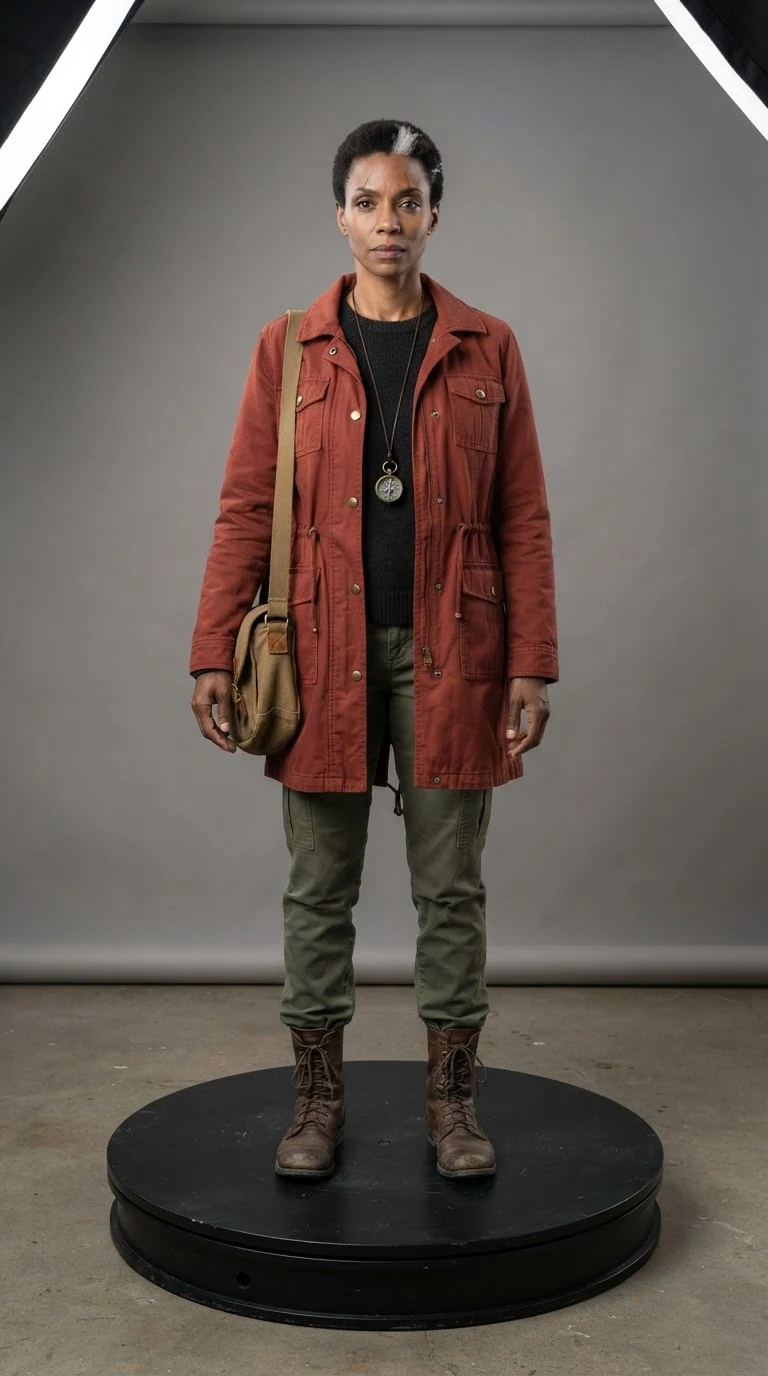
Front view, neutral pose, arms slightly away from her sides and calm neutral expression make it a reference, not a portrait: nothing hides the silhouette or the costume. The mid-gray backdrop and soft even front light keep mood out of the image, and the 85mm lens at chest height avoids wide-angle distortion of the face and legs. The white streak, the eyebrow scar and the brass compass are the identity anchors to repeat, word for word, in every later prompt.
Open FlashBoardsCharacter turnaround sheet, photographic, one consistent person: a woman in her early forties, tall and lean, close-cropped black hair with a single white streak above the right temple, a thin scar crossing her left eyebrow, deep-set gray eyes, a long rust-red canvas field coat over a charcoal knit sweater, olive cargo trousers tucked into scuffed brown lace-up boots, a small brass compass on a leather cord around her neck, a worn canvas satchel on her left hip. Left two thirds: five full-body views in a single row at identical scale and identical height, standing on the same baseline — front, three-quarter front, side profile facing right, three-quarter back, back view showing the satchel strap across her back and the short hair at the nape. Thin horizontal gray guide lines run across all five at eye, shoulder, waist and knee height. Right third: three head-and-shoulder close-ups stacked vertically — neutral, suspicious with narrowed eyes, laughing — and below them small detail boxes of the brass compass, the satchel buckle and one boot. Small clean sans-serif labels under each view: FRONT, 3/4, SIDE, 3/4 BACK, BACK. Light gray background, even studio light.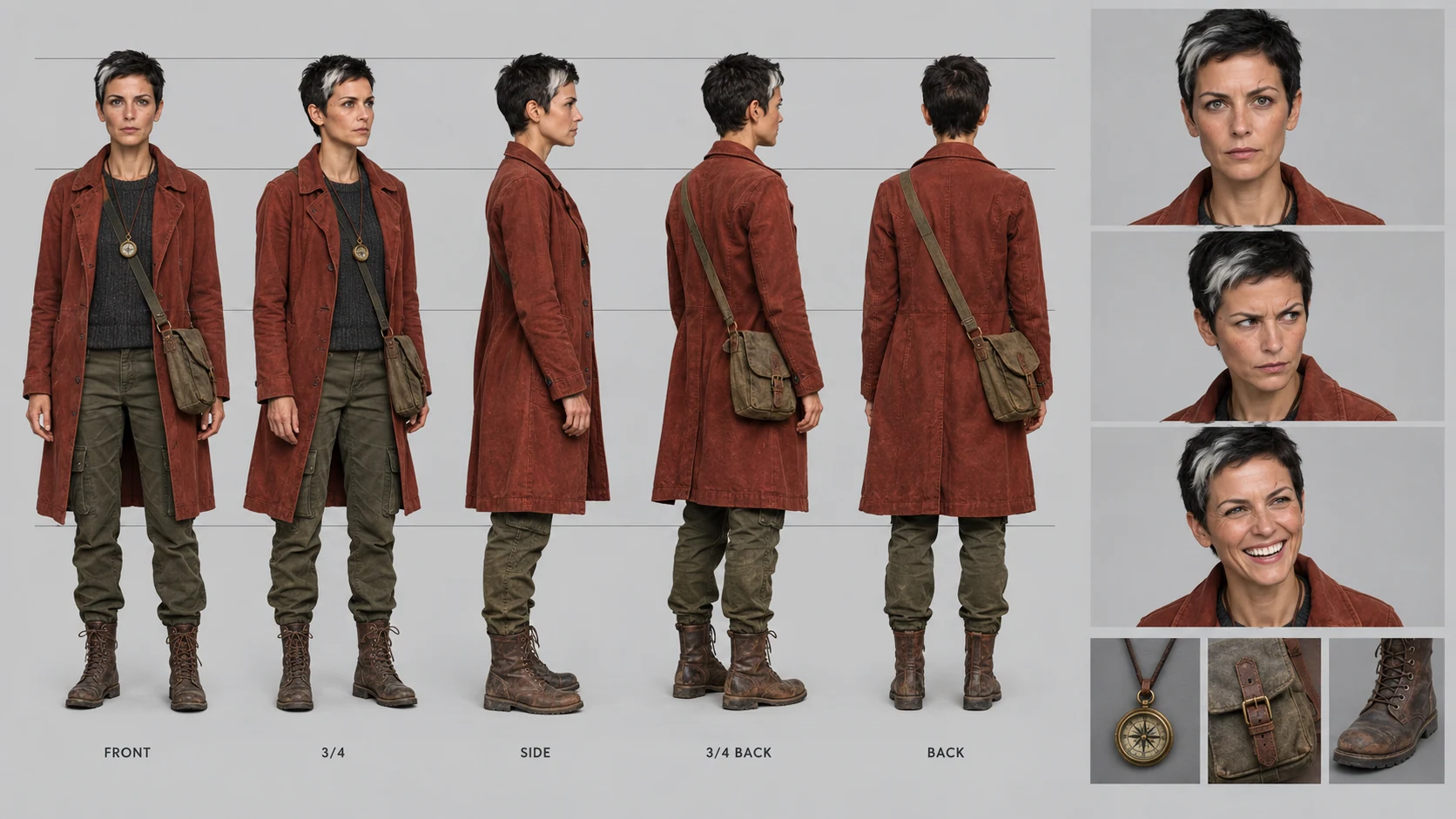
Turnaround sheet, identical scale and the same baseline produce a model sheet rather than five separate photos, and the guide lines at eye, shoulder, waist and knee height hold the proportions together across views. Describing the back view in words (the satchel strap, the hair at the nape) matters, because otherwise the model invents it. The expression column and detail boxes turn one image into the whole reference page an artist would pin up.
Open FlashBoardsCamera: locked off at chest height, completely static, the full figure stays centered in frame for the whole shot. Action: the turntable is already rotating slowly clockwise, carrying the woman with it while she holds her neutral pose and her arms stay slightly away from her sides. Her left shoulder turns toward the camera first, then her left profile faces the lens, then her back with the satchel strap. In the middle of the shot her right profile comes around, and the hem of the rust-red coat sways gently with the rotation. At the end she completes one full turn and faces the camera again, still with a calm neutral expression.A locked off, completely static camera with a rotating turntable gives a true turnaround: the light and backdrop stay fixed while the character turns, so every frame is comparable. Already rotating makes the shot move from frame one instead of creeping toward the still. Naming each view in order — profile, back, profile, front — keeps her from walking off or changing pose, and you can pause at any angle to grab a still as an extra reference.
Open FlashBoardsCommon mistakes
- The face changes between views. Repeat the same character block, in the same order, in every prompt and lead with two or three unusual features.
- A dramatic portrait instead of a reference. Words like cinematic, moody or golden hour bake light and emotion into the sheet. Ask for soft even front light and a neutral expression.
- Distorted proportions. A wide lens stretches the figure; state 85mm or 50mm and chest height.
- The back view is invented. Models guess what they can't see — describe the back of the costume and the hair explicitly.
- Views at different sizes. Add identical scale, same baseline and guide lines, or the profile ends up taller than the front.
- The turntable turns into a camera orbit. If the backdrop starts sliding, restate that the camera is locked off and only the turntable rotates.
Keep the reference frames, prompts and every generated take side by side — images and video in one canvas.
FAQ
6 questionsWhat is a character sheet?
A character sheet is a one-page reference that defines a character so everyone on a project portrays them consistently. A writer's version lists traits, goals, flaw, backstory, voice and arc. A visual version, also called a model sheet, shows the character's face, costume and body from several angles at the same scale, often with expressions and prop details.
What should a character sheet template include?
At minimum: name, age and occupation; role in the story; external want and internal need; flaw or false belief; one formative wound; stakes; voice and a sample line; a tell or habit; one contradiction; key relationships; the look, with one signature item; and a one-line arc per act. Leave out trivia that will never affect a scene or a shot.
What is a character turnaround sheet?
A turnaround sheet shows the full figure in a neutral pose from the front, three-quarter, side and back, all at identical scale and aligned on horizontal guide lines. It lets artists, modelers and AI image tools reproduce the character from any angle without guessing about proportions, the back of the costume or how the hair falls.
What is the difference between a character sheet and a model sheet?
In animation the two terms are used almost interchangeably for the visual reference page. In screenwriting, "character sheet" more often means the written profile of traits, goals and history. Many productions keep both: the written sheet defines who the character is, and the model sheet defines exactly how they look.
How do I keep an AI character consistent across shots?
Build a character sheet first: a fixed text description with a few distinctive features, plus a clean front-view and turnaround reference on a neutral background in even light. Paste the same description into every prompt and use the reference image for every new shot. Compare each take with the sheet side by side and regenerate any that drift.
Do screenwriters need a character sheet?
It isn't submitted with the script, but most writers keep one for each major character. It keeps motivations, voice and history stable across drafts, helps spot flat or redundant characters early, and becomes the basis for casting breakdowns and pitch documents. For TV, the sheets grow into a character bible for the writers' room.
Related terms
5- Character ArcStorytelling
A character arc is the inner change a character goes through over the story — from a flaw or false belief to a new understanding (or a fall) — driven by the choices the plot forces on them.
- CharacterizationStorytelling
Characterization is how a film reveals who a character is — through actions, choices, speech, appearance, how others react to them and what the camera lets us notice.
- StoryboardFilmmaking Process & Crew
A storyboard is a sequence of drawn or generated panels, one per planned shot, showing framing, action and camera movement with notes — a visual draft of the film before anything is shot.
- Character ArchetypeStorytelling
A character archetype is a recurring role that audiences recognize across cultures — the mentor, the trickster, the shadow, the herald — which writers adapt rather than copy.
- BackstoryStorytelling
Backstory is everything that happened to the characters and their world before the film begins; it shapes their motives and is revealed through hints, dialogue or flashbacks rather than dumped on the audience.
Further reading
Lajos Egri, The Art of Dramatic Writing (1946). Frank Thomas and Ollie Johnston, The Illusion of Life: Disney Animation (1981).