 FlashBoards Learn
- Learn
- Camera Movement
- Crane Shot
Camera Movement · Film language
Crane Shot
Also called: boom shot, jib shot, crane move, technocrane shot
A crane shot is filmed from a camera mounted on a crane or jib arm that can rise, descend and swing through the air in one continuous move. It lets the camera lift away from a character to reveal the whole place, or float down from above to open a scene — shifting both height and point of view mid-shot.
- What it does
- Moves the camera vertically and through the air, changing scale and vantage within a single shot.
- Use it when
- You need to open a scene from above, end one by rising away, or carry the eye over a crowd or obstacle.
- Watch out
- A crane move without a reason reads as showing off; time every rise or descent to a story beat.
- Try this prompt
Crane shot rising slowly from a woman alone at a bus stop at night, camera lifts 8 meters and tilts down to reveal the empty wet street, 5 seconds
What is a crane shot?
A crane shot uses a counterweighted arm that pivots on a base to carry the camera through space. Because the arm swings on a fulcrum, the camera can do things no tripod or dolly can: rise from lens height to several stories up, drop back down, and sweep sideways in an arc — all while a remote head pans and tilts to keep the subject framed.
Three movements make up almost every crane shot:
- Boom up / boom down — the arm raises or lowers the camera.
- Swing (or slew) — the arm rotates on its base, carrying the camera sideways along a curve, much like an arc shot.
- Travel — the whole crane rides on a dolly or track, adding forward, backward or lateral movement.
Most memorable crane shots combine two or three of these with a pan or tilt, which is why the move feels like floating rather than mechanical travel. It is one of the core techniques of camera movement, and it sits between the ground-based dolly shot and the fully airborne aerial shot.
What does a crane shot do?
A crane changes the audience’s relationship to the scene while the shot is still running. Where a cut says “now look at this,” a crane move carries the viewer there, so the change of scale feels continuous and inevitable.
Opening a scene. Starting high on a wide view and descending to eye level is a classic way to combine an establishing shot with the first beat of action. The opening of Touch of Evil (1958) rises and falls over a border town in one long take while a planted bomb ticks toward detonation.
Isolating a character. Rising away from a person turns them small against their surroundings. In High Noon (1952), the camera pulls back and up from the marshal alone in an empty street, and the height states his abandonment more clearly than any line of dialogue could. In Gone with the Wind (1939), a crane rises over a rail yard until the wounded soldiers fill the frame to the horizon — scale as statement.
Moving from the general to the specific. The reverse move — high and wide down to a detail — directs attention with surgical precision. In Notorious (1946), Hitchcock cranes from the top of a crowded party down to a key hidden in Ingrid Bergman’s hand.
Endings. A slow rise at the end of a film lets the audience step back from the characters, emotionally as well as physically — so common that viewers read it as “the end” instinctively.
Following action over space. A crane can keep up with a subject over a wall, a crowd or a staircase, where a dolly would hit an obstacle — often in combination with a tracking shot.
How to shoot a crane shot
Pick the rig for the move. A jib (roughly 2–6 m of reach, one or two operators) covers most indie needs: a rise from a seated actor to a high-angle shot over a room, a descent into a doorway. A full-size camera crane (10 m and more, often with a rider seat for operator and focus puller) is for big vertical reveals and exteriors. A telescoping crane changes its reach during the take (see below).
Remote head or rider. On most jibs the camera sits on a remote head: the operator frames on a monitor with wheels or a joystick while grips move the arm. The two jobs need rehearsal together.
Lens. Wide and medium lenses (18–35 mm on Super 35) show the parallax that sells height: foreground objects slide past, the horizon shifts, the floor opens up below. Long lenses flatten the movement so much that a 5 m rise can look like a tilt.
Use foreground. A lamp, branches, a railing or a crowd close to the lens is what the eye uses to measure the rise. Without it, a crane move against an empty sky reads as nothing happening.
Speed and easing. Start and end the move gently; a crane that jerks into motion or stops dead looks mechanical. Time the arm to actor cues — the rise begins as the character turns away, the descent ends as someone speaks — so the move is motivated.
Focus, light, safety. Subject distance changes throughout, so the focus puller works from marks or a distance-measuring device. A high position reveals the tops of stands, so rig from above or hide units in the set. Check power lines and ceiling height, respect wind limits, and never let anyone step off a rider seat before the grips re-balance the counterweight.
Boom shot: raising and lowering the camera
A boom shot is a crane shot in which the arm rises or drops, lifting the view above a scene or lowering it into the action. “Boom up” and “boom down” are the instructions given to the crane grips.
A boom up often ends in a high, wide view that shades into an overhead shot if the camera tilts straight down. Because the arm swings on a pivot, a pure boom move is a slight arc rather than a perfectly vertical line — the camera also travels a little toward or away from the base, which adds to the floating feel.
Crane, boom or jib: which term is right?
On set the three words overlap:
- Crane — the general term for any arm that carries the camera, from a small jib to a large rider crane. “Crane shot” is the standard name for the move.
- Boom — the arm itself, and the verb for moving it up or down (“boom up two feet”). Also, confusingly, the pole that holds the microphone.
- Jib — a lighter crane arm, usually with a remote head and no rider, easy to transport and set up. “Jib shot” describes the same kind of move on a smaller scale.
For storyboards and shot lists, “crane up” or “crane down” with a start and end framing is the clearest instruction.
Technocrane: the telescoping crane
A Technocrane is a telescopic camera crane whose arm extends and retracts during the take. A standard jib has a fixed length, so its camera can only trace arcs around the base. A telescoping arm can push the camera straight forward into a space — through a window, over a table, down a corridor — and pull it back out, while the remote head keeps framing.
That makes it a hybrid of a crane and a dolly: it can deliver a push-in from a height or a position no track could reach, and it can combine extension, swing and boom into one continuous line. Telescoping cranes ride on large wheeled bases and can be mounted on a camera car to follow vehicles at speed. The cost is size, crew and setup time — use one when the camera must travel into space, not just rise.
Crane shot vs. pedestal, tilt and aerial shots
Four moves are regularly confused with the crane:
| | What moves | Effect | |---|---|---| | Crane shot | Camera travels on an arm: rises, drops, swings | Height and vantage change in one fluid, often arcing move | | Pedestal shot | Camera rises or drops straight up and down, angle stays level | Eyeline climbs or sinks without a sense of flight | | Tilt shot | Camera stays put, pivots up or down | Reveals a tall subject but the vantage never changes | | Aerial shot | Camera in a helicopter or drone | Much greater height and range, less precise near actors |
The quick test: if the camera’s position doesn’t change, it’s a tilt. If it moves only straight up or down, it’s a pedestal. If it flies high over landscape, it’s aerial. If it lifts or swoops on an arm within the scene, it’s a crane shot.
Crane Shot in motion
8 clipsWatch the vantage, not only the angle. In a crane move the camera's position changes, so trees, railings and statues slide against the background and the horizon climbs or sinks; in a tilt they stay locked. The first clips rise, the next ones descend, and the last two hang overhead.
How to create a crane shot with AI
3 promptsImage models give you the vantage a crane reaches; the move belongs to the video model, and it reads as a crane only if the camera's height changes, not just its angle. Nano Banana 2 Lite builds a low start frame with foreground to rise past, GPT Image 2.5 tries the high vantage, and MiniMax H3 Max Turbo animates the first frame into a slow crane up. Keep reference clips, stills and every take on one FlashBoards board and compare them side by side.
Cinematic film still, eye level at about 1.6 meters, 24mm lens: a woman in her sixties with cropped silver hair and a mustard-yellow raincoat stands at a bus stop on a wet cobbled square at dusk, a tall iron street lamp close to the lens on the left edge of frame, puddles reflecting warm shop windows, passers-by with umbrellas crossing behind her, light rain falling, a row of old four-story facades across the square, deep focus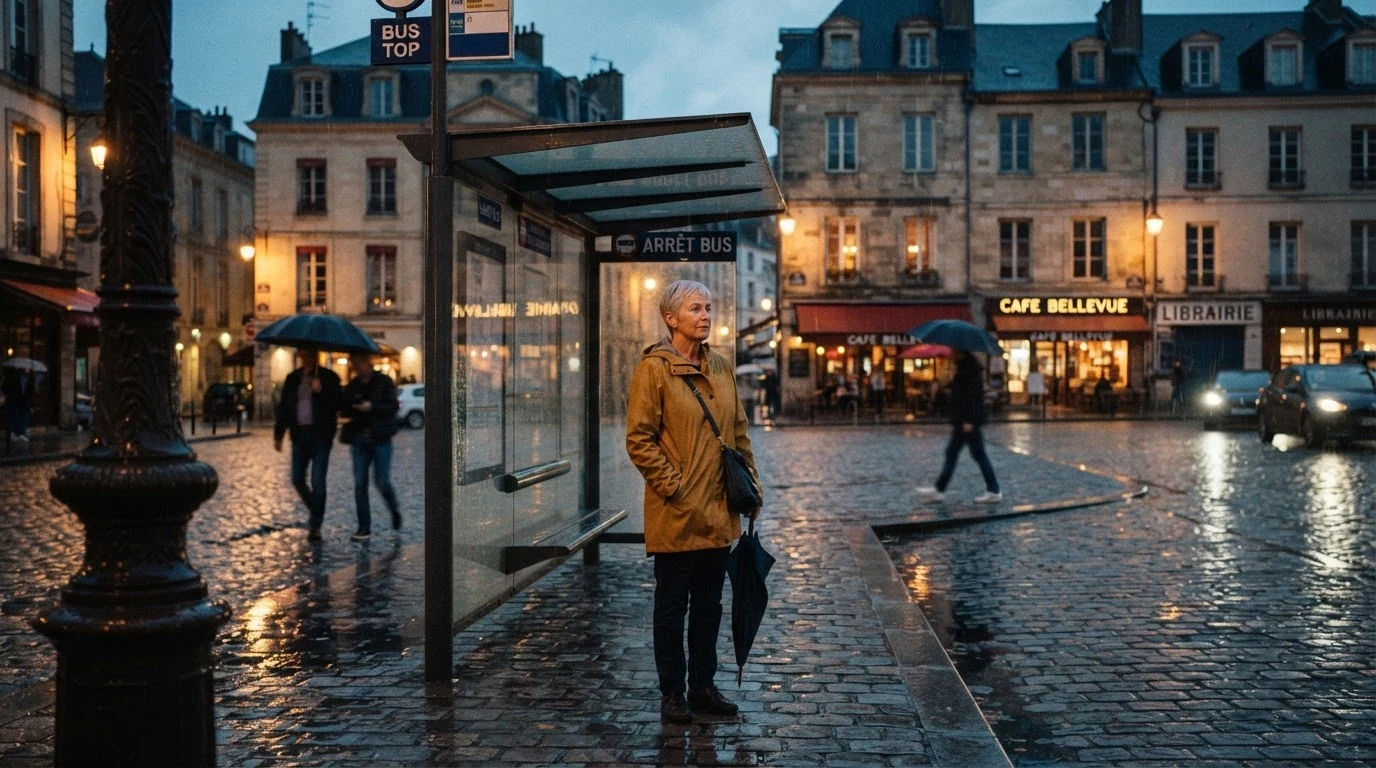
Eye level at about 1.6 meters sets the height the crane leaves from. The lamp close to the lens on the left edge is the foreground the camera will pass on the way up; without it a rise against flat facades reads as a tilt. Rain and passers-by are already moving, and the square is in frame, so the video model doesn't have to invent it.
Open FlashBoardsHigh crane vantage, camera about 8 meters up and tilted down 45 degrees over a night market street: rows of food stalls under strings of bare bulbs, steam rising from woks, a crowd flowing between them, a cook with a shaved head and a white T-shirt tossing noodles at the nearest stall in the lower third, the edge of a red paper lantern close to the lens at top left, 28mm lens, cinematic film still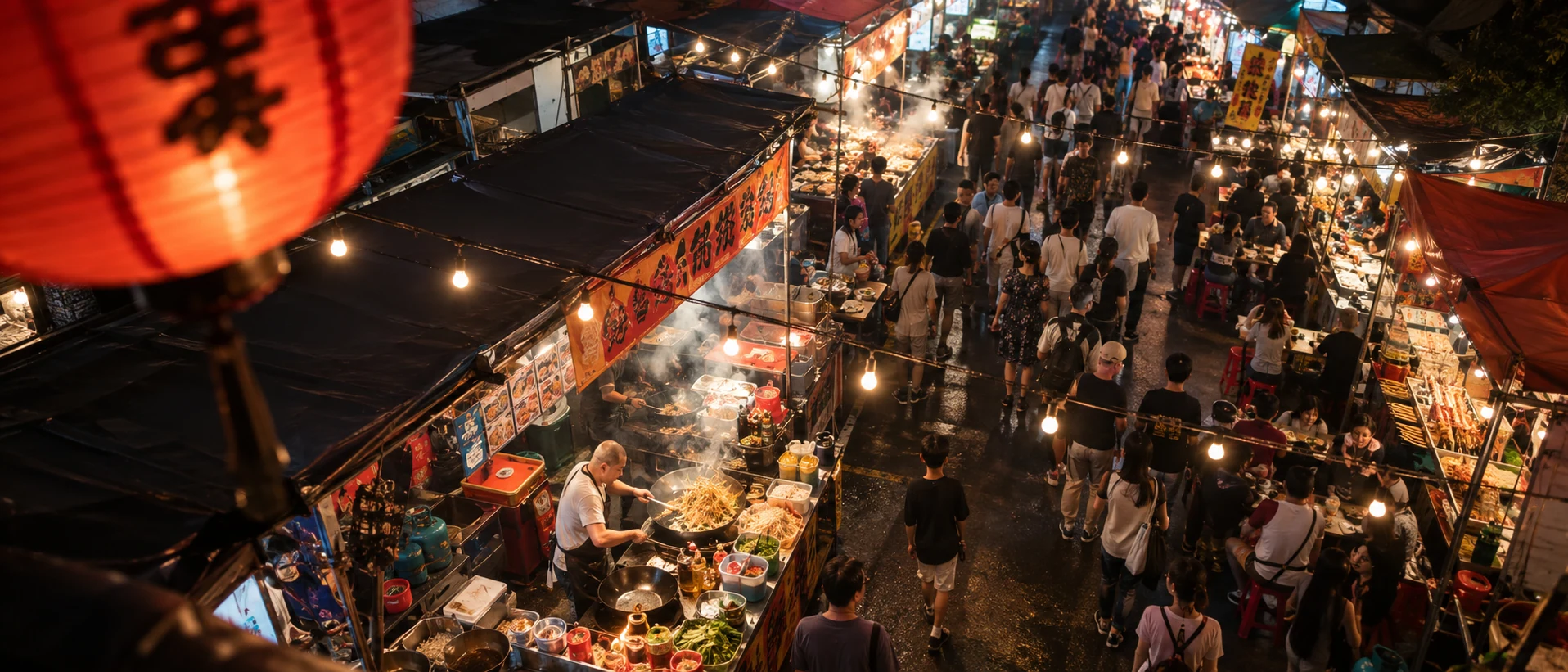
A height in meters and a tilt angle place the camera better than the word crane, which some models answer with construction equipment. The lantern near the lens and the shrinking crowd give the height a scale. Use it as a second take, or as the landing frame of a crane down.
Open FlashBoardsCamera: a slow, smooth crane up from eye level, rising steadily about 6 meters over the whole shot while tilting down to keep the woman at the bus stop centered; the iron street lamp slides down and out of the bottom-left of the frame as the camera passes it, and the wet square opens up below. The move eases in and eases out and ends high above the square, looking down on her small figure. Action: rain is already falling and passers-by with umbrellas are crossing behind her as the shot begins. In the middle she lowers her head and pulls up her raincoat collar while the camera climbs past the lamp. At the end she stands still and small at the bus stop as people cross the glistening square around her.Crane up from eye level and about 6 meters name the move and its size; tilting down to keep the woman centered separates a crane from a camera flying away. The lamp sliding out of frame is the parallax cue that sells the height. Rain and passers-by move from the first frame, so the shot is alive at once.
Open FlashBoardsCommon mistakes
- A tilt instead of a crane. The camera stays put and only tilts. Say the camera rises with a height in meters and give it a foreground object to pass.
- A drone instead of a crane. The camera flies forward over the scene. Ask for a slow vertical rise or descent within the scene, with an end height.
- A zoom instead of movement. Describe foreground sliding out of frame and the ground opening up below.
- Lost subject. During a rise the subject drifts out of frame. Add tilting down to keep her centered.
- A literal crane. Image models may draw construction equipment. Describe the vantage, not the gear.
- A frozen start. With only a camera move in the prompt, MiniMax H3 Max Turbo can open on a still and creep in. Start
Action:with something already moving: rain, a crowd, steam.
Keep the reference frames, prompts and every generated take side by side — images and video in one canvas.
FAQ
6 questionsWhat is a crane shot in film?
A crane shot is a shot filmed from a camera on a crane or jib arm that can rise, descend and swing through the air. It changes the camera’s height and vantage during a single take — typically lifting away from a character to reveal the location, or descending from a wide view to open a scene at eye level.
What is the difference between a crane shot and a jib shot?
The move is the same; the difference is scale. A jib is a lighter, shorter arm, usually with a remote head and no operator riding it, quick to set up and suited to rises of a few meters. A crane can be much larger, reach far higher and sometimes carries the operator and focus puller on a seat.
What is a boom shot?
A boom shot is a crane shot built mainly on vertical movement: the arm raises or lowers the camera. “Boom up” and “boom down” are the instructions given to crane grips. Because the arm pivots on its base, a boom move is a gentle arc, which gives it a floating quality that a straight pedestal move lacks.
Is a drone shot the same as a crane shot?
No. A drone can mimic a crane move, but it usually flies higher and covers more distance, closer to an aerial shot. A crane is tied to its base, so its moves are more precise, repeatable and safe near actors, and it can carry heavier cameras and lenses. Many productions use cranes for rises within a set and drones for landscape heights.
What are famous crane shot examples?
The opening long take of Touch of Evil (1958) is the classic study. High Noon (1952) rises away from the marshal alone in the street; Gone with the Wind (1939) cranes up to reveal a rail yard filled with wounded soldiers; and Notorious (1946) descends from a party to a key in Ingrid Bergman’s hand.
What is a Technocrane used for?
A Technocrane is a telescoping camera crane: its arm extends and retracts during the shot. That lets the camera push straight into a space — through a window or over a table — and pull back out, which a fixed-length jib cannot do. It is used for complex combined moves and is often mounted on a vehicle for car work.
Related terms
7- Pedestal ShotCamera Movement
A pedestal move raises or lowers the whole camera vertically without tilting it, so the eyeline climbs or sinks while the angle stays level — named after the studio pedestal that does it.
- Tilt ShotCamera Movement
A tilt pivots the camera up or down from a fixed position, like nodding your head — to reveal a tall subject, follow a rise or fall, or shift attention between sky and ground.
- Aerial ShotCamera Shots
An aerial shot is filmed from a camera in the air — a helicopter, drone or plane — high above the scene, revealing geography, scale and movement across a landscape or city that no ground position could show.
- Establishing ShotCamera Shots
An establishing shot opens a scene or sequence by showing where — and often when — it takes place, typically a wide view of a building, street, city or landscape before the film cuts closer to the characters.
- High-Angle ShotCamera Angles
A high-angle shot looks down on the subject from above eye level, shrinking them in the frame and in status — often used to make a character seem small, vulnerable, trapped or overwhelmed.
- Tracking ShotCamera Movement
A tracking shot moves the camera through space with a moving subject — on a dolly, Steadicam, vehicle or drone — following, leading or flanking it so the audience travels with the action.
- Camera MovementCamera Movement
Camera movement is any change of the camera's position or direction during a shot — pans, tilts, dollies, cranes, handheld and more — used to guide attention, reveal space and set the emotional rhythm of a scene.
Further reading
Blain Brown, Cinematography: Theory and Practice (Routledge). Steven D. Katz, Film Directing Shot by Shot (Michael Wiese Productions). Gustavo Mercado, The Filmmaker’s Eye (Focal Press).