 FlashBoards Learn
- Learn
- Storytelling
- Visual Metaphor
Storytelling · Film language
Visual Metaphor
Also called: metaphor, cinematic metaphor
A visual metaphor presents one thing as another through images or editing: a caged bird beside a trapped heroine, a cut from a crowd of commuters to a herd of sheep. The audience makes the comparison themselves, so the idea lands as a feeling instead of a line of dialogue.
- What it does
- Turns an abstract idea (being trapped, exploited, doomed) into a comparison the audience sees and completes on their own.
- Use it when
- A character's state or the film's argument is too blunt to say out loud but can be carried by one image or one cut.
- Watch out
- If the comparison is too obvious it reads as a lecture; if it is too private nobody gets it. Let the image work in the story first.
- Try this prompt
A tired woman at a kitchen sink framed behind a canary's cage in the foreground, the bars across her face, soft morning light, 50mm, film still.
What is a visual metaphor in film?
In language, a metaphor says one thing is another: life is a highway. On screen nobody says it. The film places two things together, in one frame or across a cut, and the viewer transfers the qualities of one to the other.
Every visual metaphor has two parts:
- The subject: a character, group or situation.
- The borrowed image: something that shares one strong quality with the subject: cage bars, a herd, a drain.
Chaplin's Modern Times (1936) opens on a flock of sheep pushing through a pen, then cuts to workers streaming out of a subway toward the factory. The cut says the workers are sheep, and the audience laughs because they worked it out.
It is a core tool of visual storytelling and of storytelling in general: an idea delivered without exposition.
Types of visual metaphor
In-frame metaphor. Both halves share one shot. At the end of The Truman Show (1998), Truman's boat hits the painted sky of the set: his whole world is a backdrop.
Editing metaphor. Two unrelated shots are joined so the second comments on the first. In Strike (1925), Eisenstein intercuts the massacre of workers with the slaughter of a bull; Apocalypse Now (1979) does the same, cutting Willard's attack on Kurtz against the ritual killing of a water buffalo. This is juxtaposition pushed to a comparison, often inside a montage. When the two shots also share a shape, it becomes a match cut.
Extended metaphor. One image system runs through the whole film. In Parasite (2019), stairs put class on a vertical axis: in the flood, rainwater runs downhill into the poor family's semi-basement. When the comparison covers the entire plot, it becomes allegory.
Why filmmakers use visual metaphors
- To say what characters can't. A trapped heroine rarely announces that she is trapped. A cage in the foreground does it for her and keeps the scene's subtext intact.
- To make the audience participate. A comparison the viewer completes feels discovered, so it sticks.
- To get past the censor. North by Northwest (1959) ends on the newlyweds in a sleeper berth, then cuts to the train rushing into a tunnel.
How to create a visual metaphor
- Name the idea in one word. Trapped, replaceable, sinking.
- Find a borrowed image that shares one visible quality. Bars share enclosure; a herd shares the loss of the individual.
- Justify it inside the world. The best metaphors are also real objects in the scene: the canary actually lives in that kitchen.
- Stage the link with composition. Put the borrowed image in the foreground, or match screen position and movement across the cut. A longer lens (75–100mm) stacks foreground and subject into one plane, so bars read across a face.
- Say it once, or build it as a motif. If you repeat it, change it each time so it becomes a motif, not a reminder.
- Test it on a fresh viewer. Missed means strengthen the composition; a groan means hide it deeper.
In FlashBoards, pin the subject shot and candidate images for its comparison on one board, generate a few versions of the pairing and compare them side by side.
Visual metaphor vs. symbolism
The two overlap. A working distinction:
- A symbol is one concrete thing that stands for an idea: the snow globe in Citizen Kane (1941) for a lost childhood. It works alone; see symbolism in film.
- A visual metaphor is a comparison between two things: this person is that animal, this marriage is that cage. It needs both halves on screen, together or across a cut.
A simile, a comparison with like or as, lives mostly in dialogue and voice-over.
How to create a visual metaphor with AI
4 promptsAn in-frame metaphor is a staging problem, so prompt the composition that links the two halves, not the idea. Recipe 2 builds an editing metaphor as a two-panel storyboard. Keep the takes on one FlashBoards board to compare how clearly each reads. The fourth prompt re-shoots a real film shot from a text description alone, and the original plays next to the result so you can compare.
A woman in her late thirties with cropped copper-red hair, freckles and a faded mustard cardigan stands at a kitchen sink washing a plate, seen through a small brass birdcage in the sharp foreground. Inside the cage a yellow canary sits on its perch. The vertical cage bars cross her face and shoulders. Cramped kitchen, pale green tiles, soft gray morning light. Long lens, 85mm, shallow depth of field with the cage and her face both readable, eye-level. Muted colors, 35mm film grain, cinematic film still.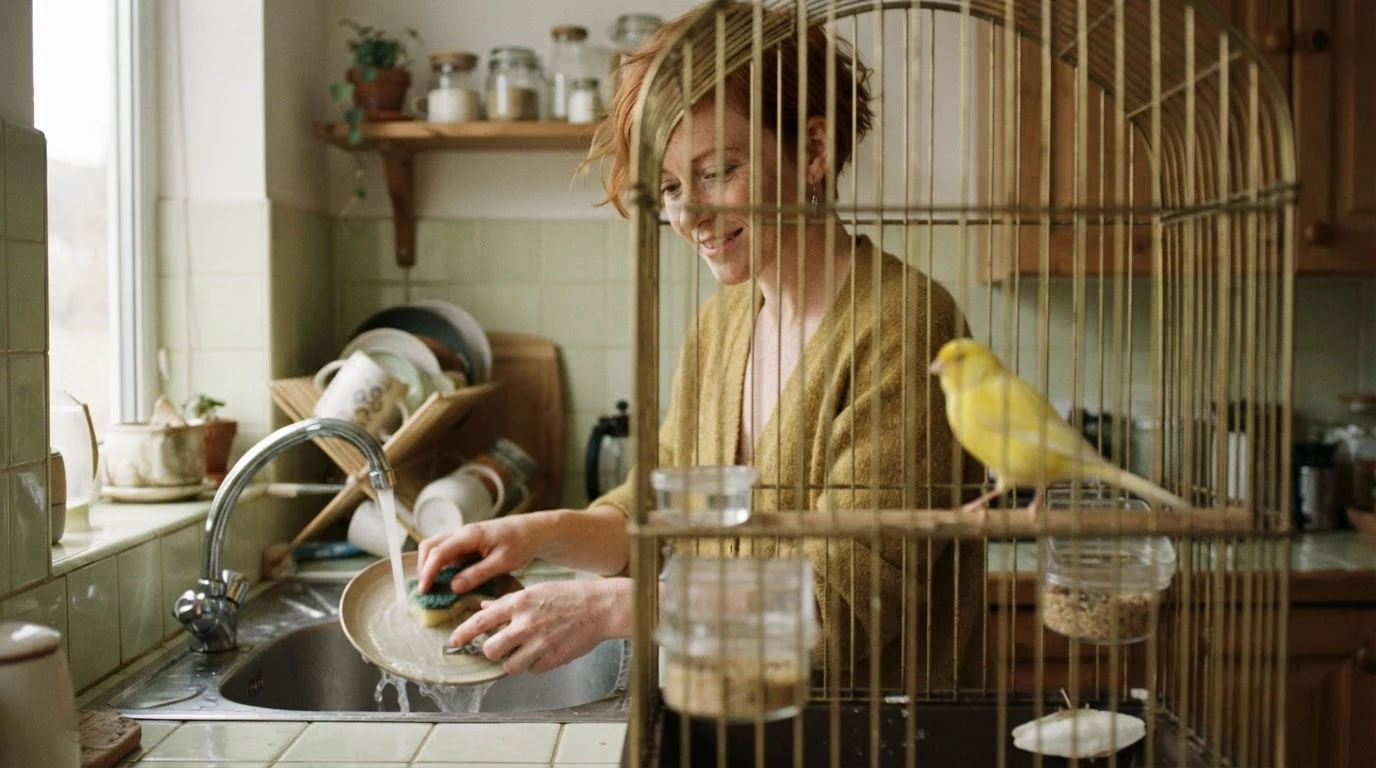
"Seen through a small brass birdcage in the sharp foreground" and "the vertical cage bars cross her face" put both halves of the metaphor in one plane; the 85mm lens compresses the cage onto her.
Open FlashBoardsTwo-panel storyboard frame split vertically by a thin white line. Left panel: high-angle wide shot of office workers in gray and navy coats crowding through a row of metal subway turnstiles, all moving left to right, heads down. Right panel: matching high-angle wide shot of a flock of gray sheep pushing through a narrow wooden pen gate, also moving left to right. Same camera height, same angle, same composition in both panels, overcast light, cinematic film stills.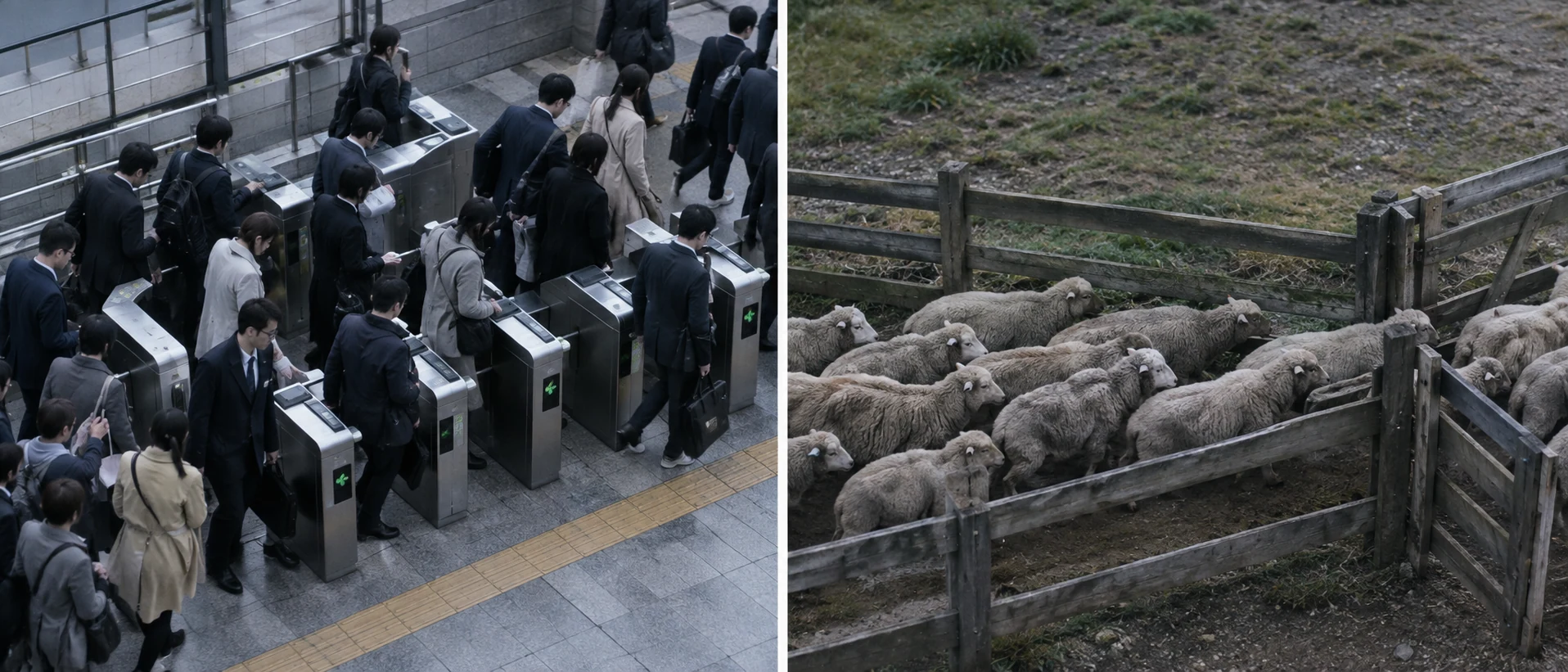
An editing metaphor is two shots, so ask for both at once. "Same camera height, same angle, same composition" and the shared left-to-right direction make the cut read as a comparison rather than a random insert.
Open FlashBoardsCamera: locked-off, with a very slow push-in toward the cage over six seconds, the bars staying across the woman's face. Action: from the first frame, the canary hops from its perch to the cage bars and flutters its wings. The woman keeps scrubbing the plate, then stops and looks up at the bird. At the end she stands still, water running over her hands, holding its gaze through the bars.The bird moves in the first second, so the shot is alive immediately; her look at the canary makes the comparison without a word.
Open FlashBoards{
"output": "Full-screen live-action close-up from Mirror (1975) from its very first frame: one continuous shot, a single unbroken take. 1970s Soviet 35mm color film, soft grain, low contrast, a dim sickroom, soft shadowless cool daylight from above, muted palette of bluish-white linen, deep bottle green and warm skin. Seen from above: a dark green quilt with a fern pattern fills the top of the frame, its cream lace-trimmed edge curving from the centre up to the top right corner; below it a rumpled white sheet fills the lower half, and a short diagonal trail of small dark-red spots runs down across it from the middle of the frame.",
"characters": {
"S1": {
"role": "the sick man lying in the bed, seen only as his bare forearm and hand",
"look": "a man's bare, pale forearm with raised veins and a large weathered hand; only the forearm and hand are ever in the frame",
"voice": "weak, hoarse male voice, barely above a whisper"
},
"V1": {
"role": "a woman standing by the bed, heard off screen only, never seen",
"look": "not in the picture",
"voice": "quiet, anxious woman's voice"
}
},
"shots": [
{
"shot": 1,
"camera": "locked-off, high angle looking down onto the bed, close shot framing the hand and the sheet around it; the frame holds almost still with only the faintest slow drift, focus fixed on the hand; the same framing at the end",
"action": [
"BEGINNING: alive from the first frame, the bare forearm reaches in from the left edge of frame and lies across the middle of the sheet; the hand, just left of centre, is closed in a loose fist around a small live brown sparrow, pressing it against the lace edge of the quilt, only a tiny dark tail tip showing under the fingers; the red spots trail away below the fist.",
"THEN: while the woman's question is heard, the fingers slowly tighten, the knuckles rise and the wrist rolls a little; a faint tremor runs through the hand.",
"THEN: the fist creeps a few centimetres to the right and settles, knuckles up, pressing into the sheet; the forearm lies still, its veins showing.",
"THEN: the hand slowly rolls outward, thumb side turning up, and the sparrow's small brown head and speckled back appear at the top of the fist between thumb and index finger; the bird sits still.",
"END: the thumb lifts off and rises, the grip loosening, while the man's weak answer is heard; the sparrow sits cradled in the loosely curled fingers as if about to be let go, and the arm stays where it is."
],
"voice": "both voices come from off screen, heard over the hand",
"dialogue": [
{
"speaker": "V1",
"on_screen": false,
"when": "from the first frame",
"delivery": "quiet, anxious, a reproachful question",
"line": "<d>[Russian] А что будет с твоей матерью, если ты не встанешь?</d>"
},
{
"speaker": "S1",
"on_screen": false,
"when": "late in the shot, as the hand turns and the sparrow's head shows between thumb and fingers",
"delivery": "weak, slow, trailing off, a tired reassurance",
"line": "<d>[Russian] Ничего, все обойдется...</d>"
}
]
}
],
"sound": {
"ambience": "the hush of a still room, a faint rustle of linen under the hand, one slow tired breath",
"speech": "exactly these spoken phrases, each said once, in this order, both from off-screen voices heard over the hand",
"never_spoken": "no narration and no voice-over: the descriptions, performance notes and step words of this prompt are never spoken aloud",
"music": "a film score under the scene, always below the voices: a slow, hushed baroque organ over low strings, grave and tender",
"subtitles": "none"
}
}Remakes the sickbed close-up from Mirror (1975), dir. Andrei Tarkovsky, DP Georgy Rerberg: the high angle, the bare forearm from frame left, the fist around a live sparrow above a trail of red spots, the grip rolling over and loosening, and the two Russian lines heard off screen carried over.
Both halves of the metaphor share one frame: a sick man's hand and the live sparrow inside it. The action phases move the grip beat by beat, tighten, settle, roll over, the thumb lifts off, so the loosening fist reads as a life about to be let go, while the film's own Russian lines play off screen.
Common mistakes
- The foreground object drifts to the side and the metaphor breaks. Say "seen through" the object "in the sharp foreground" and describe where it crosses the subject.
- Split frames lose their match. Repeat the camera height, angle and direction of movement in both panels.
Keep the reference frames, prompts and every generated take side by side — images and video in one canvas.
FAQ
5 questionsWhat is a visual metaphor in film?
A visual metaphor is a comparison made with images instead of words. The film shows the subject with something that shares one of its qualities, in one frame or across a cut, so the audience transfers that quality to the subject: a heroine behind a birdcage reads as trapped, commuters cut against sheep read as a herd.
What are some famous examples of visual metaphors in movies?
Classic examples include the cut from sheep to factory workers in Modern Times (1936), the slaughtered bull intercut with a massacre in Strike (1925), the train entering a tunnel at the end of North by Northwest (1959), and the stairs that map class in Parasite (2019).
What is the difference between a metaphor and a symbol in film?
A symbol is a single object that stands for an idea, like a snow globe standing for childhood. A visual metaphor is a comparison of two things: the film presents one thing as another. A metaphor needs both halves on screen, in one composition or joined by an edit, while a symbol can work alone.
How do you create a visual metaphor?
Name the idea in one word, then find an image that shares one visible quality with it, such as bars for being trapped. Make that image a real part of the scene and link it to the character through foreground framing, aligned shapes or a matched cut.
Is a visual metaphor the same as a simile?
No. A simile compares two things openly with 'like' or 'as', so on screen it usually appears in dialogue or voice-over. Images can't say 'like', so a comparison made through framing or editing is a metaphor: the audience makes the link themselves instead of being told.
Related terms
5- SymbolismStorytelling
Symbolism is using a concrete object, color, place or action to stand for an abstract idea — a key, a staircase, rain, a red coat — so the image carries meaning beyond itself.
- JuxtapositionEditing
Juxtaposition places two contrasting images side by side — in one frame or across a cut — so their collision creates a meaning neither has alone.
- Match CutEditing
A match cut joins two different shots through a shared shape, movement, composition or sound — the bone that becomes a satellite in 2001 — so the cut draws a link between them.
- AllegoryStorytelling
An allegory is a story whose characters and events stand, as a whole, for something else — a political system, a moral idea, a historical moment — so the literal plot carries a second meaning throughout.
- Visual StorytellingStorytelling
Visual storytelling conveys story, character and emotion through images — framing, blocking, light, color, objects and cuts — instead of dialogue; it's the core skill behind every storyboard and AI-generated shot.
Further reading
Sergei Eisenstein, Film Form (1949): essays on montage and intellectual cutting.