 FlashBoards Learn
Lighting · Film language
Chiaroscuro
Also called: chiaroscuro lighting, high-contrast lighting
Chiaroscuro is dramatic modelling with strong light and deep shadow: usually one hard source from the side or above carves a face or figure out of darkness. Borrowed from Renaissance and Baroque painting, it gives the image weight, mystery and moral tension, and it defines German Expressionism and film noir.
- What it does
- Sculpts faces and objects out of darkness with one dominant hard source, so light itself becomes the drama of the frame.
- Use it when
- Noir, crime, horror, period drama, confessions and interrogations, or any scene about secrets, guilt or a divided character.
- Watch out
- Keep the lit areas correctly exposed and the shadows placed with intent; random darkness reads as underexposure, not as chiaroscuro.
- Try this prompt
chiaroscuro lighting, single hard key from a high window camera-left, deep black shadows, no fill, face carved out of darkness, painterly
What is chiaroscuro?
The word joins two Italian adjectives: chiaro, light or clear, and scuro, dark. In painting it names modelling form through strong light and shade, so a face or a fold of cloth pushes forward out of a dark ground; in cinematography the idea is the same. Chiaroscuro is not just a dark image; it is a dark image in which a hard, directional light carves out the few things that matter.
Three features make a frame read as chiaroscuro:
- One dominant source. A single key light does the modelling, usually from the side or from above. A second source, if any, is a rim or a practical, never a flattening front light.
- Hard light with defined edges. Hard light from a small or distant source makes crisp shadow lines across cheekbones, walls and floors. The shape of the shadow is part of the composition.
- A very high ratio. The shadow side receives little or no fill light. Ratios of 8:1 and above (three stops or more) are typical, and large parts of the frame fall to black.
What separates chiaroscuro from simple darkness is modelling. Raking light makes the viewer feel volume: the round of a skull, the depth of an eye socket. Faces are often split, one half lit and one half lost, which is why the technique overlaps with side lighting and with the triangle-on-the-cheek pattern of Rembrandt lighting.
In practice it is one of the strongest looks in film lighting: the extreme end of contrast.
Where chiaroscuro comes from: painting, Expressionism and noir
Painting. Around 1600 Caravaggio pushed it to an extreme, placing figures in near-total darkness under a single high beam, a style often called tenebrism. Rembrandt made it intimate and psychological in his portraits, and Georges de La Tour built whole scenes around one candle flame.
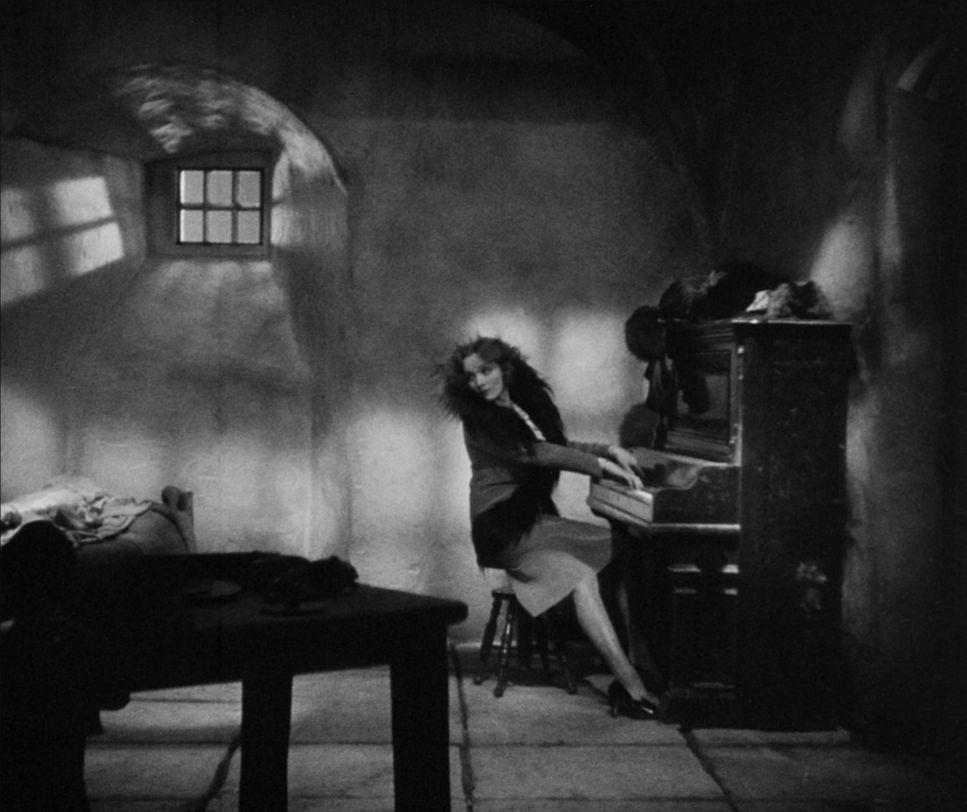
German Expressionism. In Weimar cinema, shadow became a character. German Expressionism treated light as an expression of inner states: The Cabinet of Dr. Caligari (1920) even painted streaks of light and shadow directly onto its sets, and Nosferatu (1922) shows only the vampire's shadow as he climbs a staircase toward his victim. Many of its filmmakers later worked in Hollywood and brought that graphic lighting with them.
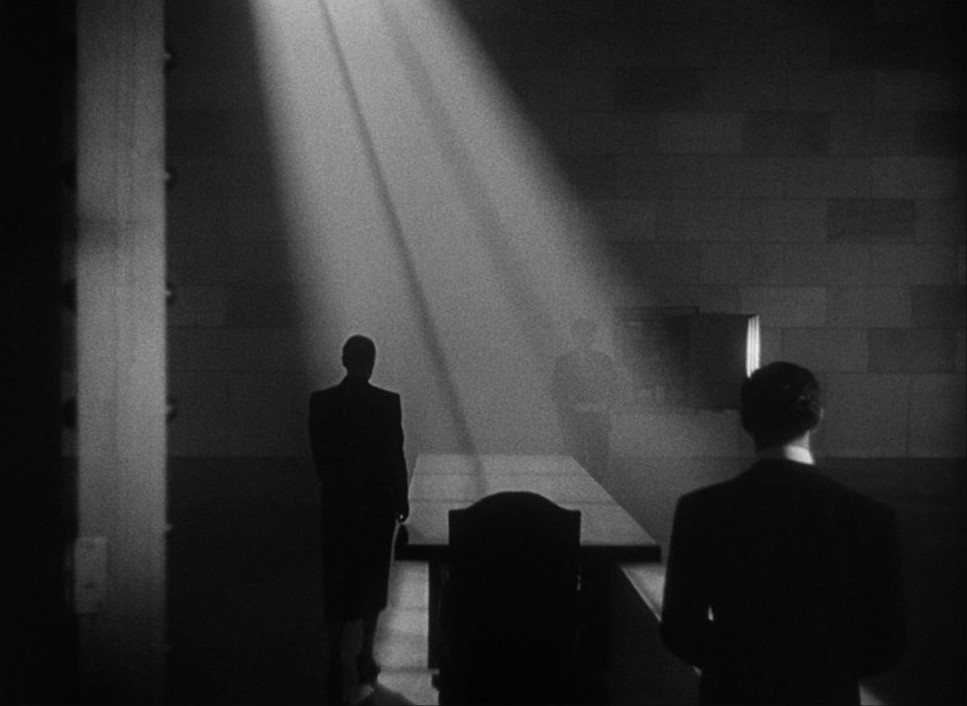
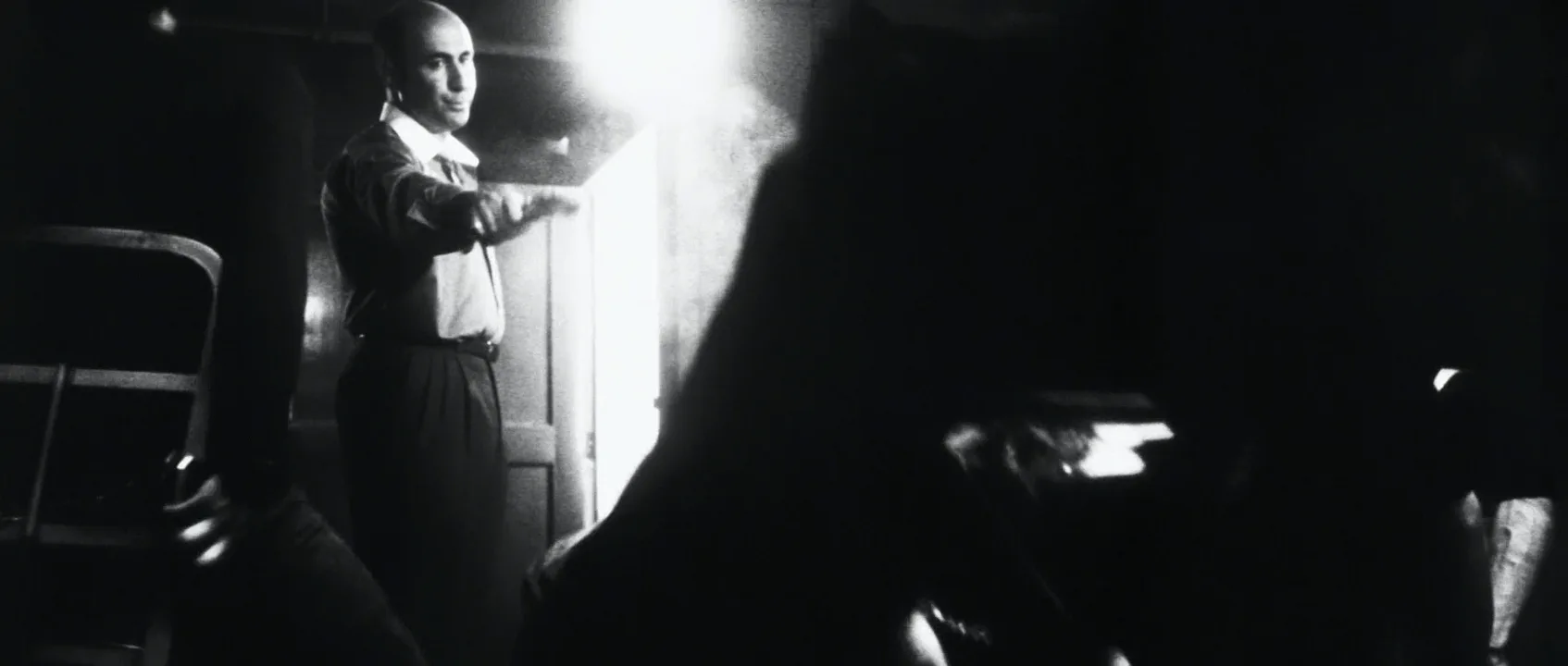
Film noir. In 1940s American crime films the Expressionist shadow met the hard studio key. Film noir lit faces through venetian blinds, from bare bulbs and street lamps, with the frame dominated by black. The Maltese Falcon (1941) and Citizen Kane (1941) came out the same year; the second opens our gallery with a shaft of light cutting through a dark room. The Third Man (1949) gives the canonical reveal: a man hidden in a dark doorway until a light from a window above suddenly falls across his face.
Color and after. Chiaroscuro did not end with black-and-white. Gordon Willis lit The Godfather (1972) with soft top light that often left the eyes in shadow, and Vittorio Storaro kept Colonel Kurtz mostly in darkness in Apocalypse Now (1979), letting only the top of his head and fragments of his face surface into the light.
Why do filmmakers use chiaroscuro lighting?
Chiaroscuro hides more than it shows. The eye goes to the brightest area of the frame, and when there is only one, the filmmaker controls attention completely. Everything left in shadow becomes a question.
Mystery and threat. What is not lit could contain anything. The audience fills the darkness with its own fears.
Moral ambiguity. A face split between light and dark is the oldest visual shorthand for a divided character. The image states the conflict before any dialogue does.
Weight and gravity. Hard modelling makes faces look carved, aged and serious. A confession, an interrogation, a decision that cannot be undone: chiaroscuro gives these moments a sense of consequence.
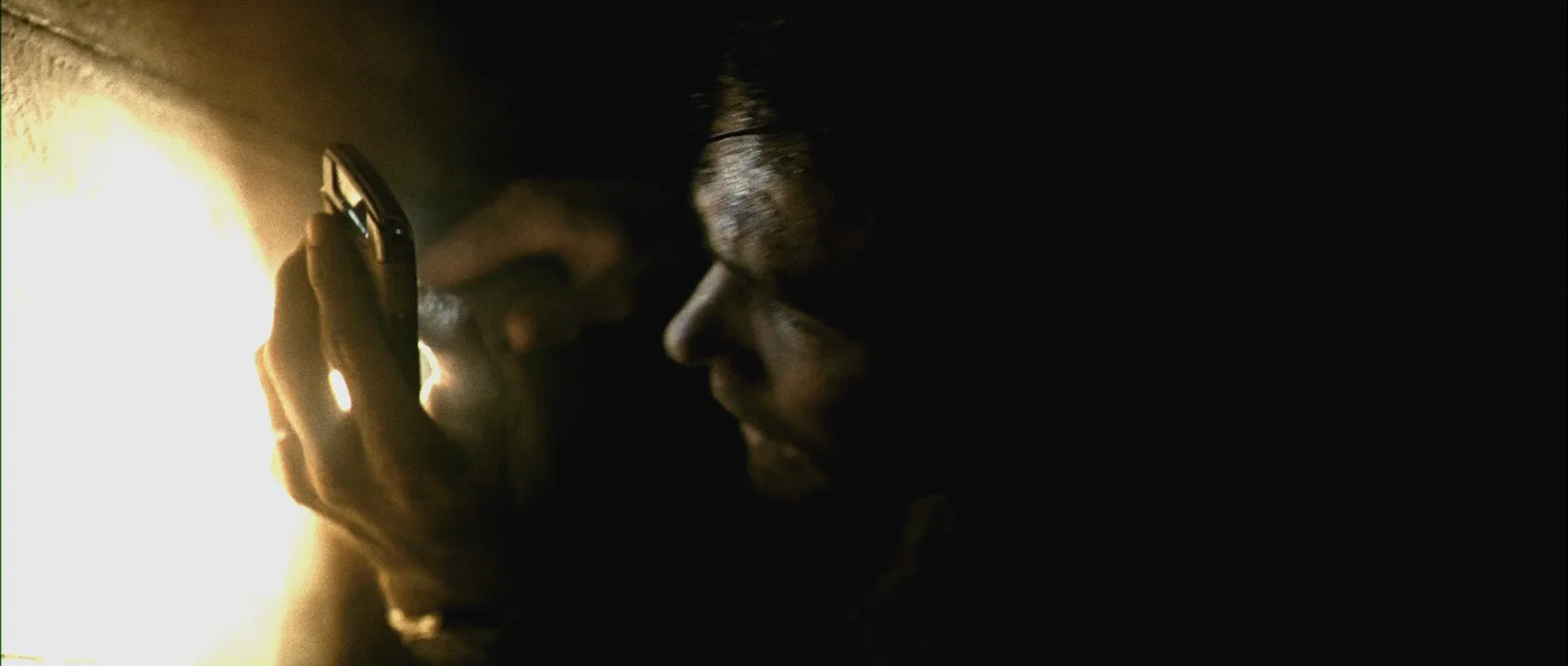
Isolation. When one pool of light holds one character and darkness surrounds them, the frame says they are alone. Buried (2010), in the gallery below, reduces the whole world to one flame and one face.
Painterly authority. The Old Master association helps period films make a room feel lit by its own era: a window, a candle, an oil lamp.
The trade-off is readability. Chiaroscuro sacrifices information for mood, so it suits scenes where what we cannot see matters as much as what we can.
How to light chiaroscuro
Chiaroscuro is built by subtraction as much as by adding light.
1. Choose one source and motivate it. Decide where the light comes from in the story (a high window, a bare bulb, a candle) and place the key there. Motivation makes extreme darkness feel real; often it is a practical lamp in frame.
2. Make the key hard and directional. A fresnel, an open-face lamp, a small LED with a tight reflector, or sun through a window. Keep it small relative to the subject, or far away. Put it 60–90° off the camera axis for a split face, or high and 45° for a Rembrandt pattern. Top light from almost straight above hides the eyes and gives the Willis look.
3. Kill the fill. Black out unwanted windows and use negative fill: black flags or solids on the shadow side to stop bounce from pale walls. Aim for a ratio of 8:1 or higher. If the key reads f/5.6, the shadow side should sit around f/2 or darker.
4. Control spill. Chiaroscuro fails when the key spills onto the background and lifts the whole set. Use barn doors, snoots, grids and flags to shape the beam so it hits the face and a sliver of the set only. A cucoloris or real blinds break spill into shadow patterns.
5. Separate the dark edge. When dark hair or a black coat merges with a black background, a thin rim light from behind, or a touch of light on the wall behind the shadow side, keeps the silhouette readable.
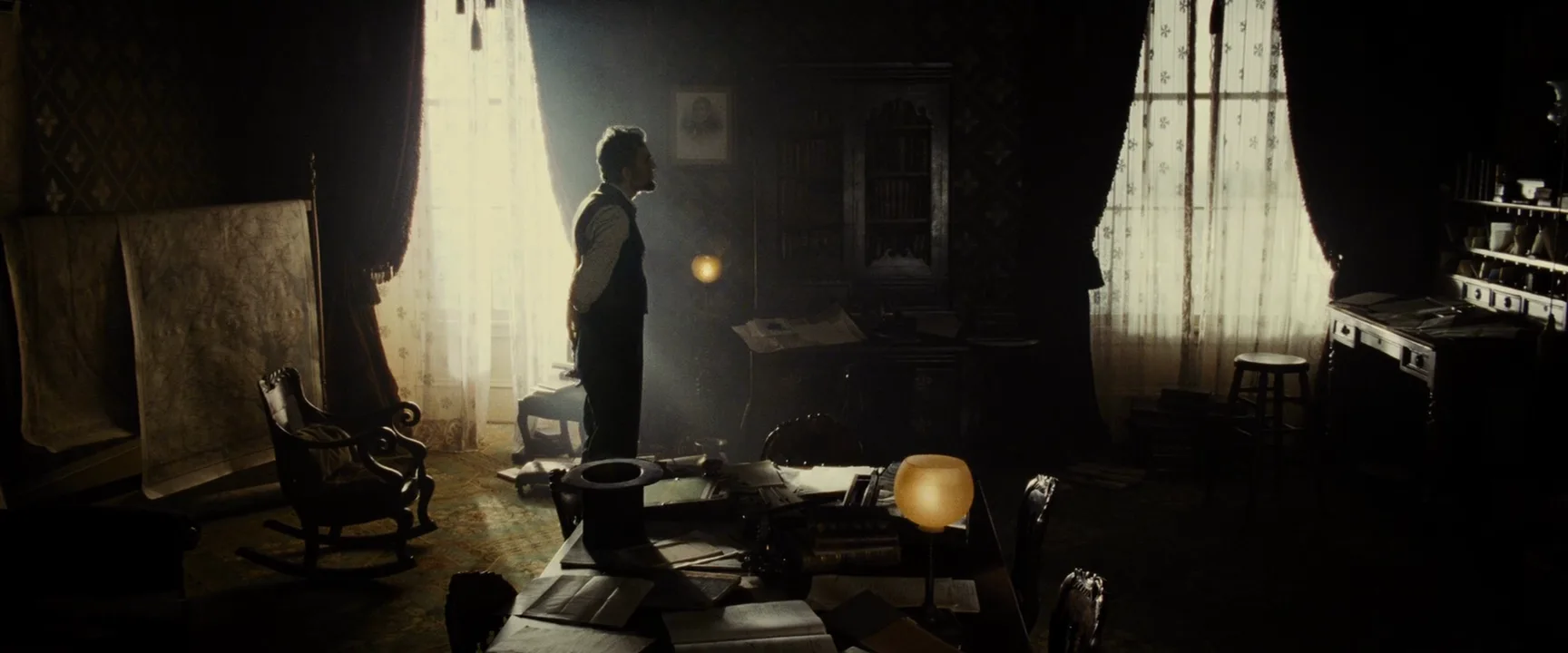
6. Add haze if you want the beam. A light haze makes shafts of light visible, as in the Citizen Kane and Lincoln frames below. Without haze, the light is only visible where it lands.
7. Expose for the highlights. Meter the lit side of the face and let the rest fall. Check shadows with false color: deep blacks with some texture near the light, not noise.
Chiaroscuro vs. low-key lighting
The two terms are often used as synonyms, and they overlap heavily, but they describe different things.
Low-key lighting describes a tonal range and a ratio: most of the frame sits in dark tones, the key is strong and the fill is weak. It is a technical category, the opposite of high key. A low-key image can be lit with soft sources and still qualify, as long as the frame is mostly dark.
Chiaroscuro describes a way of modelling. It comes from painting and emphasizes the sculpting of form: hard, directional light that carves volume out of darkness, with deliberate shapes of light and shadow. Every chiaroscuro frame is low key, but not every low-key frame is chiaroscuro.
| | Chiaroscuro | Low-key lighting | |---|---|---| | Origin | Renaissance and Baroque painting | Studio lighting terminology | | Core idea | Carving form with light and shadow | A frame dominated by dark tones | | Light quality | Usually hard, one dominant source | Hard or soft | | Shadows | Shaped, graphic, part of the composition | Can be soft and undefined | | Typical use | Expressionism, noir, painterly drama | Any dark scene: thrillers, night interiors, horror |
A dim, softly lit bar at night is low key. The same bar lit by one hard bulb that splits the bartender's face and throws his shadow on the wall is chiaroscuro.
A related term is tenebrism, from the Italian tenebroso, murky. Art historians use it for the most extreme chiaroscuro, where darkness dominates and figures emerge as if under a spotlight. On set, it is simply chiaroscuro with the fill and background taken to black.
Chiaroscuro in color and on digital
In color, light and shadow can also carry different color temperatures: a warm tungsten key against blue-black shadows reads as intimate and old, a cold window key against warm practicals as clinical or lonely. Keep the palette narrow, because chiaroscuro depends on value, not hue. On digital, resist lifting the blacks in the grade; set a firm black point and let texture live only at the edges of the light.
Silhouettes are chiaroscuro reversed: the subject is dark against a lit background. Several gallery frames combine both, a figure carved on one side and silhouetted on the other.
Chiaroscuro examples in film
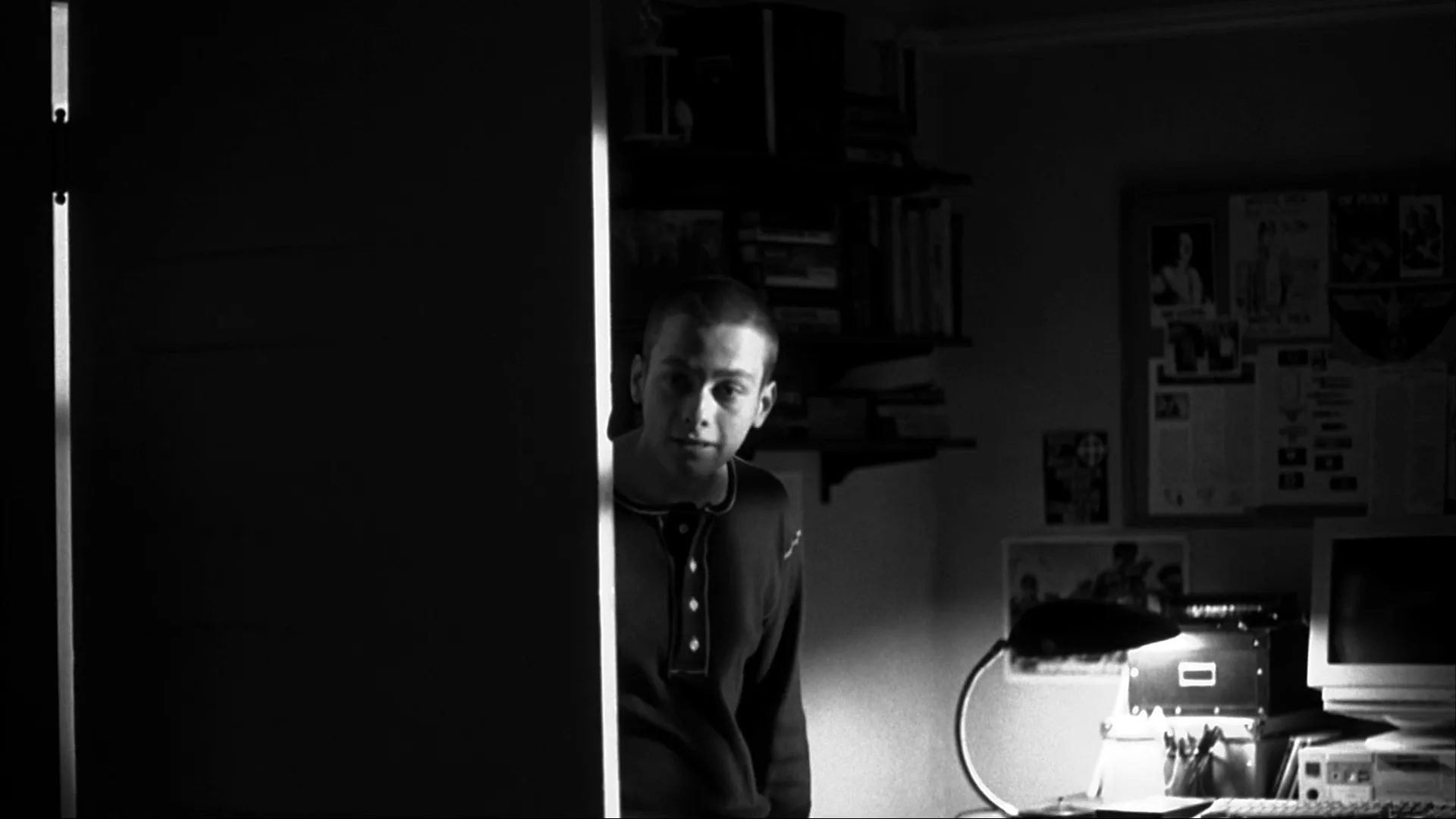
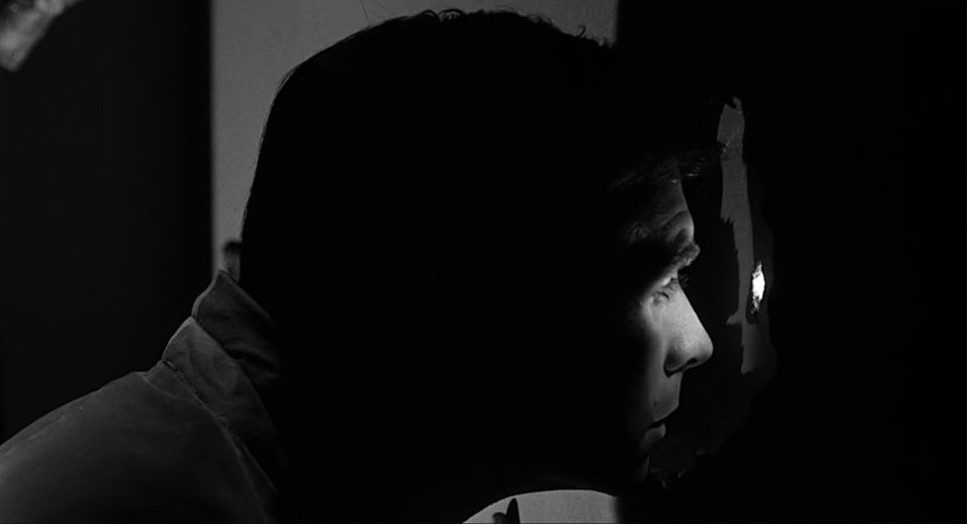
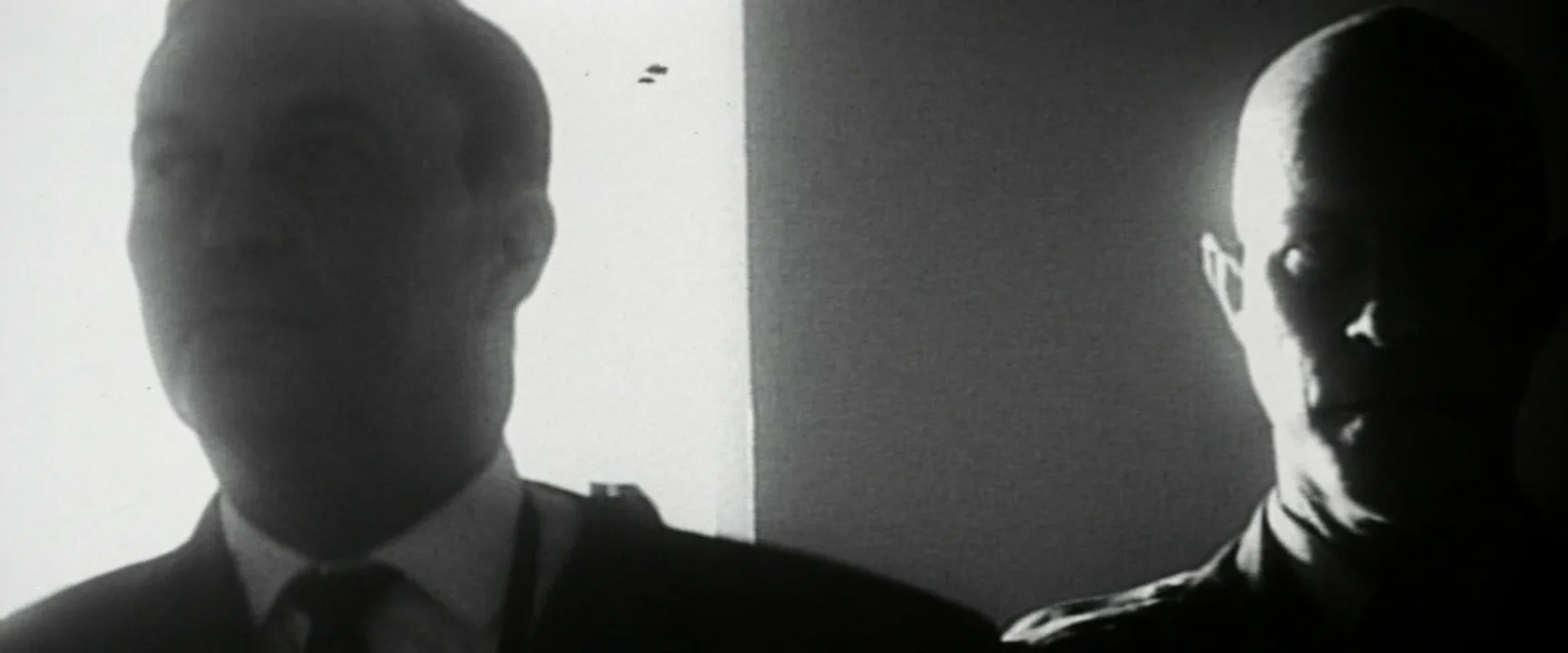
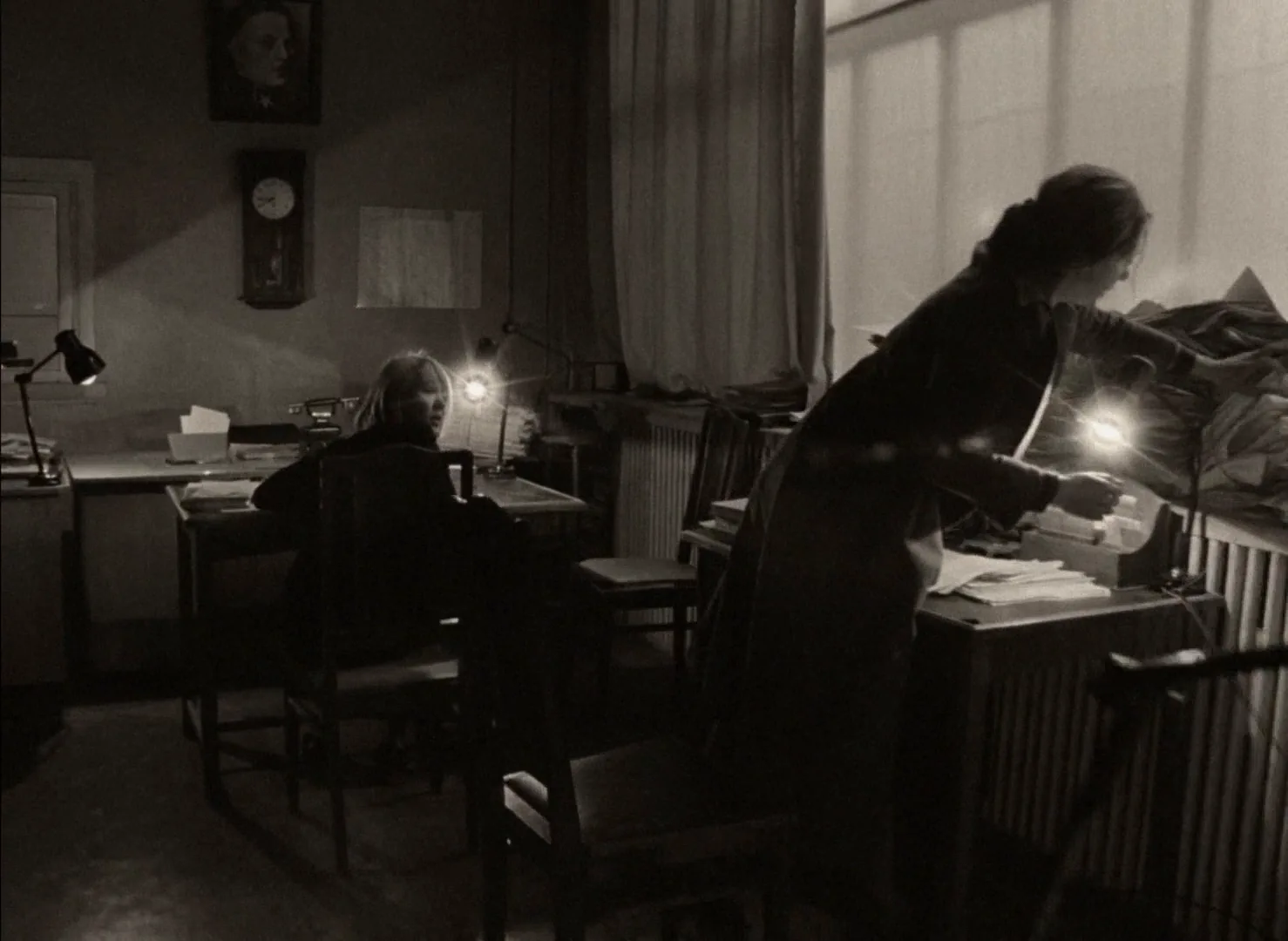
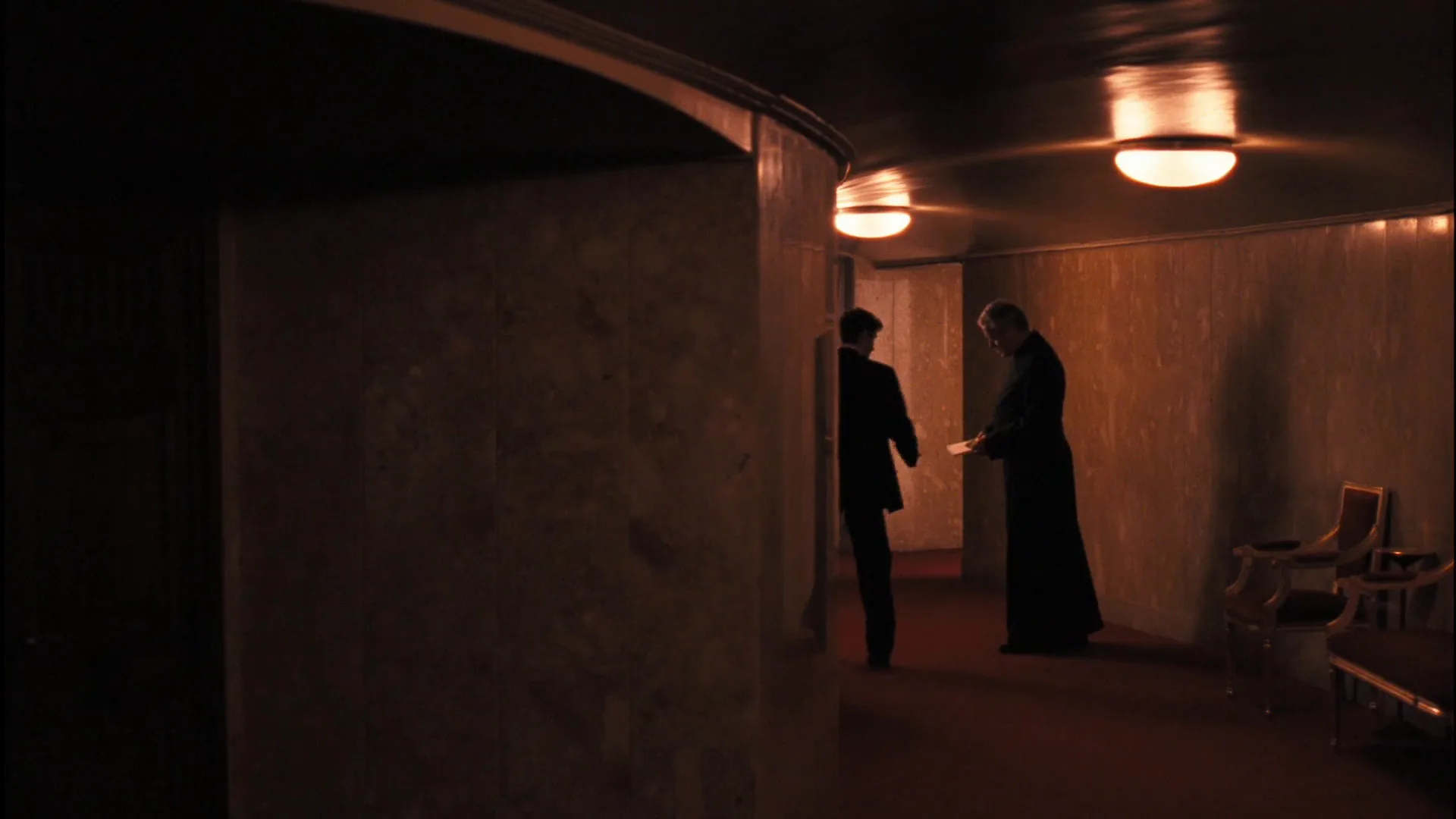
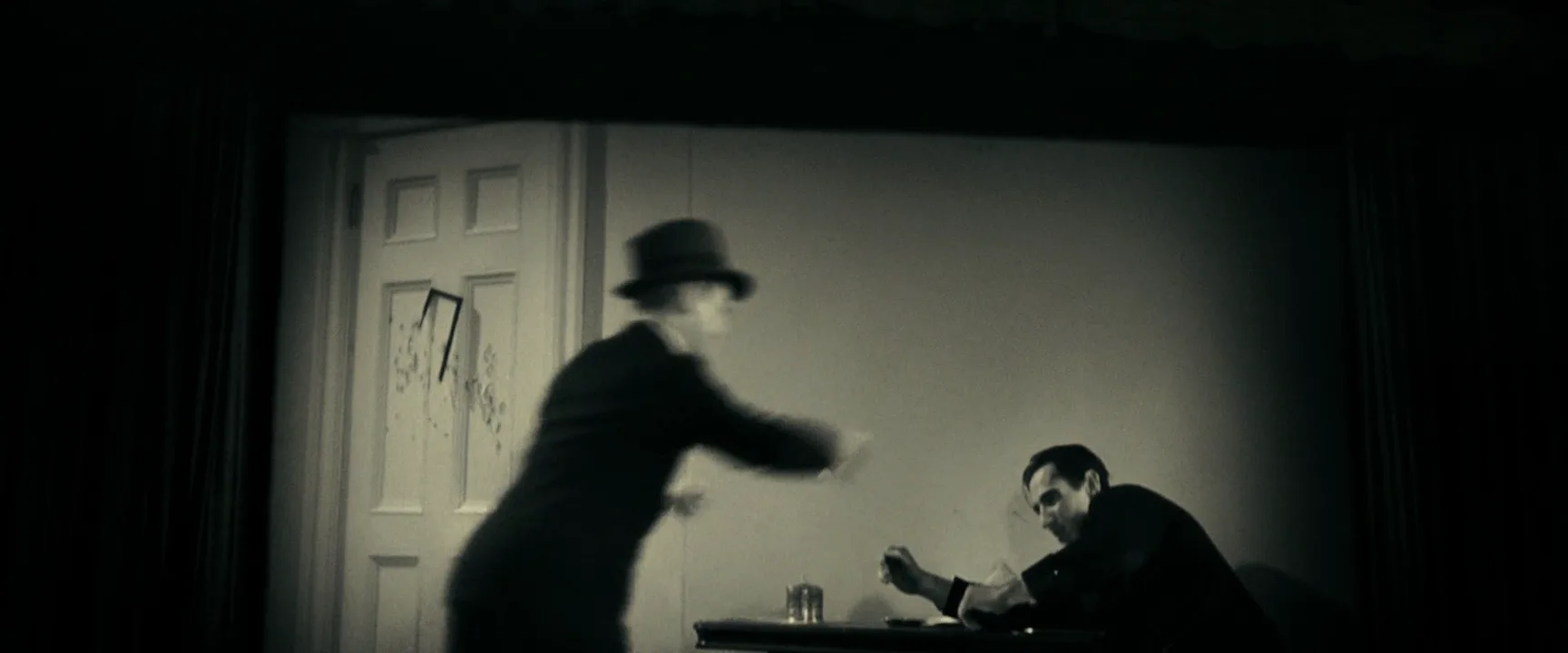
14 framesFourteen frames from 1930s studio pictures to modern thrillers and period dramas. In each one, find the single source first, then notice how much of the frame it is allowed to reach.
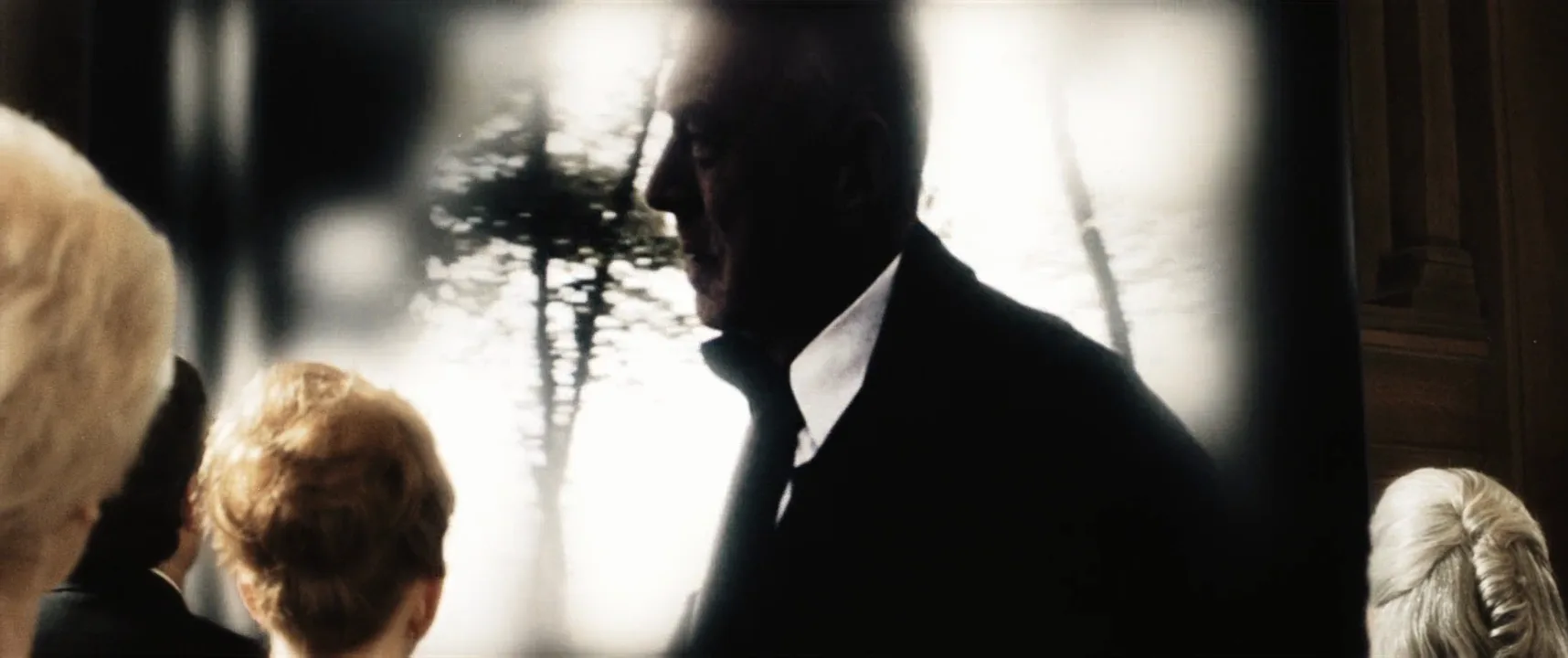
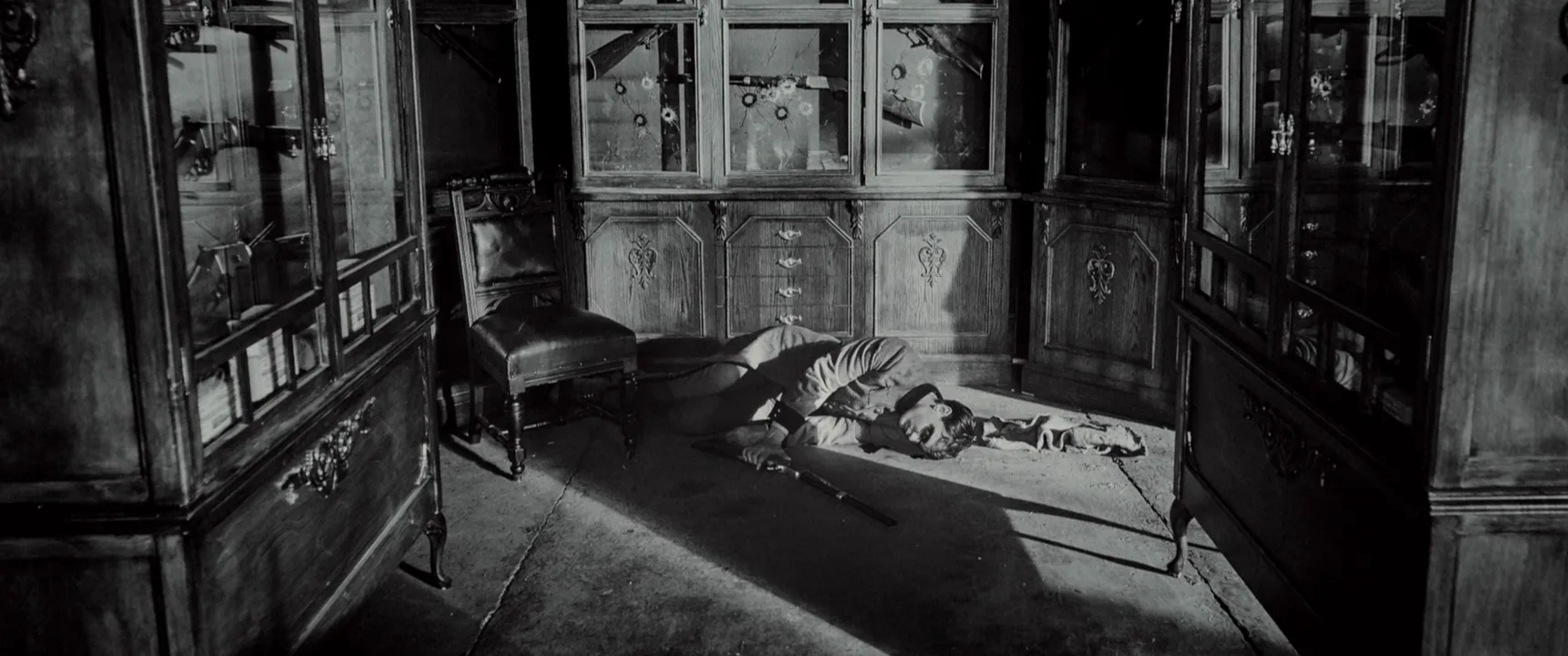
How to create a chiaroscuro with AI
4 promptsImage and video models know the word "chiaroscuro", but on its own it often produces a generically dark, moody picture with soft fill everywhere. The effect comes from describing the setup: one hard source, its position, what it hits, and what stays black. In FlashBoards, keep reference frames on the same board as your takes, build the start frame with Nano Banana 2 Lite, try a second take with GPT Image 2.5, and animate the best frame with MiniMax H3 Max Turbo. The fourth prompt re-shoots a real film shot from a text description alone, and the original plays next to the result so you can compare.
Chiaroscuro lighting, cinematic film still. A fictional clockmaker in his sixties with a shaved head, a grey horseshoe mustache and a thin scar through his left eyebrow, wearing a dark wool vest over a collarless white shirt, leans over a wooden workbench holding a small brass gear. Medium shot at eye level, 50mm lens. A single hard beam of daylight enters from a small high window camera-left and falls across his face, hands and the bench; the right side of his face drops into deep shadow. No fill, black background, visible dust in the beam, warm skin against near-black surroundings, painterly Baroque mood like an Old Master painting.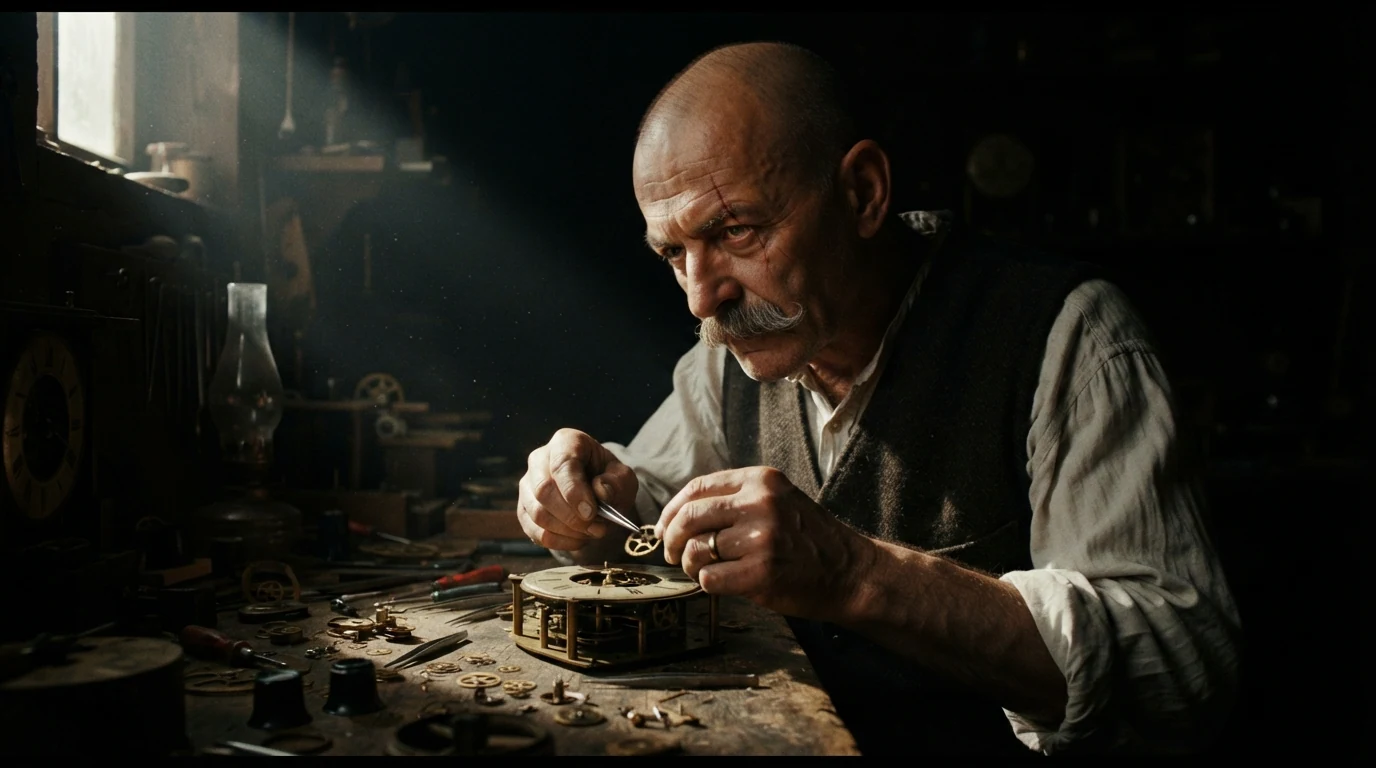
"Single hard beam" and "small high window camera-left" give the model one source and a direction, which is what creates the modelling. "Right side of his face drops into deep shadow", "no fill" and "black background" set the ratio and stop the model from lifting the shadows. "Visible dust in the beam" turns the light itself into a shape.
Open FlashBoardsBlack-and-white 1940s film noir still, extreme chiaroscuro. A fictional woman in her forties with close-cropped silver hair, a long neck and a dark trench coat stands halfway up a narrow stone staircase, one hand on the rail, turning her head toward the camera. Wide shot, 35mm lens, camera slightly below her at the foot of the stairs. One bare bulb hangs above and to the right, a hard source that lights half of her face and throws her enormous sharp shadow onto the pale wall beside her. Everything outside the light is pure black; deep blacks, bright highlights, crisp shadow edges, high contrast.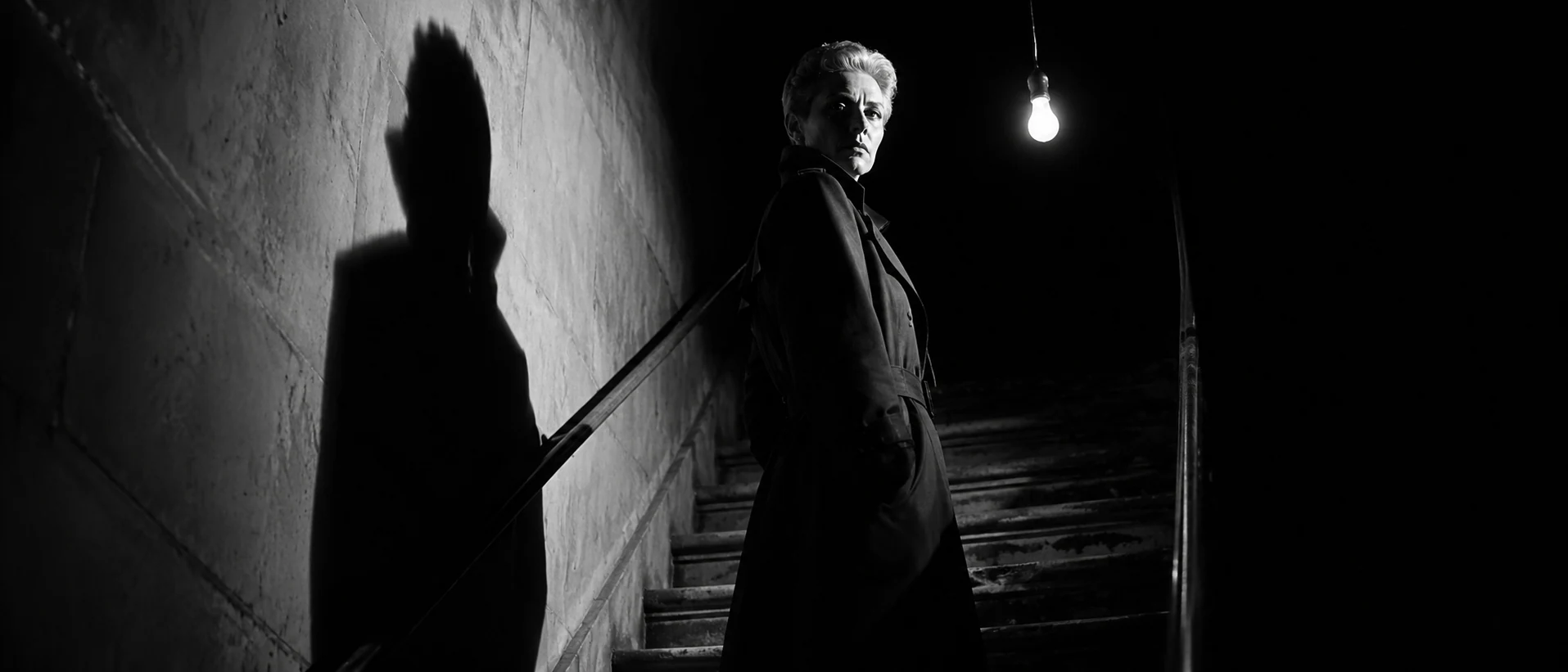
This take moves from a painterly close study to the Expressionist and noir branch: monochrome, a wider lens and the giant cast shadow, which is as much a part of chiaroscuro as the lit face. "Lights half of her face" gives the split, "crisp shadow edges" keeps the source hard, and 21:9 leaves room for the shadow.
Open FlashBoardsCamera: slow, steady push-in from medium shot to medium close-up across the whole shot, ending on the clockmaker's face and hands. Action: The clockmaker is already turning the small brass gear between his fingers inside the beam of light. He lifts it higher into the light, dust drifting slowly through the beam around it. He raises his eyes toward the window, and the light slides across his cheekbone and forehead while the right side of his face stays in deep shadow. He lowers the gear back to the bench and holds still in the light.The action starts immediately ("is already turning") so the shot is alive from the first frame. Everything named is already in the start frame: the gear, the beam, the dust, the window light. Restating that "the right side of his face stays in deep shadow" keeps the ratio from drifting brighter as the head moves.
Open FlashBoards{
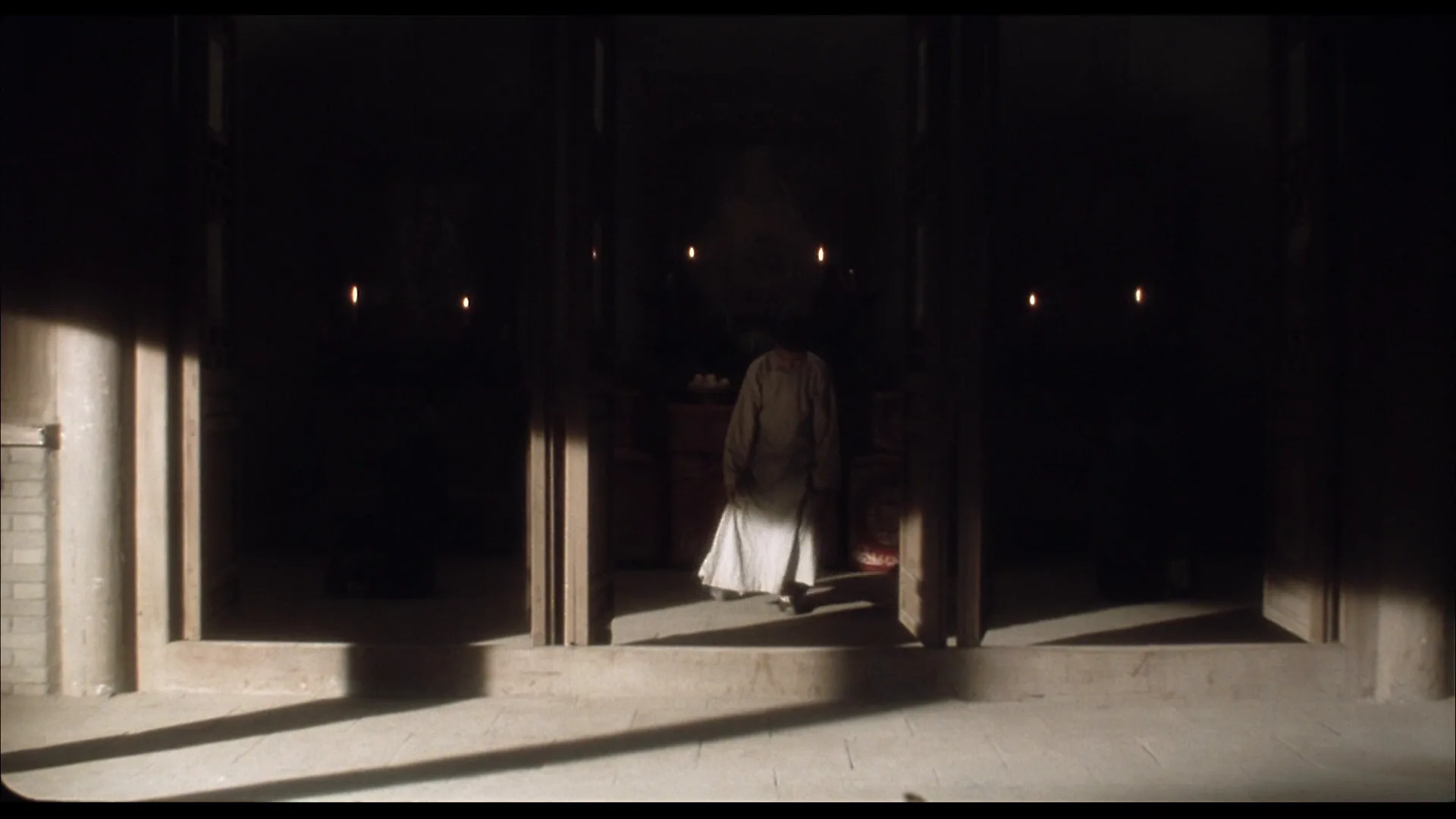
"output": "Full-screen live-action shot from Farewell My Concubine (1993), alive from its very first frame: one continuous shot, no cuts. Grainy early-1990s 35mm color film, extreme chiaroscuro with a very high contrast ratio: the upper two thirds of the frame are near-black shadow with no fill light at all. The only light is low, hard late-afternoon sun raking in from the left at floor level: it lights the pale stone floor of an open porch that fills the bottom third of the frame, cut by long diagonal shadow bars, catches only the left face of one wooden column at the far left edge of frame, and reaches into the doorway only as a low, knee-high wedge of light on the hall floor. Every other column, the door frame, the walls and the ceiling are black silhouettes. Beyond the wide doorway the hall is in deep darkness: five tiny candle flames float as points of light in the black, a barely visible altar table sits at the back, a faint red ember glows low to the right of centre. Warm brown and amber palette.",
"characters": {
"S1": {
"name": "an unnamed young man (the film's subtitles and cast list name no character in this shot)",
"look": "slim, short dark hair, a long pale cream traditional Chinese gown to the ankles, dark cloth shoes, nothing in his hands",
"voice": "silence: he never speaks"
}
},
"shots": [
{
"shot": 1,
"camera": "locked-off static wide shot from far back on the porch, eye level, normal lens: the lit porch floor fills the bottom third of frame, the dark doorway with its columns fills the rest; the frame never moves, pans or zooms; the man is small in frame, his whole figure about one third of frame height, in the centre of the doorway beyond the porch; deep focus, the candle points stay sharp",
"voice": "silence: nobody speaks in this shot, no voice at all",
"action": [
"BEGINNING: alive from the first frame, S1 is already walking slowly from just left of the right-hand door column toward screen left and deeper into the hall, back to camera, arms hanging loose at his sides; only the hem of his pale gown, below the knees, is in the wedge of sunlight and glows; his back, shoulders and head are a dim brown shape almost lost in the shadow.",
"THEN: he reaches the centre of the doorway and keeps walking slowly away from camera toward the dim altar, back to camera, head level, still only his gown hem lit.",
"THEN: he stops at the centre in front of the altar and turns around on the spot, turning toward camera, until he faces straight out through the doorway, head slightly bowed, gaze down at the floor in front of him.",
"THEN: facing camera, he sinks slowly down onto his knees in the patch of sunlight, both hands gathering the gown at his thighs, one on each side, so the pale cloth spreads over his knees.",
"END: he kneels upright and still in the centre of the doorway, facing camera, head slightly bowed, both hands resting on the spread gown at his sides; the gown spread over his knees in the wedge of sunlight blazes as the brightest thing in the frame, while his face and chest stay dim and half lost in shadow and the hall behind him stays black around the candle points."
],
"dialogue": []
}
],
"sound": {
"ambience": "a quiet, still stone hall: soft footsteps on stone, a rustle of cotton as he turns and kneels, faint wind heard from outside",
"speech": "no words in this video; the only human sounds are breaths and movement",
"never_spoken": "no narration and no voice-over: the descriptions, performance notes and step words of this prompt are never spoken aloud",
"music": "a film score under the scene, always below the voices: a slow, sparse solo erhu line over a low sustained string drone",
"subtitles": "none"
}
}Remakes the static wide shot from Farewell My Concubine (1993), dir. Chen Kaige, DP Gu Changwei: the locked-off frame, the black hall with candle points, the low raking sun that lights only the gown hem, and the young man who walks in, turns and kneels, with no dialogue and an added score line.
A first take lit the whole gown and the columns, which read as warm and moody rather than chiaroscuro. This prompt fixes the ratio in the frame: a lit floor in the bottom third, near-black above, and sun reaching only knee-high, so the gown hem is the brightest thing while his face stays in shadow.
Open FlashBoardsCommon mistakes
- Fill creeps back in. State the dark side explicitly ("the right side of his face drops into deep shadow", "black background", "no fill") rather than only saying "dramatic".
- Several light sources appear. Name exactly one source and its position; a second one should be a thin rim from behind.
- Soft light instead of hard. "Moody" and "cinematic" often mean soft, diffused light to a model. Ask for "hard light", "crisp shadow edges" and a small or distant source.
- Everything becomes murky. Dark with no clear lit area is underexposure. Say what the light hits (face, hands, a strip of floor) and that those areas are bright.
- Video brightens over time. Shadows may open up as the subject moves; restate the shadow side in the action lines.
Keep the reference frames, prompts and every generated take side by side — images and video in one canvas.
FAQ
6 questionsWhat does chiaroscuro mean?
Chiaroscuro is Italian for "light-dark", from chiaro (light, clear) and scuro (dark). In painting and film it means modelling a subject with strong contrasts of light and shadow, so forms emerge from darkness with a sense of volume. In cinematography it usually refers to one hard, directional light that carves a face or figure out of a mostly dark frame.
What is chiaroscuro lighting in film?
Chiaroscuro lighting in film is a setup with one dominant hard source, usually from the side or above, very little fill and a high lighting ratio of 8:1 or more. The lit areas are sculpted and bright while large parts of the frame fall to black. It is the signature look of German Expressionism and film noir, and it is still common in thrillers, horror and period drama.
What are some famous examples of chiaroscuro in film?
Classic examples include The Cabinet of Dr. Caligari (1920), which painted shadows onto its sets; Nosferatu (1922), with the vampire's shadow on the stairs; Citizen Kane (1941); The Maltese Falcon (1941); the doorway reveal in The Third Man (1949); Gordon Willis's top-lit interiors in The Godfather (1972); and Colonel Kurtz emerging from darkness in Apocalypse Now (1979).
Is chiaroscuro the same as low-key lighting?
Not quite. Low-key lighting describes a frame dominated by dark tones with a high key-to-fill ratio, and it can be soft or hard. Chiaroscuro is a narrower, painterly idea: hard, directional light that sculpts form and creates deliberate shapes of light and shadow. Every chiaroscuro image is low key, but a softly lit dark room is low key without being chiaroscuro.
How do you create chiaroscuro lighting?
Use one hard source, such as a fresnel, a bare bulb or sun through a small window, placed 60 to 90 degrees to the side or high above the subject. Remove fill with black flags on the shadow side, control spill with barn doors and snoots so the background stays dark, and expose for the lit side of the face. Add haze if you want the beam itself to be visible.
What is the difference between chiaroscuro and tenebrism?
Tenebrism is the most extreme form of chiaroscuro. The term comes from art history, especially Caravaggio and his followers, and describes images where darkness dominates and figures appear as if caught in a spotlight. Chiaroscuro covers the whole range of strong light-and-shade modelling. On a film set, tenebrism simply means chiaroscuro with the fill and background taken all the way to black.
Related terms
7- Low-Key LightingLighting
Low-key lighting keeps most of the frame in shadow, with a strong key, little or no fill and a high lighting ratio, so only fragments of faces and objects emerge from the dark — the language of noir, thrillers and horror.
- ContrastLighting
Contrast is the difference between the brightest and darkest parts of an image — set on set by the ratio between key and fill — and ranges from flat, gentle low contrast to hard, graphic high contrast.
- Rembrandt LightingLighting
Rembrandt lighting places the key high and about 45° to one side, so the far cheek falls into shadow except for a small triangle of light under the eye — a moody, painterly portrait look named after the Dutch painter.
- Side LightingLighting
Side lighting puts the key roughly 90° to the side of the subject, splitting the face into light and shadow and raking across texture — the most direct way to reveal volume and inner conflict.
- Film NoirFilm Movements & Styles
Film noir is the cycle of 1940s–50s American crime films — named by French critics — defined by fatalistic plots, morally compromised heroes, femmes fatales and low-key black-and-white lighting full of hard shadows.
- German ExpressionismFilm Movements & Styles
German Expressionism is the 1920s Weimar cinema movement that externalized inner states through distorted painted sets, slanted lines, stark chiaroscuro and stylized acting — The Cabinet of Dr. Caligari, Nosferatu, Metropolis.
- Film LightingLighting
Film lighting is the craft of shaping light for the camera — its direction, quality, color and contrast — to model faces, build space, set the time of day and carry the mood of a scene.
Further reading
John Alton, Painting with Light (1949). Blain Brown, Motion Picture and Video Lighting (3rd ed., 2018). Lotte H. Eisner, The Haunted Screen (1952).