 FlashBoards Learn
Editing · Film language
Smash Cut
Also called: crash cut, hard cut
A smash cut is an abrupt cut from one scene to a sharply contrasting one: quiet to loud, calm to chaos, a promise to its opposite. It lands at the peak of a moment, with no transition and no warning, so the collision itself becomes the joke, the scare or the punctuation mark.
- What it does
- Jolts the viewer by slamming two opposite moments together at full volume, with no bridge between them.
- Use it when
- You want a laugh from a broken promise, a scare out of calm, or a hard reset of tone between scenes.
- Watch out
- If the two shots aren't opposite on sound, light and energy, it reads as an ordinary cut that came too early.
- Try this prompt
Quiet porch at dusk, a woman with a silver pixie cut holds a cup of tea, warm low sun, 85mm, still, cinematic still
What is a smash cut?
In film editing, a smash cut is a straight cut that joins two shots as different from each other as possible, placed where the audience least expects the scene to end. The first shot builds a mood, often hushed, slow or intimate. The second arrives mid-action, loud and bright, as if someone threw open a door. There is no dissolve, no fade and no sound easing in to warn you.
What makes it a smash, rather than just a cut to a new scene, is contrast on several axes at once:
- Sound: silence or a whisper against noise, music or a scream.
- Energy: stillness against motion, a held close-up against a crowded wide.
- Light and color: night against day, warm against cold, dark against blown-out bright.
- Meaning: a promise against what actually happens, a fantasy against reality.
The cut usually lands mid-sentence or on the peak beat, a few frames before the scene would naturally resolve. That early exit is what makes it feel violent. Editors also call it a hard cut or a crash cut, though “hard cut” is also used loosely for any cut without a transition.
A smash cut is a special case of juxtaposition: the meaning comes from the collision of two shots, not from either shot alone. The difference is timing and force. Juxtaposition can be calm and reflective; a smash cut wants a physical reaction.
Why do filmmakers use smash cuts?
The smash cut works on the body before the mind. The ear registers the jump in volume first, the eye catches up a fraction of a second later, and only then does the viewer read what the contrast means. Filmmakers use that delay in four ways.
Comedy: the broken promise
The oldest comic form is the “Gilligan cut,” named after the running gag in Gilligan’s Island: a character swears they will never do something, and the very next shot shows them doing it. Arrested Development built running gags on narration contradicted by the very next shot, and Edgar Wright’s Hot Fuzz (2007) uses rapid, heavily punctuated cuts with exaggerated sound effects to turn paperwork and small-town routine into action beats. For comedy the cut must come on the last syllable of the line, before the audience has time to anticipate.
Horror and shock: calm into violence
Horror uses the smash in the other direction. A quiet, lingering image lowers the viewer’s guard, and the cut delivers the threat at full level. Kubrick’s The Shining (1980) punctures Danny’s encounter with the twins in the corridor with sudden inserts of a bloody aftermath, gone before you can study them. The familiar nightmare structure is the same device reversed: horror at its peak, then a smash cut to the dreamer sitting bolt upright in a silent bedroom.
Tone reset between scenes
A smash cut can end a scene that has run its course without wind-down. Going from a tense argument straight into a roaring party says the story has moved on before the characters have. It is also a classic way out of a cold open: the teaser hits its peak and the show smashes to the title card.
Smash cut to black
The hardest version cuts not to another scene but to nothing. The series finale of The Sopranos (2007) ends mid-moment on an abrupt cut to black and silence, and viewers famously thought their TV had died. A cut to black at a peak denies the audience the release a fade would give them, so the tension stays with them after the image is gone.
How to shoot and edit a smash cut
A smash cut is designed on set, not rescued in the edit. If both sides of the cut are shot with the same light, lens and energy, no amount of timing will make it slam. Plan it as a pair.
Build the A-side for contrast. The shot before the cut should be as still and contained as the scene allows: a locked-off camera, a longer lens (75–100mm) for a compressed, intimate close-up, soft low-key light, a limited palette. Keep the sound bed quiet on set so the editor can take it down to room tone or a whisper. Stillness is the loaded spring.
Build the B-side as its opposite on every axis you can. If A is a close-up, open B on a wide with a 24mm or wider. If A is dark and warm, make B bright and cold, a 3–4 stop jump in exposure is easy to feel. If A is static, B should already be moving on its first frame: a handheld operator mid-run, a crowd crossing the lens, a car entering frame. Start the action before rolling so the take opens at full speed.
Cut on the peak, slightly early. Leave A two to six frames before the line or the gesture completes. The audience finishes the thought, and that is where the jolt happens. For comedy, cut on the last stressed syllable; for shock, cut on the breath before the scream.
Let sound do half the work. Kill ambience and music a beat before the cut, even a few frames of near-silence make the next shot louder. On B, hit full level on the first frame, often with a designed impact: a slam, a horn, a crowd roar. Avoid a sound bridge or an L-cut here; letting audio overlap softens exactly the edge you want.
Hold B long enough to read. The first half second after a smash is disorientation. Don’t cut away again until the viewer has understood where they are, typically at least 1.5–2 seconds, unless you are deliberately stacking smash cuts into a burst of fast cutting.
Ration it. A smash cut is punctuation. Three in a scene and it becomes the scene’s rhythm, which is a valid style but no longer a shock. Watch the overall pacing: the device lands hardest after a stretch of patient, uncut time.
Crash cut: the smash cut with an impact
“Crash cut” is another name for a smash cut, and in practice editors often use it for a version that adds an extra hit on top of the contrast: a whoosh, a slam, a drum stab, or a crash zoom that punches into a face or detail right before or right after the cut. The zoom acts like a wind-up; the cut is the punch.
The crash version is common in comedy, trailers and music videos. Edgar Wright’s films are the textbook example in features: tight inserts, snap zooms and hard sound effects turn ordinary actions like stamping a form or opening a door into punchlines.
Two practical rules:
- Sync the hit to the frame of the cut. An impact sound that lands two frames late feels like a mistake, not a style. Put the transient exactly on the first frame of the new shot.
- Keep the zoom short. A crash zoom of 6–10 frames is enough. Longer, and it becomes a camera move the viewer watches instead of an accent they feel.
Smash cut vs. match cut: what’s the difference?
A match cut joins two shots through something they share: a shape, a movement, a composition, a sound. Its effect is continuity of form across a jump in time or place, and it invites the viewer to link the two ideas. The bone thrown into the air in 2001: A Space Odyssey (1968) becomes an orbiting satellite; in Lawrence of Arabia (1962) a blown-out match becomes a desert sunrise. The eye glides across the cut.
A smash cut does the opposite: it joins two shots through what they don’t share. Volume, energy, light and mood all break at once, and the eye crashes rather than glides.
The two can combine. In Hitchcock’s The 39 Steps (1935), a landlady discovers a body and opens her mouth to scream, and the sound becomes the shriek of a train whistle as the film cuts to a speeding locomotive. The audio matches, while everything else, place, pace, scale, smashes.
| | Smash cut | Match cut | |---|---|---| | Joins shots through | Contrast | Similarity | | Viewer feels | A jolt | A glide | | Typical use | Comedy, shock, tone reset | Metaphor, time jump, elegant transition | | Sound | Jumps in level | Often carried or matched |
Smash cut vs. jump cut
A jump cut is abrupt too, but it stays with the same subject from nearly the same angle, so what the viewer notices is time skipping forward. A smash cut changes everything: subject, place, sound and mood. One breaks continuity inside a shot; the other breaks the emotional continuity of the film.
Smash Cut in motion



6 clipsA still can only show one side of a smash cut; these clips play the cut itself. Watch the last frames before each cut, then feel how far the next shot jumps in scale, noise, color or mood, with no transition to soften it.
How to create a smash cut with AI
4 promptsAn AI video model makes one shot at a time, which suits a smash cut: the effect is always two shots designed as opposites. Generate the quiet A-side and the loud B-side on one FlashBoards board, place them next to each other in edit order and judge the contrast before animating anything. The recipes below build a broken-promise smash: a woman savoring a quiet evening, then the same woman in a roaring restaurant kitchen. The fourth prompt re-shoots a real film shot from a text description alone, and the original plays next to the result so you can compare.
Cinematic close-up at dusk, a woman in her mid-thirties with a cropped silver-dyed pixie cut, a thin scar through her left eyebrow and small gold hoop earrings, wearing a mustard wool cardigan, sits on a wooden porch swing holding a steaming mug of tea with both hands, eyes half closed, content smile, 85mm lens at eye level, locked-off camera, soft warm low sun from frame left, shallow depth of field, empty meadow softly blurred behind her, calm muted amber palette, film grain
This is the A-side, and every word pushes toward stillness. 85mm, locked-off, shallow depth of field give a compressed, intimate close-up; soft warm low sun and calm muted amber palette keep the image gentle. Empty meadow matters too: an uncluttered background is the opposite of the crowded kitchen to come. The detailed face (silver pixie cut, scar through her left eyebrow, gold hoops) makes the character clearly fictional and repeatable in the next shot.
Open FlashBoardsCinematic wide shot, chaotic restaurant kitchen at the peak of dinner service, a woman in her mid-thirties with a cropped silver-dyed pixie cut, a thin scar through her left eyebrow and small gold hoop earrings, in a stained white chef jacket, shouting orders with both arms raised, flames leaping from three pans in front of her, cooks rushing past in the foreground, steam and smoke everywhere, harsh cold fluorescent overhead light mixed with orange fire, 24mm lens, slightly tilted handheld framing, motion blur on the moving cooks, crowded frame, high contrast, film grain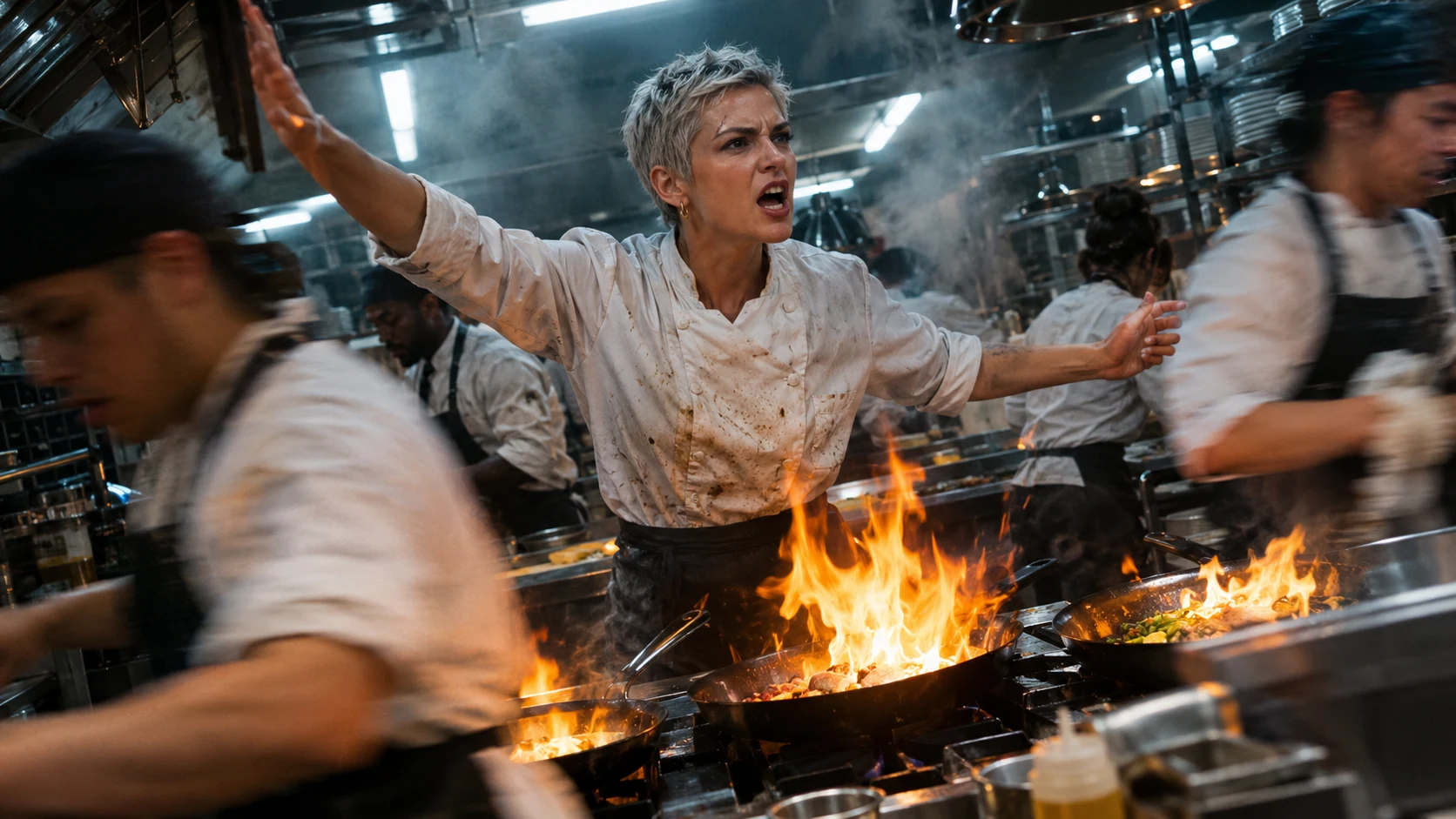
This is the B-side, written as the opposite of recipe 1 on every axis: wide, 24mm instead of a long-lens close-up, harsh cold fluorescent instead of warm sun, flames, steam, cooks rushing past instead of an empty meadow, shouting, arms raised instead of a half-closed smile. Motion blur and tilted handheld framing make the still feel like it is already moving. The character description is copied word for word so the cut reads as the same person, which is what turns the contrast into a joke.
Open FlashBoardsCamera: static locked-off shot, the framing holds on her face for the whole clip. Action: the porch swing is already rocking gently from the first frame and steam curls up from the mug. She lifts the mug, takes a slow sip, lowers it and lets out a long, satisfied breath. She leans her head back against the swing, closes her eyes fully and smiles, completely at peace.Already rocking from the first frame and steam curls up keep the shot alive so the model doesn’t drift into a slow push-in on the still. Static locked-off shot preserves the stillness the smash depends on. The action ends on the most peaceful beat, closes her eyes fully and smiles: that is your cut point. In the edit, leave this clip a few frames before the smile settles and slam into the kitchen frame with a loud sound hit.
Open FlashBoards{
"output": "Full-screen live-action scene from Argo (2012) from its very first frame: two shots joined by one hard cut, a smash cut from a tight, quiet two-shot to an enormous crowd. Anamorphic 35mm, 1979 Tehran, warm brown and faded blue palette, soft overcast daylight under a covered bazaar, gentle film grain.",
"characters": {
"S1": {
"name": "Mark Lijek, played by Christopher Denham",
"look": "slim man in his late twenties, short dark hair, full dark beard, wire-rimmed glasses, tan-brown jacket over a white open-collar shirt",
"voice": "silent in this scene"
},
"S2": {
"name": "Reza, played by Omid Abtahi",
"look": "never seen in this scene, heard only",
"voice": "calm, measured tour-guide voice with a light Persian accent"
}
},
"shots": [
{
"shot": 1,
"camera": "locked-off, eye level, long lens, tight two-shot, shallow focus; S1 is soft in the left foreground, a stern man in a grey plaid suit is sharp in the centre-right, a blurred grey tweed shoulder fills the right edge of frame",
"action": [
"BEGINNING: alive from the first frame, S1 in the left foreground shows the back of his head and the right arm of his glasses to camera, facing into the frame toward the man in the plaid suit.",
"THEN: the plaid-suited man in the centre-right keeps his head still, eyes fixed on S1's face at screen left, mouth shut, brows slightly drawn; his hands stay out of frame.",
"THEN: S1 slowly turns his head toward camera and to screen right, his bearded face coming round into three-quarter profile, glasses catching a little light.",
"END: S1 is in profile facing screen right, a faint half-smile at the corner of his mouth; the plaid-suited man has not moved, still staring at him; nobody moves their lips."
],
"voice": "silence: nobody speaks in this shot, no voice at all",
"dialogue": []
},
{
"shot": 2,
"cut_at": "00:02.040",
"camera": "locked-off, high angle from above head height, extreme wide shot straight down a long covered bazaar alley, deep focus, the alley vanishing into bright hazy light far away",
"action": [
"BEGINNING: right after the cut, the frame is already packed edge to edge with hundreds of people, the crowd moving at full density from the first frame of this shot.",
"THEN: people stream both toward the camera and away from it, heads bobbing, many men in white knitted caps and dark jackets, a few women in dark chadors among them.",
"THEN: racks of hanging clothes and fabric line both walls, small green-white-red flags hang at the upper left, nobody in the crowd looks at the camera.",
"END: the static frame holds on the endless moving crowd, no empty space anywhere in the picture."
],
"dialogue": [
{
"speaker": "S2",
"on_screen": false,
"when": "starting right at the cut to the crowd, over the crowd, never before the cut",
"delivery": "calm, informative, like a guide pointing something out",
"line": "<d>[English] The bazaar in Tehran is one of the largest in the world.</d>"
}
]
}
],
"sound": {
"ambience": "shot 1: a hushed, close room tone; shot 2: the roar of the bazaar hits at the cut, hundreds of overlapping voices, footsteps and haggling",
"speech": "exactly these spoken phrases, each said once, in this order",
"never_spoken": "no narration and no voice-over: the descriptions, performance notes and step words of this prompt are never spoken aloud",
"music": "a film score under the scene, always below the voices: low, uneasy strings with a soft pulsing percussion",
"subtitles": "none"
}
}Remakes the cut in Argo (2012) from a hushed two-shot to a high wide of the packed Tehran bazaar, carrying over the cut time, both framings and Reza's line over the crowd.
The whole smash lives in cut_at: 00:02.040, the original's cut time, so the model holds the quiet two-shot and then jumps without a dissolve. Shot 1 is written as stillness (locked-off, long lens, nobody moves their lips, explicit silence); shot 2 is already packed edge to edge from the first frame of this shot, and the sound block makes the roar of the bazaar hit at the cut. The only spoken line is Reza's, verbatim from the film, placed after the cut.
Common mistakes
- Asking for the cut inside one clip. Prompts like “then suddenly cut to a busy kitchen” make video models morph or dissolve between the two places. Generate each side as its own shot and make the cut in the edit.
- Sides that drift toward each other. Models default to one pleasant cinematic look. Write the B-side from scratch with opposite words for lens, light, color and density, not a copy of the A-side prompt with a few words changed.
- A cluttered A-side. Models add bystanders and props. Name the background (an empty meadow, a bare wall).
- A B-side that starts slow. A loud shot that eases into motion kills the smash. If you animate the B-side, state that the chaos is already at full speed from the first frame.
- Character drift between sides. A broken-promise gag needs the same person on both sides. Keep the full description identical in both prompts and compare the two frames side by side on the board before you animate.
- Forgetting the sound. Plan a near-silent A-side tail and a hard impact on the B-side’s first frame.
Keep the reference frames, prompts and every generated take side by side — images and video in one canvas.
FAQ
6 questionsWhat is a smash cut in film?
A smash cut is an abrupt cut between two sharply contrasting shots, placed at a peak moment with no transition. Quiet jumps to loud, calm to chaos, or a character’s promise to the opposite outcome. Because the contrast hits sound, light and energy at once, the viewer feels a jolt before they understand the meaning. It is used for comedy, shock and sudden changes of tone.
What are some famous smash cut examples?
Gilligan’s Island made the comic version famous: a character refuses to do something and the next shot shows them doing it. In The 39 Steps (1935), a landlady’s scream becomes a train whistle. Edgar Wright’s Hot Fuzz (2007) is built on punchy, sound-heavy smash cuts, and The Sopranos finale (2007) ends on a sudden cut to black that viewers still argue about.
What is the difference between a smash cut and a match cut?
A match cut links two shots through something they share, like a shape, movement or sound, so the eye glides from one to the other, as in the bone-to-satellite cut in 2001: A Space Odyssey. A smash cut links two shots through contrast, so everything changes at once and the viewer is jolted. Some cuts do both, matching the sound while the picture smashes.
Is a crash cut the same as a smash cut?
Yes, crash cut is another name for the same device. Editors often use crash cut for a smash cut with an added impact, such as a whoosh, slam or drum hit on the cut, or a crash zoom into a face right before it. “Hard cut” is used for it too, although hard cut can also simply mean any straight cut with no transition effect.
What does “smash cut to black” mean?
It means cutting from a scene at full intensity straight to a black screen, usually with sound cut off at the same frame. Unlike a fade to black, which lets the audience exhale, a smash cut to black stops the moment mid-stride and leaves the tension unresolved. It is used for endings, act breaks and the jump from a cold open to the title.
How do you write a smash cut in a screenplay?
Use the transition SMASH CUT TO: on its own line, right-aligned like other transitions, directly after the last line of the scene you are breaking. Use it sparingly, only where the abrupt contrast is essential to the story, since editors decide most cuts. Make the next scene heading and its first action line immediately show how different the new moment is. See screenplay transitions for the full set.
Related terms
6- Jump CutEditing
A jump cut joins two shots of the same subject from nearly the same angle, so time visibly skips forward and the cut itself becomes noticeable — used for energy, unease or elapsed time.
- Match CutEditing
A match cut joins two different shots through a shared shape, movement, composition or sound — the bone that becomes a satellite in 2001 — so the cut draws a link between them.
- JuxtapositionEditing
Juxtaposition places two contrasting images side by side — in one frame or across a cut — so their collision creates a meaning neither has alone.
- Crash ZoomCamera Movement
A crash zoom is an abrupt, very fast zoom in or out that slams the frame onto a face or detail; it punctuates a shock or a joke and openly announces the camera's presence.
- Cutaway ShotEditing
A cutaway briefly leaves the main action for something else — a detail, a bystander, an object elsewhere — then returns, adding information, a joke or a way to hide a cut.
- CutEditing
A cut is the instant change from one shot to the next with no transition effect — the basic unit of editing, from invisible continuity cuts to jarring jump and smash cuts.
Further reading
Walter Murch, In the Blink of an Eye (Silman-James Press, 2001). Karel Reisz and Gavin Millar, The Technique of Film Editing (Focal Press).