 FlashBoards Learn
Genres · Film language
Slasher Film
Also called: slasher, slasher movie, stalk and slash
A slasher film is a horror subgenre in which a masked or seemingly unstoppable killer stalks a group of young people and murders them one by one, until a last survivor, the “final girl,” turns and fights back. Its fear comes from watching and waiting.
- What it does
- Turns ordinary places (a suburb, a summer camp, a bedroom) into a hunting ground and makes the audience scan every dark corner of the frame.
- Use it when
- Your story is a countdown: one killer, a closed group of victims, an isolated setting and a survivor who has to become the hunter.
- Watch out
- Kills without suspense are just gore; the genre lives in the minutes before the attack, in empty space and in what the audience sees that the victim doesn’t.
- Try this prompt
cinematic 2.39:1 night frame, young woman at a kitchen sink in the foreground, pale masked figure standing still in a dark hallway behind her, low-key moonlight, 24mm, deep focus
What is a slasher film?
A slasher is a branch of the horror film with an unusually strict recipe. Critics call it “stalk and slash,” and the phrase covers most of the formula. The ingredients almost never change:
- One killer. Usually masked or disfigured, usually silent, carrying a signature blade or tool: a kitchen knife, a chainsaw, a machete, a bladed glove. He (occasionally she) seems to feel no pain and rarely stays dead.
- A closed group of young victims. Teenagers, students, camp counselors, met just long enough to tell apart.
- An isolated or ordinary setting. A sorority house, a quiet suburb on one night of the year, a summer camp by a lake, a farmhouse at the end of a dirt road.
- A body count. The plot is a countdown: the group shrinks scene by scene, often with the bodies discovered only at the climax.
- A final girl. One survivor, usually a young woman, sees the pattern first, finds the bodies, and faces the killer alone.
The villain of a slasher is less a character than a force. His backstory is a single trauma or a campfire story; his face is hidden. That blankness is the point. Because he has no inner life on screen, the camera can take his place, and the audience ends up looking through the killer’s eyes as often as the victims’. These are the genre conventions every later slasher obeys, breaks or jokes about; few other film genres are this rigid.
Where did slasher movies come from?
The pieces were in place by 1960. Psycho (1960) made a killer’s identity the mystery and killed its apparent heroine in the first act; Peeping Tom (1960) put the audience behind a murderer’s camera. In Italy, the giallo thrillers of Mario Bava and Dario Argento added gloved killers, stylish set-piece murders and a rising body count; Bava’s A Bay of Blood (1971) is the usual candidate for the first true body-count film.
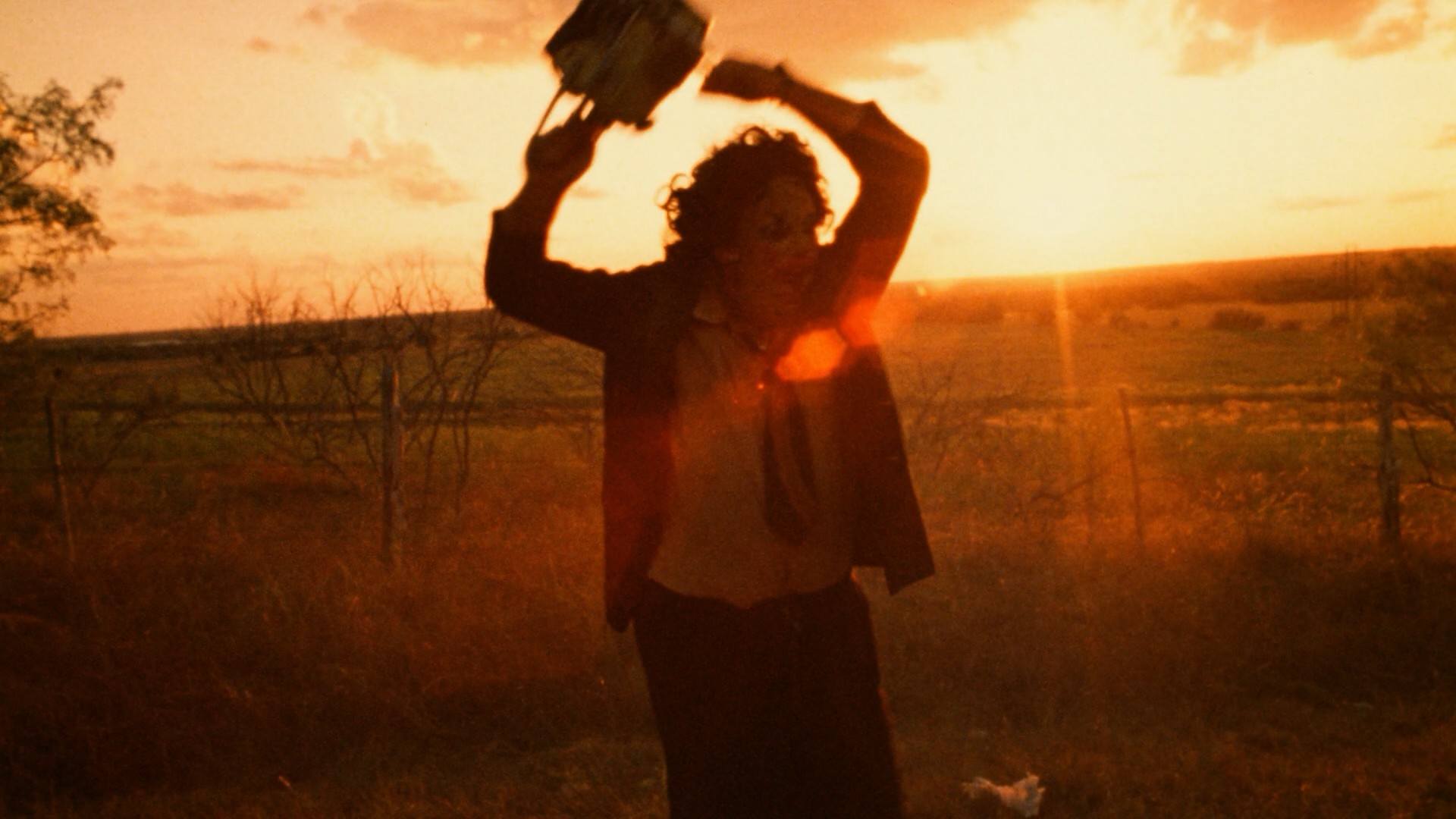
Bob Clark’s Black Christmas (1974) moved the formula into a sorority house over the holidays, with an unseen caller whose phone calls turn out to come from inside the building and prowling first-person shots of the intruder. The same year, Tobe Hooper’s The Texas Chain Saw Massacre (1974), shot on grainy 16mm by Daniel Pearl, gave the genre its most brutal masked killer and its most famous escape.
John Carpenter’s Halloween (1978) fixed the template: a suburban street, a babysitter, a masked figure who simply stands and watches. Friday the 13th (1980) took the killer to a summer camp; its hockey-masked Jason arrived in Part III (1982), and sequels turned killers into brands. Wes Craven’s A Nightmare on Elm Street (1984) moved the murders into dreams, which let the killer strike in the one place nobody can stay awake to guard.
By the late 1980s the formula had worn out. Craven revived it with Scream (1996), a slasher whose teenagers have seen all the slasher movies and know the rules, and the meta-slasher was born. Since then the genre keeps splitting: brutal remakes, legacy sequels, and art-house variants such as It Follows (2014), which keeps the stalking and the teenage victims but replaces the masked man with a slow, walking curse.
What is the final girl trope?
The term comes from film scholar Carol J. Clover, who named the pattern in a 1987 essay and expanded it in her 1992 book Men, Women, and Chain Saws. The final girl is the one who survives. Classically she is more watchful than her friends, the first to sense danger and the last to be believed. She discovers the bodies, is chased through the location, and in the last act stops running and fights the killer with whatever is at hand: a knitting needle, a coat hanger, a kitchen knife.
For a filmmaker, the trope is a structural tool as much as a character type:
- Point of view shifts to her. Early on the camera floats between victims or sits in the killer’s eyes; in the final act it stays with her, and the audience’s identification moves with it.
- She sees what the audience sees. Scenes gain suspense when we notice the figure in the background and she doesn’t; the final act pays off when she finally looks where we’ve been looking.
- The ending reopens. The killer’s body vanishes, a hand bursts out of the ground, the chainsaw keeps swinging. The survivor lives, but the threat is not quite over.
Modern films play with every step: final girls ready from the start, groups of survivors, killers hiding inside the group. The better your audience knows the rules, the more precisely you can bend them.
The visual language of the slasher
The killer’s point of view. The signature shot is a moving POV shot that prowls outside windows or up staircases. Halloween opens with a long first-person take through a house, with the frame partly blocked by the eyeholes of a mask. The audience is made complicit before it knows who is looking.
Empty space as threat. Carpenter framed Halloween in wide 2.39:1 and left large areas of the frame empty behind his characters. Negative space becomes a promise: something will fill it. The killer often appears as a still figure far in the background, in focus, unnoticed by the person in the foreground. It Follows built its whole visual strategy on this: wide lenses, deep focus and slow figures walking toward the camera from the far edge of the frame, so viewers learn to search every background.
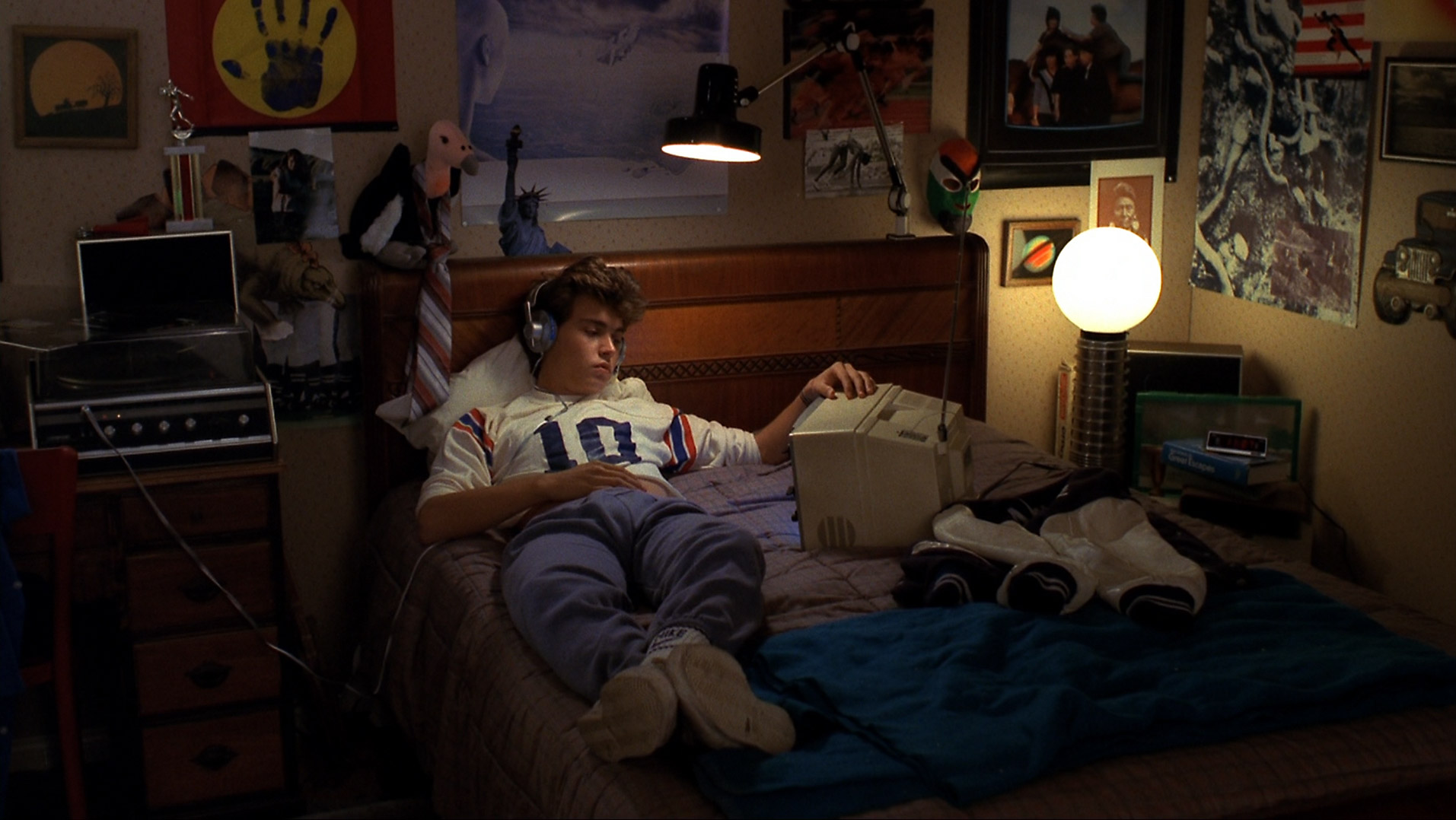
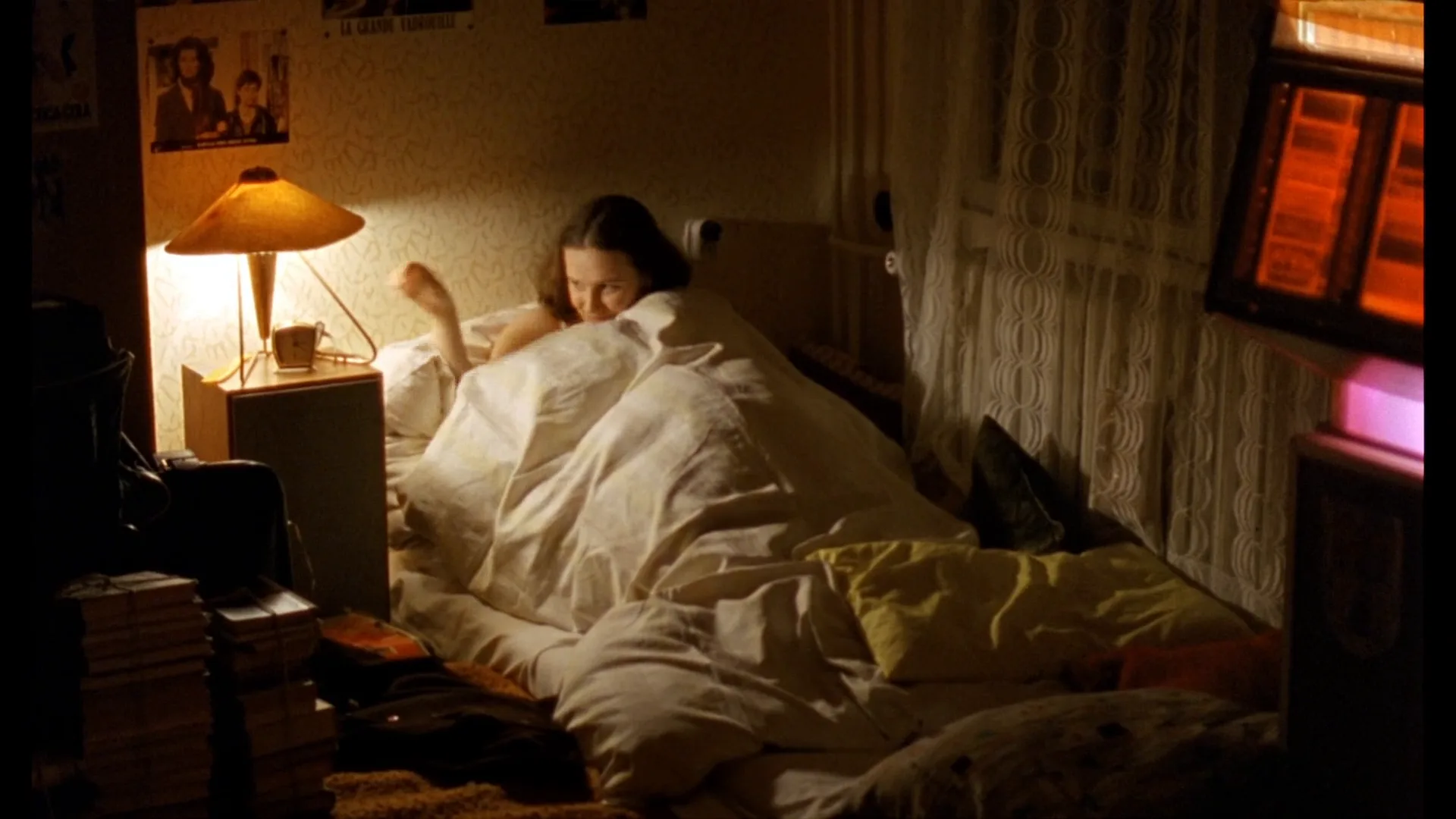
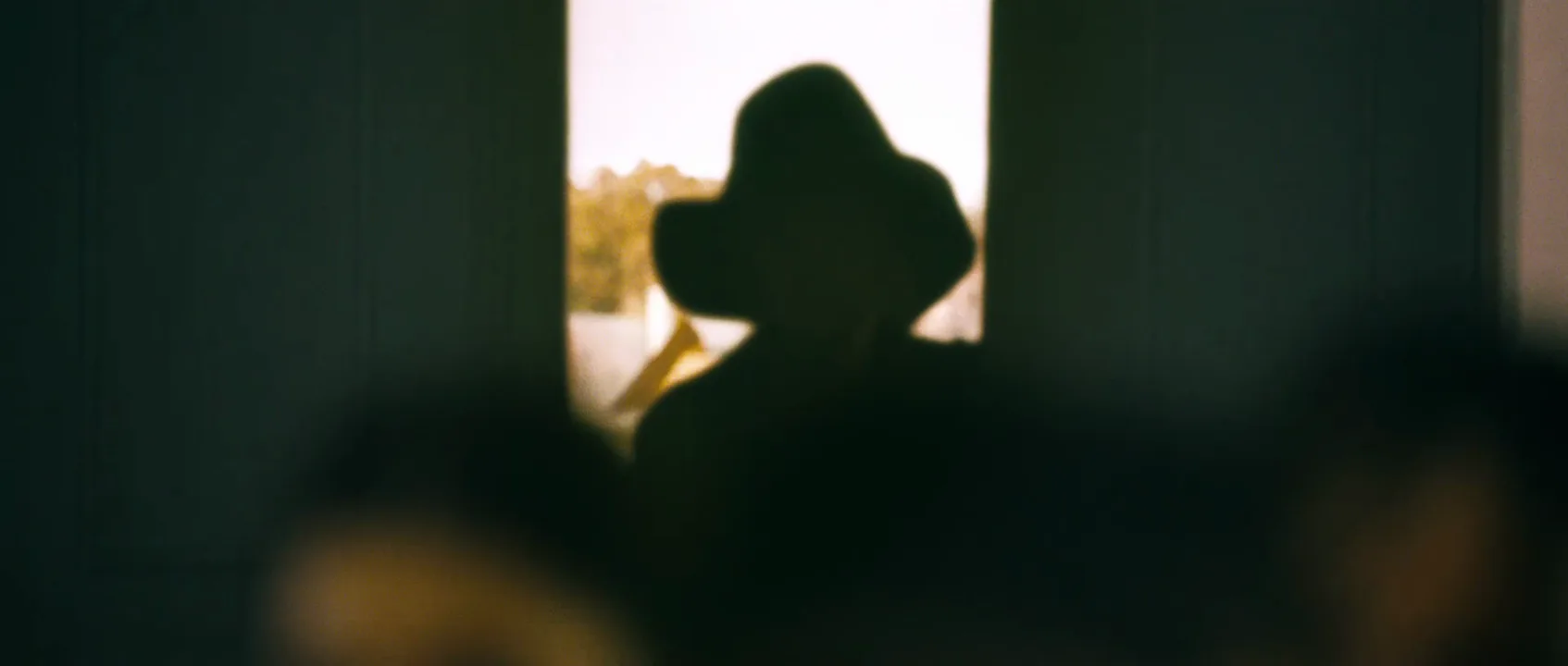
Darkness with a few islands of light. Night interiors use low-key lighting: a bedside lamp, a television, a porch light, moonlight through blinds. Faces fall half into shadow, and doorways become black rectangles. The killer is often a silhouette against a lit window, a shape with no face.
Domestic places. Bedrooms, kitchens, cars, closets: the genre turns the most private spaces into traps.
Sound. A cheap, repetitive film score can carry a whole franchise: Carpenter’s own piano theme for Halloween is little more than a few notes in an odd meter. Silence before an attack and the false scare (a cat, a friend’s hand on a shoulder) complete the grammar.
How to shoot a slasher scene
A stalk-and-kill sequence has three phases, and each needs its own coverage.
1. The approach. Establish geography first so the audience knows where the doors, stairs and windows are. Then play long, quiet shots. A 24–32mm lens at eye height keeps both the victim in the foreground and the dark doorway behind her sharp; stop down to f/5.6–f/8 or use a split diopter if the light allows. Stage the killer in the deep background and let him stand still: stillness reads as more menacing than movement.
2. The watcher. Cut to the killer’s view. A handheld or stabilized rig at the killer’s eye height (a tall actor, around 6 ft 2 in) gives the lurching walk; a longer lens, 85–135mm, from outside a window or through branches makes the victim look observed. Frame through something (blinds, leaves, a door gap) so the POV feels hidden.
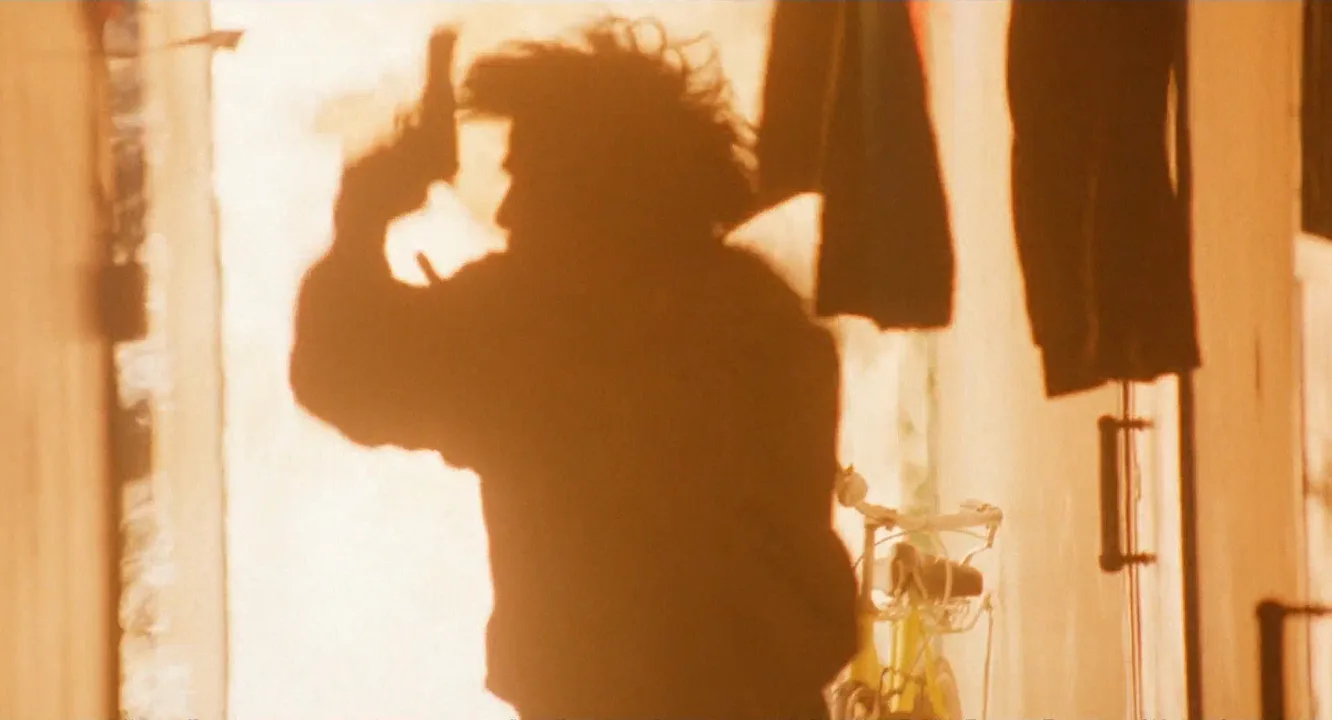
3. The attack. Speed up the cutting, go tighter and closer, and hide more than you show. A raised blade in silhouette, a reaction, a hand on a door frame will do more than a full wide shot of the kill. When you do show violence, plan practical effects with your makeup team and shoot the effect in one clean angle rather than covering it from everywhere.
Lighting numbers. Work at ratios of 8:1 or higher between key and fill. Motivate everything: a bedside lamp, a fridge light, a streetlight through a window. A cool, soft moonlight wash at about two stops under key keeps the dark readable in the grade, and a hard backlight in a doorway turns the killer into a shape. Keep the killer’s mask slightly under-lit so it glows rather than shows detail.
The mask. Design it first and test it under your actual lighting: a white mask can blow out in a doorway backlight, and a dark one disappears entirely. Simple, pale and expressionless works best, so a head tilt does the acting.
Slasher vs. horror film vs. thriller
Every slasher is a horror film, but most horror films are not slashers. Horror is the broad genre built to frighten; its monsters can be ghosts, demons, creatures or a curse, like the beast of the werewolf film. The slasher narrows it to a human (or nearly human) killer, a group of victims picked off in sequence, and a survivor. If the threat can be exorcised, the story is probably supernatural horror; if it can be stabbed and gets up anyway, it is probably a slasher.
The line with the thriller is about emphasis. A serial-killer thriller such as The Silence of the Lambs (1991) follows the investigation: detectives, clues, the mind of the killer. A slasher barely cares who the killer is or how to catch him; it stays with the victims and asks only who will survive the night. The giallo sits between the two, with a whodunit plot and slasher-style murders.
Slasher Film examples in film
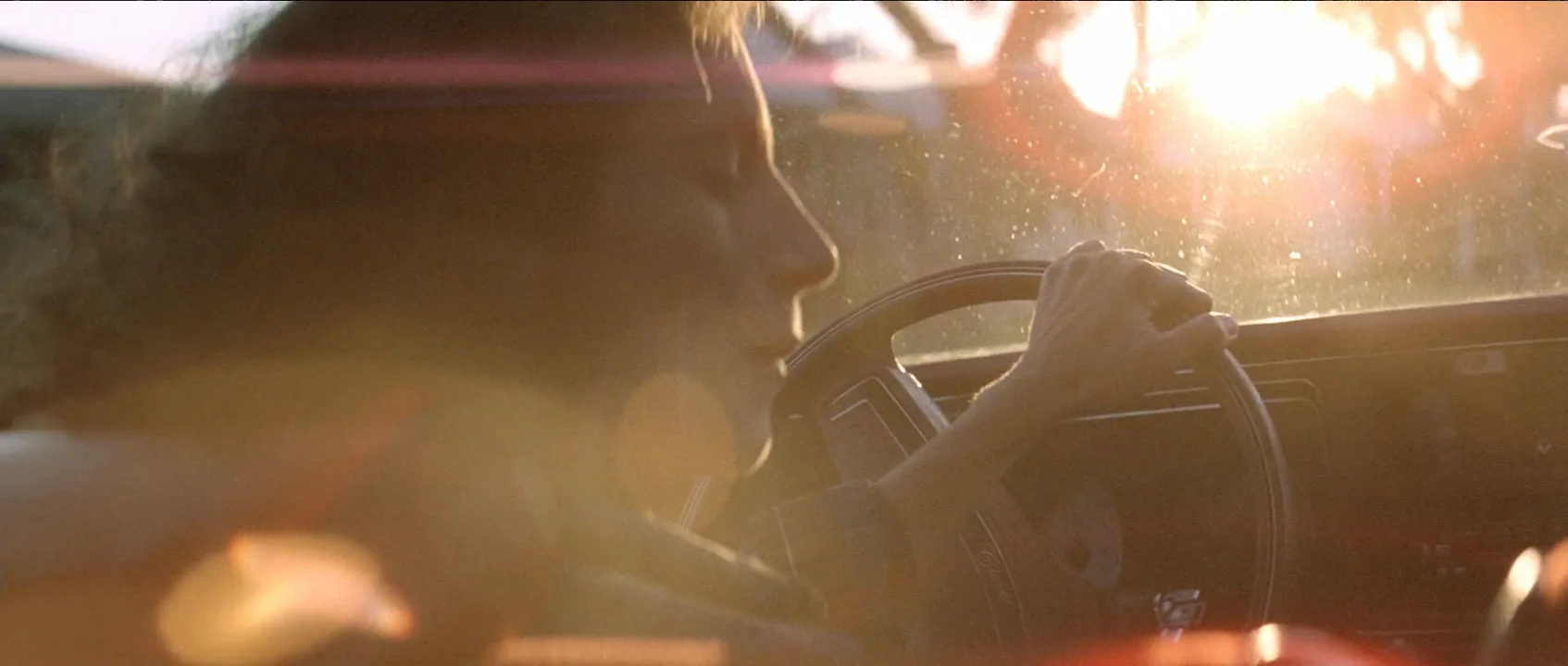
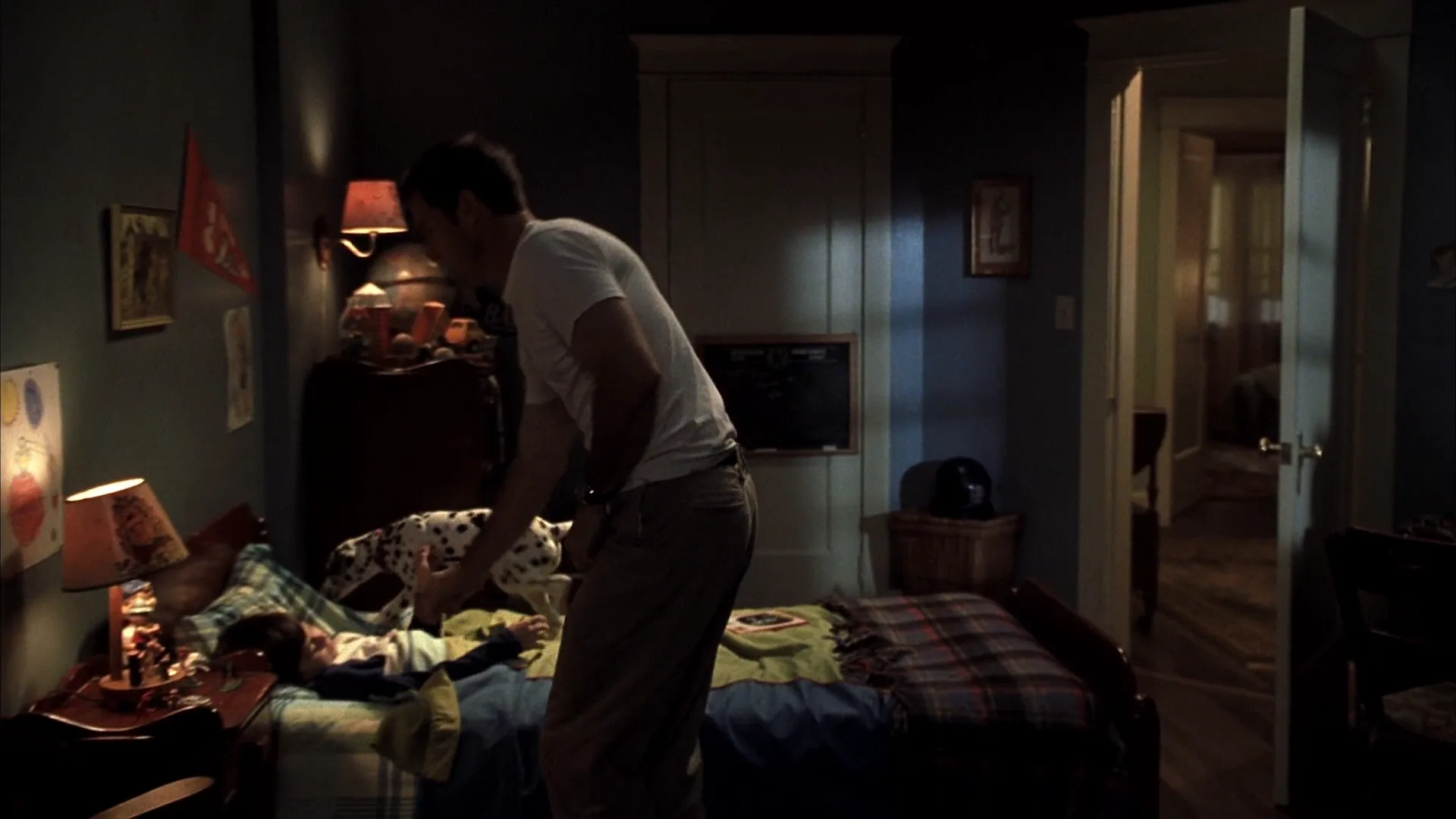
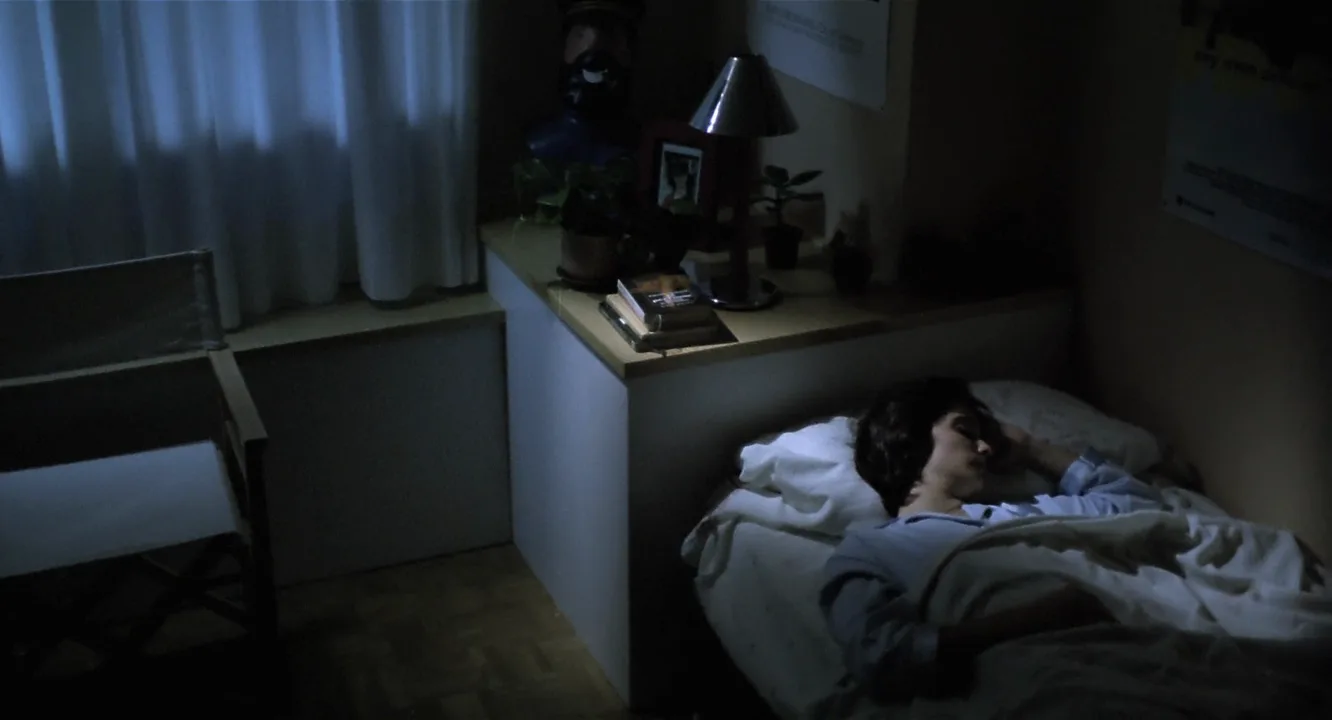
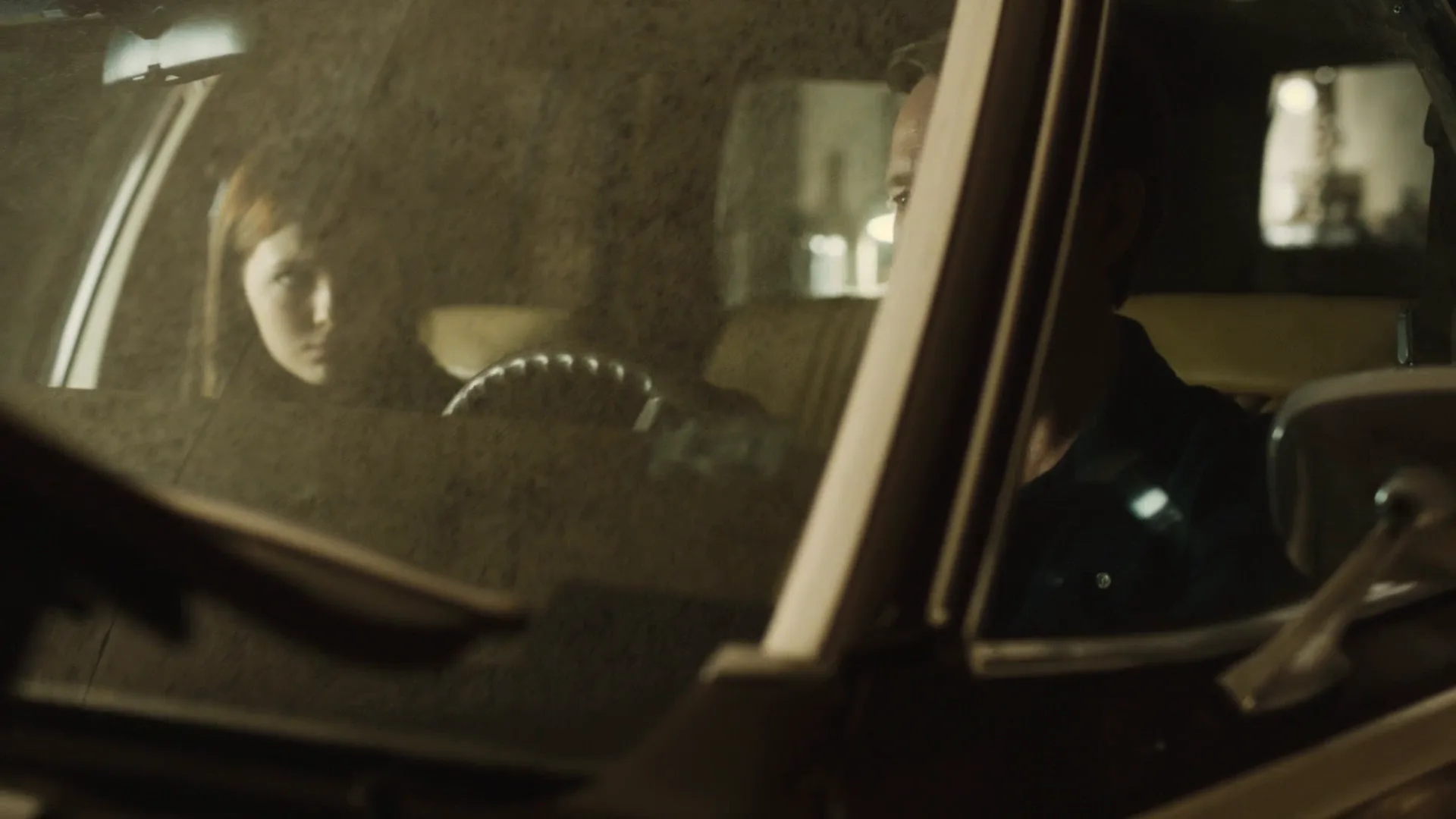
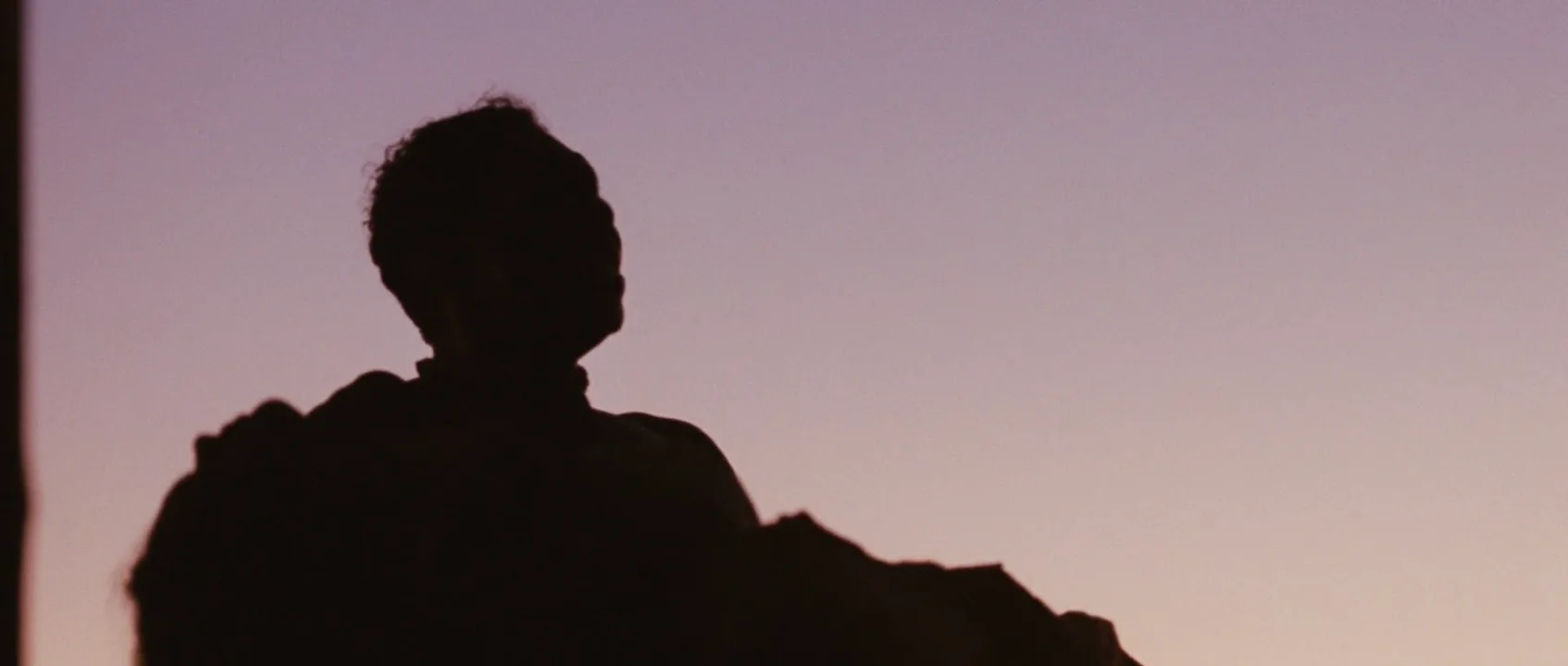
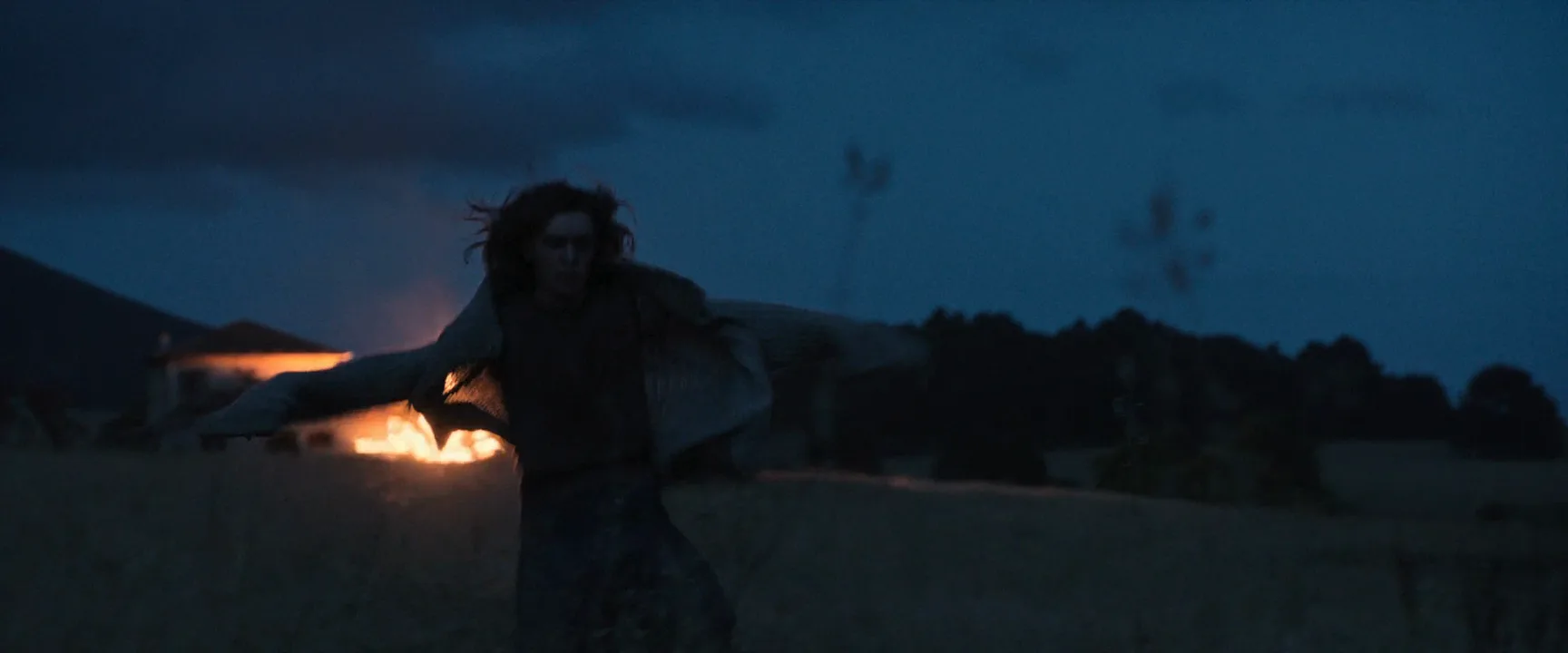
11 framesThree frames from the slasher canon, followed by frames from other films that use the same grammar the genre borrowed: sleepers in lamplit bedrooms, figures in doorways, silhouettes against light, drivers alone in a car.
How to create a slasher film with AI
4 promptsWith AI you direct the slasher the way Carpenter did: by where you place the killer in the frame and how much light you give him. Image models want to light everyone and put the threat in the foreground, so state the depth order, the lens and the darkness explicitly. Keep the reference frames, both stills and the video take on one FlashBoards board so you can compare where the figure sits in each take. The fourth prompt re-shoots a real film shot from a text description alone, and the original plays next to the result so you can compare.
Cinematic 2.39:1 night interior of a small suburban kitchen. In the foreground, a fictional 19-year-old woman with a long dark-brown braid, a small silver nose ring, a round face and an oversized mustard knit cardigan rinses a mug at the sink, her face lit from the side by a warm lamp on the counter. Far behind her, through an open doorway, a tall figure stands perfectly still in a black hallway, small in the frame: the hood of a long dark oilskin raincoat is pulled up over a smooth oval mask of cracked off-white porcelain, featureless except two small round eye holes, with no mouth, no nose and no hair, and is lit only by a thin strip of cool moonlight across the mask. Low-key lighting, high contrast, deep shadows, large empty dark areas of frame. 24mm lens at eye level, deep focus, both the woman and the masked figure sharp. 35mm film grain, muted colors, tense and quiet.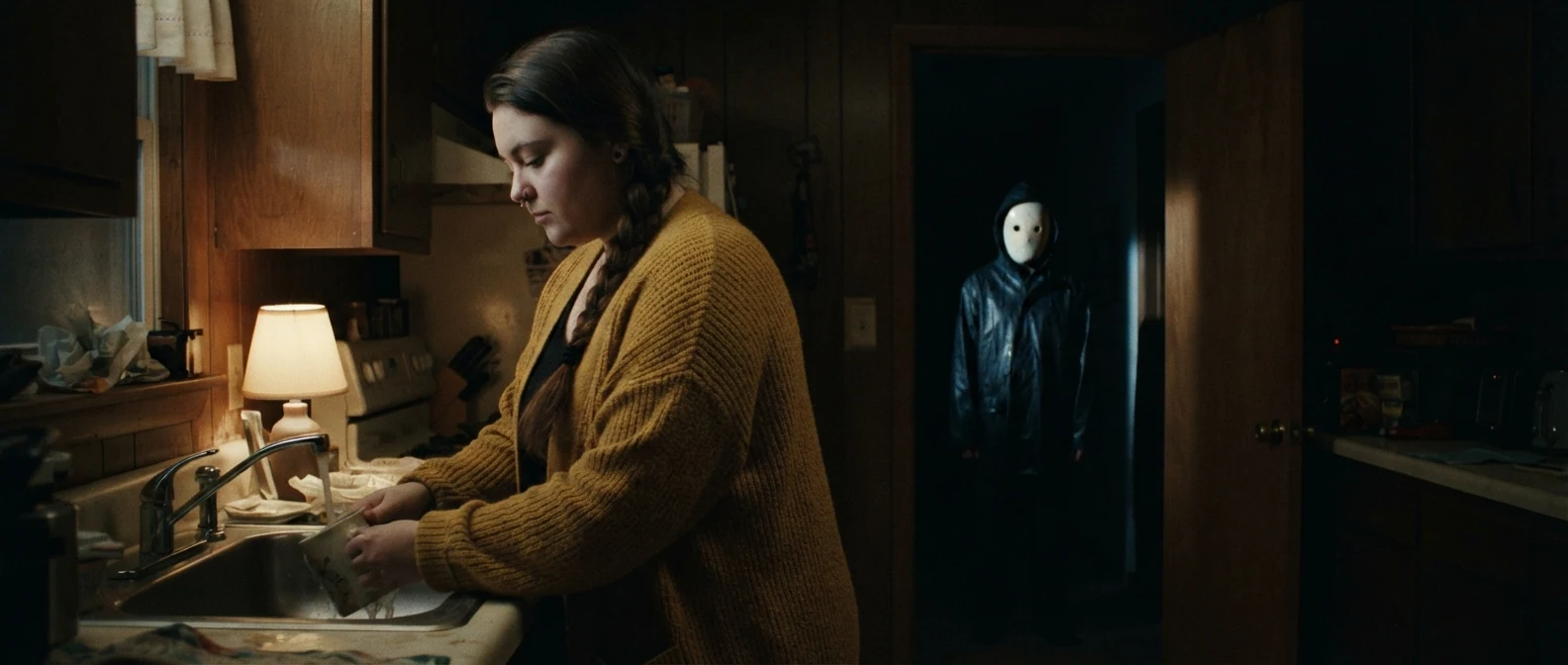
The depth order carries the scare: “in the foreground … far behind her, through an open doorway” keeps the killer small and in the background instead of posing next to her. “24mm, deep focus, both sharp” is what lets the audience spot him while she doesn’t. “Thin strip of cool moonlight across the mask” gives the mask just enough light to read, and “large empty dark areas of frame” asks for Carpenter-style negative space. The original mask design (cracked porcelain, no mouth, no hair, hood up) keeps the model away from franchise icons.
Open FlashBoardsKiller’s point of view at night from deep in a pine forest, looking through dark out-of-focus branches at a lit lakeside cabin 40 meters away. Through the cabin’s bright window, three fictional camp counselors in their early twenties play cards at a wooden table: a lanky young man with a shaved head and a red flannel shirt, a young woman with long black braids and a yellow raincoat, and a stocky young man with round glasses and a sunburned nose. They laugh, unaware. Warm tungsten light inside, cold blue moonlight outside, mist over the black lake. 135mm telephoto lens, handheld at standing height, foreground branches blurred and framing the window, voyeuristic, grainy 16mm look.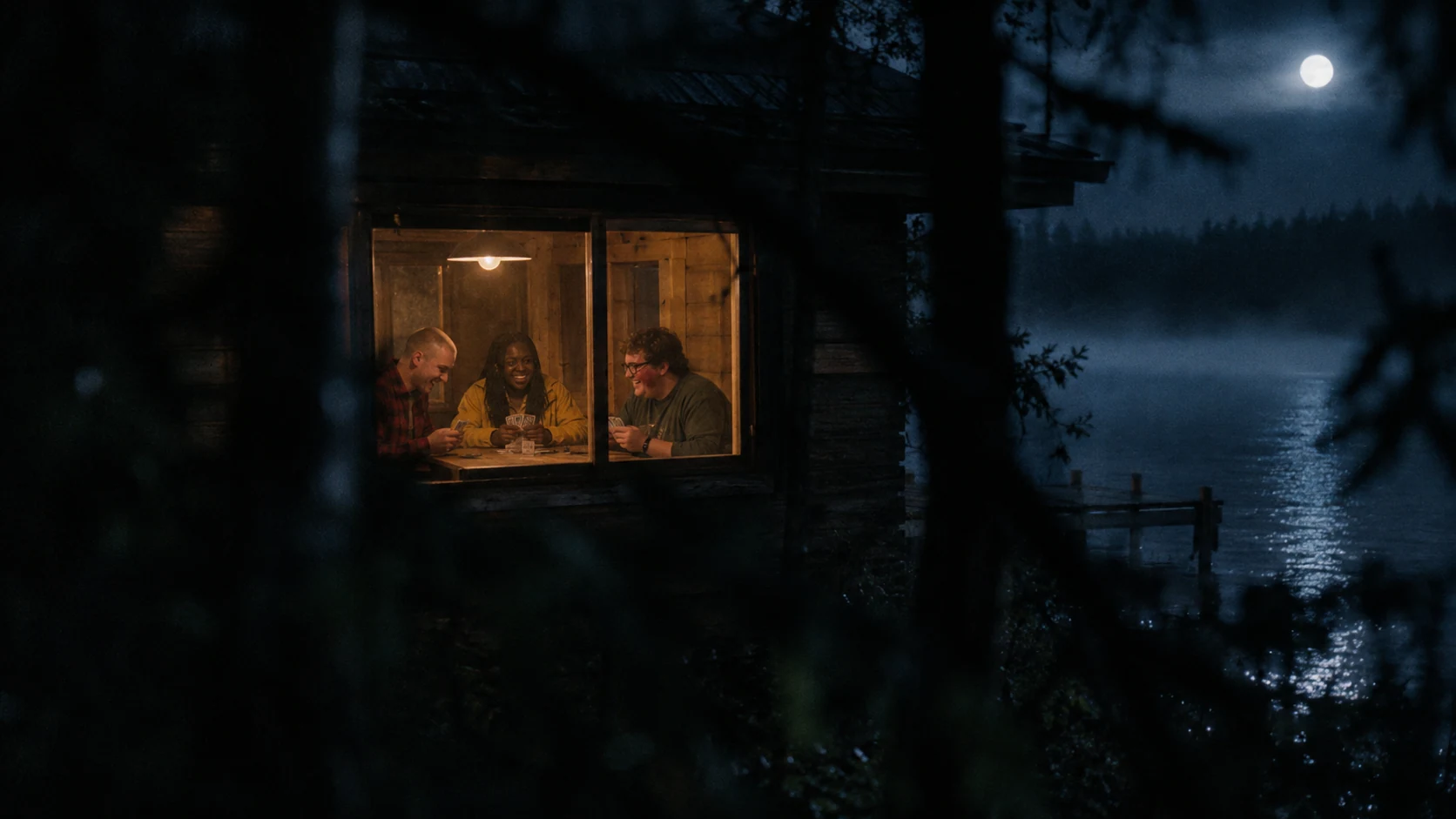
This take switches to the other half of the grammar: the watcher. “Killer’s point of view … looking through dark branches” and “foreground branches blurred and framing the window” make the frame feel hidden. The “135mm telephoto” compresses the distance so the cabin looks observed rather than visited, and the warm-inside / cold-outside split tells you at a glance who is safe and who is watching.
Open FlashBoardsCamera: a very slow, steady dolly push-in from the first frame, moving straight toward the doorway over the woman’s shoulder, ending on a medium-wide framing of the doorway with the woman still at frame left. Action: water runs from the tap as the woman rinses the mug and sets it on the drying rack. Behind her, the masked figure in the dark hallway takes one slow step forward into the thin strip of moonlight, so more of the white mask is lit. The woman turns off the tap and goes still, listening, without turning around. The masked figure slowly tilts its head to one side and stays there.The running water and the rinsing start the motion in the first frame, so the model doesn’t creep in on a frozen still. The push-in over her shoulder shrinks the distance between the two figures, which is the whole scene. “One slow step” and “tilts its head … stays there” keep the killer’s movement tiny, which reads as more menacing than an attack, and “without turning around” preserves the gap between what we see and what she knows.
Open FlashBoards{
"output": "Full-screen live-action scene from its very first frame: one single continuous shot from Thesis (1996). Night in a small, tidy student bedroom in a Madrid apartment. The only light is cold pale-blue moonlight glowing through tall white sheer curtains; everything else sinks into deep blue-black shadow. Low-key, cold blue palette, 35mm film look, fine grain.",
"characters": {
"S1": {
"name": "Ángela, played by Ana Torrent",
"look": "a young woman in her early twenties with short dark bobbed hair and a fringe, pale skin and a light-blue pajama top; she lies asleep on her back under a white sheet and a gray wool blanket, her head on a white pillow",
"voice": "silence: she is asleep and does not speak"
}
},
"shots": [
{
"shot": 1,
"camera": "one unbroken move from a standing adult's eye height, as if an unseen person standing in the middle of the room slowly turns to look: a slow, smooth pan to the right combined with a slow tilt down. The camera stays where it stands, well back from the bed, never moving in close. It starts as a medium-wide frame centred on the curtained window and ends as a high-angle medium-wide shot looking steeply down on the bed from above its foot, the whole upper half of the bed and a corner of the desk in frame. Steady and deliberate, one continuous take.",
"action": [
"BEGINNING: alive from the first frame, the camera is already turning slowly to the right. Centre of frame: tall white sheer curtains glowing cold blue with moonlight, and in front of them an empty folding director's chair with a pale canvas seat and back, standing at a low white cabinet under the window; a dark chest of drawers at the left edge, the corner of a white built-in desk at the right edge.",
"THEN: the chair and the window slide toward screen left while the desk comes in from screen right: a small metal desk lamp that is switched off, a framed photo, a short stack of books, a potted plant and a dark figurine, all in shadow.",
"THEN: the camera tilts down past the desk; the head of a narrow bed stands pushed against the side of the desk, and a white pillow with S1's dark hair on it appears in the lower right corner, her face turned up toward the ceiling, eyes closed.",
"THEN: the window slides out of the left edge until the curtains are only a thin blue strip; the bed runs diagonally across the frame, its pillow end up at the upper left against the desk and its foot toward the lower right corner, a bare pale wall along the right side. S1 lies perfectly still with her head at the upper left: one arm bent up with the hand resting at her forehead, elbow out toward screen right on the pillow, the other arm lying along her side on top of the blanket on screen left.",
"END: the move slows and settles on a high angle looking steeply down at S1 from above the foot of the bed: her small face near the top left of the frame, the white sheet and gray blanket filling the middle, the desk corner at the upper left, the pale wall on the right, the lower edge and the corners of the frame falling into black. She keeps sleeping, her chest rising slowly, and nothing else in the room moves."
],
"voice": "silence: nobody speaks in this shot, no voice at all",
"dialogue": []
}
],
"sound": {
"ambience": "a quiet bedroom at night: S1's slow even breathing, the faint rustle of the sheet, a distant city hum heard from outside",
"speech": "no words in this video; the only human sounds are breaths and movement",
"never_spoken": "no narration and no voice-over: the descriptions, performance notes and step words of this prompt are never spoken aloud",
"music": "a film score under the scene, always below the voices, clearly audible from the first frame to the last: low, slow dark strings holding one uneasy chord with a soft, heartbeat-like pulse",
"subtitles": "none"
}
}Remakes the bedroom shot from Thesis (1996), dir. Alejandro Amenábar, DP Hans Burmann, carrying over the slow pan right and tilt down from a moonlit window and an empty chair to Ángela asleep, the bed’s layout, the cold blue light and the wordless silence under a low score.
The prompt makes the camera the unseen watcher: it opens on an empty chair by a moonlit window and only then turns right and down to find the sleeper, so the audience searches the room before it finds her. Naming what enters frame in order (chair, desk, pillow, bed) and where the camera stands and settles keeps the model from rushing into a close-up, while “nothing else in the room moves” keeps the dread in the waiting.
Open FlashBoardsCommon mistakes
- The killer jumps to the foreground. Models like a clear subject and often place the masked figure right behind the victim’s shoulder or give him equal size. State the distance (“far behind her, through an open doorway”) and the lens (24mm, deep focus).
- Everything gets lit. Horror prompts often come back with a bright, even image. Name the few sources (“warm lamp on the counter,” “thin strip of moonlight”) and ask for “large empty dark areas of frame.”
- Franchise masks. Generic words like “hockey mask” or “white mask with dark hair” pull models toward famous killers. Invent your own: material, crack, missing mouth, color.
- Gore instead of dread. The strongest slasher frames are before the attack. Prompt the watching and waiting; save the blade for a silhouette.
- Video killers that lunge. In video, a masked figure tends to rush the camera. Give him one small action (a step, a head tilt) and describe the victim’s ongoing action so the shot stays alive.
Keep the reference frames, prompts and every generated take side by side — images and video in one canvas.
FAQ
5 questionsWhat is a slasher film?
A slasher film is a horror subgenre about a killer, usually masked or disfigured and carrying a blade, who stalks and murders a group of young people one by one in an isolated or ordinary setting. The story works as a countdown, ending when a last survivor, the final girl, confronts him. Classic examples include Black Christmas, Halloween, Friday the 13th, A Nightmare on Elm Street and Scream.
What is the final girl trope?
The final girl is the last survivor of a slasher, typically a young woman who notices the danger first, discovers her friends’ bodies and finally stops running to fight the killer herself. Film scholar Carol J. Clover named the pattern in a 1987 essay and developed it in her 1992 book Men, Women, and Chain Saws. In the last act the camera stays with her, so the audience’s identification shifts from watching the victims to rooting for the one who fights back.
What was the first slasher movie?
There is no single answer. Psycho and Peeping Tom (both 1960) laid the groundwork, and Mario Bava’s A Bay of Blood (1971) is often called the first body-count film. Black Christmas (1974) and The Texas Chain Saw Massacre (1974) came close to the full formula, and Halloween (1978) is the film that fixed the template and started the wave of 1980s slashers.
What is the difference between a slasher and a horror movie?
Horror is the broad genre designed to frighten, with threats that can be supernatural, monstrous or human. A slasher is one subgenre of horror with a specific structure: a single, usually human killer, a group of victims killed in sequence, an isolated setting and a surviving final girl. Ghost stories, creature features and possession films are horror, but they are not slashers.
Why do slasher killers wear masks?
A mask removes the killer’s face, and with it any readable emotion, which makes him feel less like a person and more like a force. It also gives the film an instantly recognizable icon for posters and sequels, lets different performers play the role, and lets light do the acting: a small head tilt or a sliver of light on a blank mask reads as more menacing than any expression.
Related terms
6- VillainStorytelling
A villain is an antagonist driven by malicious goals or methods; the memorable ones believe they're right, want something concrete and test exactly the protagonist's weakness.
- POV ShotCamera Angles
A POV shot shows exactly what a character sees by placing the camera at their eyes — usually right after a shot of them looking — so the audience shares their perspective, including movement, obstruction or distortion.
- Low-Key LightingLighting
Low-key lighting keeps most of the frame in shadow, with a strong key, little or no fill and a high lighting ratio, so only fragments of faces and objects emerge from the dark — the language of noir, thrillers and horror.
- SuspenseStorytelling
Suspense is anticipatory tension created when the audience knows or fears what may happen and waits for it — Hitchcock's bomb-under-the-table example: show the bomb, and a dull chat becomes unbearable.
- Werewolf FilmGenres
A werewolf film is a horror subgenre built around a human who turns into a wolf-like beast — the transformation scene, the full moon and the curse stand in for loss of control and a divided self (The Wolf Man, An American Werewolf in London).
- Horror FilmGenres
Horror is the genre designed to frighten — through threat, the uncanny and the grotesque — and it relies on darkness, negative space, sound and withheld information as much as on monsters.
Further reading
Carol J. Clover, Men, Women, and Chain Saws: Gender in the Modern Horror Film (Princeton University Press, 1992). Adam Rockoff, Going to Pieces: The Rise and Fall of the Slasher Film, 1978–1986 (McFarland, 2002).