 FlashBoards Learn
- Learn
- Storytelling
- Pixar Storytelling Formula
Storytelling · Film language
Pixar Storytelling Formula
Also called: story spine, Pixar story spine
The Pixar storytelling formula is the story spine: Once upon a time… Every day… One day… Because of that… Because of that… Until finally… Filling in the blanks shows whether your story has a status quo, a disruption and a chain of cause and effect that ends in a change.
- What it does
- Compresses a whole story into six or seven linked sentences so you can test its causality before writing scenes.
- Use it when
- Pitching an idea, rescuing a draft that meanders, or planning a short film or animation on a board.
- Watch out
- "And then" is not "because of that": if a line doesn't cause the next one, the spine is broken.
- Try this prompt
Storyboard panel, stylized 3D animation look, an old lighthouse keeper climbing a spiral staircase at dusk with an oil can, warm lamplight from above
What is the Pixar story spine?
The story spine is a fill-in-the-blanks template:
- Once upon a time there was ___.
- Every day, ___.
- One day ___.
- Because of that, ___.
- Because of that, ___.
- Until finally ___.
- (optional) And ever since then ___.
Improv teacher and playwright Kenn Adams created it as an exercise for performers building stories on stage. It became the "Pixar formula" in 2011, when Pixar story artist Emma Coats posted storytelling lessons from the studio that spread as Pixar's 22 Rules of Storytelling; the spine was rule four. It is a tool story artists use, not an official studio method.
Its power is its size: seven sentences can't hide a weak middle.
How does the story spine map onto story structure?
Each phrase does one job in a compact version of story structure:
- Once upon a time / Every day set up the character and the routine about to break. "Every day" defines the normal the story will destroy.
- One day is the inciting incident: a single event, not a mood.
- Because of that (repeated) is the rising action. Each consequence creates the next problem.
- Until finally is the climax, where the chain meets the character's choice.
- And ever since then is the new normal. Set it beside "Every day" and the character arc shows in two lines.
On three-act structure, the first three lines are Act One, the "because of that" chain is Act Two, and the ending lines are Act Three.
Pixar story spine examples
Run the formula over the studio's own films:
Finding Nemo (2003). Once upon a time there was a widowed clownfish, Marlin, terrified of losing his only son. Every day he warned Nemo about the ocean. One day Nemo swam out to a boat to defy him and was taken by a diver. Because of that, Marlin crossed the ocean to find him. Because of that, he had to rely on forgetful Dory. Until finally he found Nemo and learned to let him go.
Toy Story (1995). Once upon a time there was a cowboy doll, Woody, Andy's favorite toy. Every day he ran the bedroom. One day Andy got Buzz Lightyear for his birthday. Because of that, Woody grew jealous and knocked Buzz out the window. Because of that, both ended up trapped at Sid's house. Until finally they worked together to get back to Andy on moving day.
In both, "Every day" hides the flaw that "Until finally" fixes.
How to use the story spine on your own film
Test every link. Draft the spine in five minutes, then check each "because of that": if "and then" fits just as well, replace it with a consequence the character caused.
Make "One day" specific. "Things changed" is not an event; "a crew arrived to replace her lamp with an automatic beacon" is.
Turn the spine into a board. One frame per line gives you six or seven key images. In FlashBoards, write each spine sentence as a note above a column, drop reference and generated frames under it, and read the story left to right before you storyboard full scenes. "One day" plus the first "because of that" and the stakes is usually your logline.
Story spine vs. story circle vs. Save the Cat
All three describe the same shape at different resolutions.
- The story spine is the smallest: six or seven sentences that test causality, with no timing.
- Dan Harmon's story circle has eight character-driven steps (need, go, pay the price, return changed) and suits TV episodes.
- The Save the Cat beat sheet has 15 beats with page targets. It tells you when, not only what.
Start with the spine to check the story holds, then expand it when you outline. More models live in the storytelling hub.
How to create a pixar storytelling formula with AI
3 promptsEach spine line is one key frame. Our example spine follows a lighthouse keeper whose light is automated: Nano Banana 2 Lite draws the "Every day" frame, GPT Image 2.5 lays out the whole spine as a storyboard sheet, and MiniMax H3 Max Turbo animates the routine. Pin all three beside the written spine on one FlashBoards board.
Storyboard key frame, stylized 3D animated feature look, soft rounded shapes. Inside a stone lighthouse at dusk, low-angle wide shot up a white spiral iron staircase. A small, stout keeper in her seventies with a silver bun, round cheeks, a navy wool sweater and yellow rubber boots climbs halfway up, a brass oil can in one hand, a worn leather logbook under her arm. Warm amber lamplight from above, cool blue dusk through a round window. Quiet routine.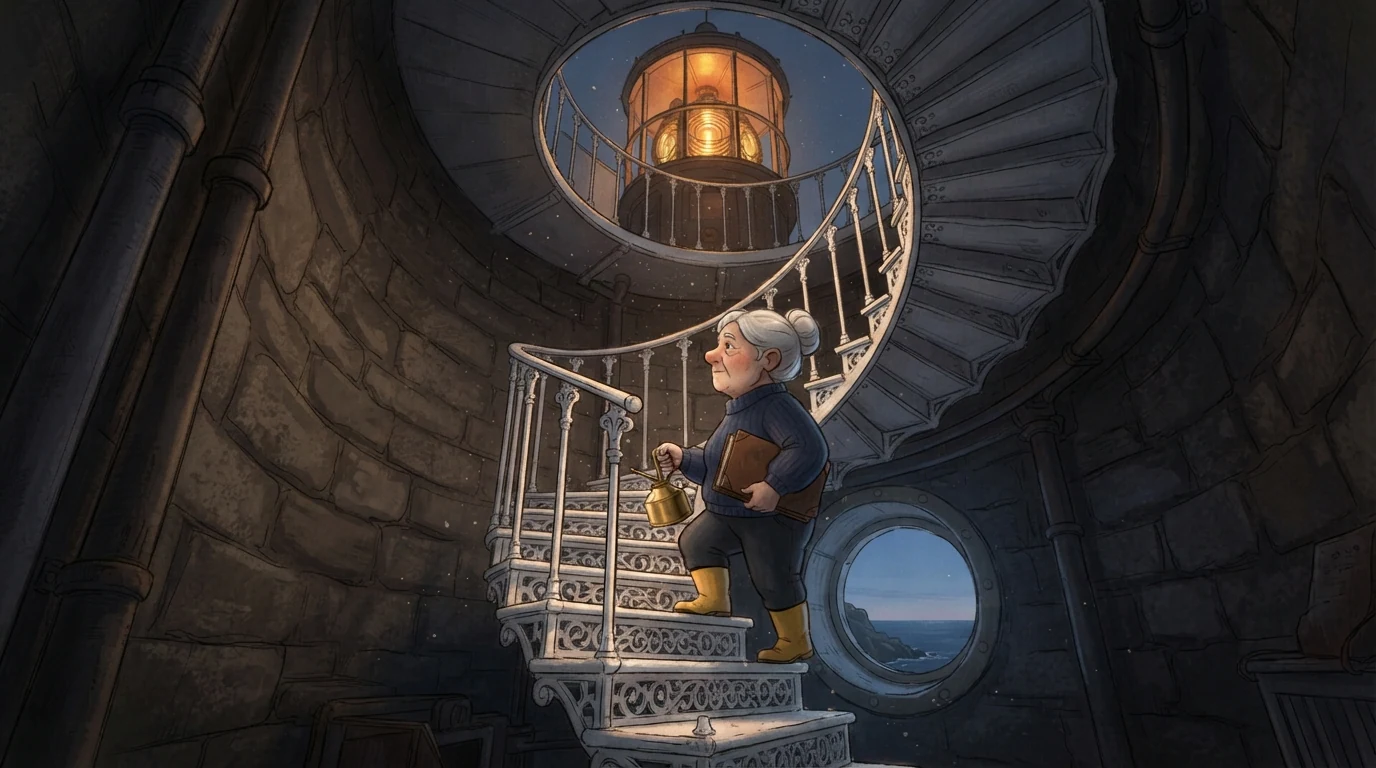
"Every day" needs a routine in progress: climbs halfway up with the props of habit, an oil can and a logbook. The stylized 3D animated feature look sets the style for later panels.
Open FlashBoardsSix-panel storyboard sheet in a 3x2 grid, pencil and gray marker sketches, short handwritten caption under each panel. Same character in every panel: a small, stout lighthouse keeper in her seventies with a silver bun and a wool sweater. 1 "ONCE UPON A TIME": lighthouse alone on a rocky point. 2 "EVERY DAY": she logs a passing ship. 3 "ONE DAY": two workers carry an automatic beacon upstairs. 4 "BECAUSE OF THAT": she sits by a dark window, logbook closed. 5 "BECAUSE OF THAT": she rows toward a freighter. 6 "UNTIL FINALLY": in a storm she lights the old lamp by hand.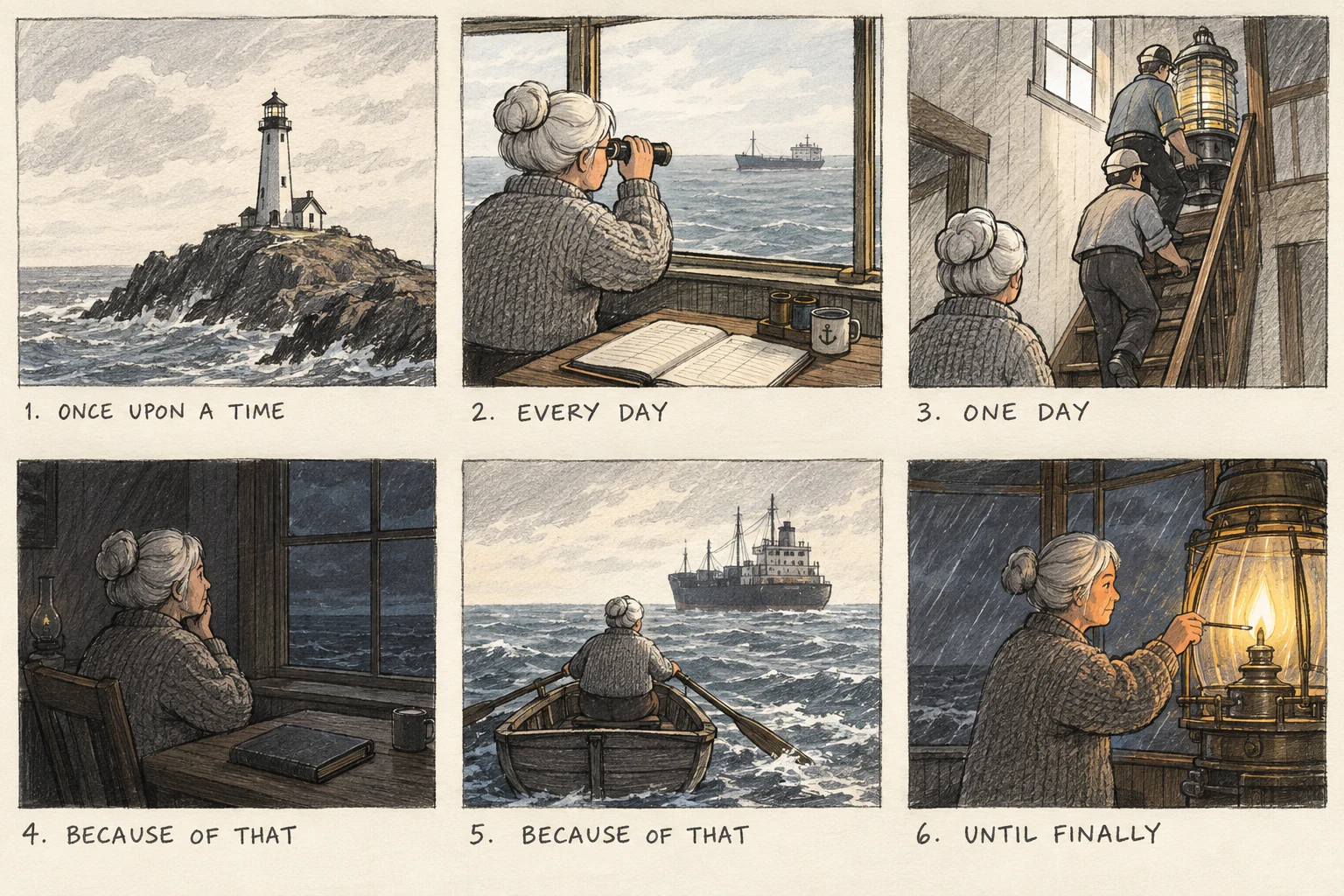
The spine phrases as captions produce the planning artifact itself. Same character in every panel keeps her consistent, and one visible action per panel makes the cause-and-effect chain readable.
Open FlashBoardsCamera: a slow, steady tilt up following the keeper as she climbs, ending on the glowing top of the stairwell. Action: The keeper is already climbing, boots ringing on the iron steps. She shifts the logbook under her arm and keeps going toward the warm light. At the end she reaches the top step and lifts the oil can.Already climbing makes the clip move from the first frame, and every object named is already in recipe 1's frame, so nothing new gets invented.
Open FlashBoardsCommon mistakes
- Storyboard sheets drift: the character's age or clothes change between panels. Repeat one short description.
- Models draw a dramatic event instead of a routine. For "Every day," describe an action in progress with everyday props.
Keep the reference frames, prompts and every generated take side by side — images and video in one canvas.
FAQ
5 questionsWhat is the Pixar storytelling formula?
It is the story spine: Once upon a time there was ___. Every day, ___. One day ___. Because of that, ___. Because of that, ___. Until finally ___. Filling in the blanks reduces a story to its status quo, the event that breaks it, a chain of consequences and a resolution, so you can see whether each part causes the next.
Who created the story spine?
Improv teacher and playwright Kenn Adams created the story spine as an exercise for building stories on stage. It became known as Pixar's formula after 2011, when Pixar story artist Emma Coats shared storytelling lessons from the studio, later called Pixar's 22 Rules of Storytelling, with the spine as rule four.
What does "Once upon a time, every day, one day" mean?
They are the first three lines of the story spine. "Once upon a time" introduces the character and world, "Every day" establishes the routine, and "One day" is the inciting incident that breaks it. Everything after, the "because of that" chain, is a consequence of that single change.
Is the story spine enough to outline a feature film?
Not on its own. The spine tests causality but doesn't say how long each part runs or where the midpoint falls. Confirm the story holds together with it, then expand it into a three-act outline, story circle or beat sheet before writing scenes.
How many "because of that" lines should a story spine have?
As many as the story needs: one or two for a short film, five or more for a feature. Each line must be caused by the one before and make the next one necessary. If "and then" fits in its place, it is an episode, not a link.
Related terms
5- Save the Cat Beat SheetScreenwriting
The Save the Cat beat sheet is Blake Snyder's 15-beat map of a feature, from Opening Image and Catalyst to Finale and Final Image, with page targets for each beat — a ready template for planning scenes and storyboards.
- Dan Harmon Story CircleStorytelling
Dan Harmon's story circle is an eight-step, simplified hero's journey — you, need, go, search, find, take, return, change — used to structure episodes and features.
- LoglineScreenwriting
A logline sums up a film in one or two sentences: the protagonist, their goal, the obstacle and what's at stake — the hook that sells the script and, today, the seed for an AI storyboard.
- Three-Act StructureStorytelling
The three-act structure splits a story into setup, confrontation and resolution, turned by plot points at roughly the quarter and three-quarter marks — the default blueprint of feature screenwriting.
- Story StructureStorytelling
Story structure is the order and shape of the events that carry a story from setup to resolution; models like the three-act structure, Freytag's pyramid, the hero's journey or Save the Cat are different maps of it.
Further reading
Kenn Adams, How to Improvise a Full-Length Play: The Art of Spontaneous Theater. Emma Coats, "Pixar's 22 Rules of Storytelling" (2011).