 FlashBoards Learn
- Learn
- Lenses, Focus & Exposure
- Fisheye Lens
Lenses, Focus & Exposure · Film language
Fisheye Lens
Also called: fish-eye lens, fisheye shot, fisheye effect
A fisheye lens is an extreme wide-angle lens, often seeing around 180°, that gives up straight lines to fit more of the world into the frame. Horizons bow, walls curve and whatever is near the lens swells, so the shot feels claustrophobic, comic, surveilled or hallucinatory — never neutral.
- What it does
- Bends every straight line that doesn't pass through the center of the frame and inflates whatever is close to the lens.
- Use it when
- You want a machine or peephole view, a skate-video energy, a drugged or paranoid headspace, or a room that seems to close around a character.
- Watch out
- It sees almost everything — lights, crew and ceiling end up in shot — and a tilted camera turns the horizon into a banana.
- Try this prompt
Full-frame fisheye shot, 180-degree view, camera 20 cm from a grinning teenager's face, curved horizon, walls bowing outward
What is a fisheye lens?
A fisheye is the far end of the wide-angle lens family, but it is built on a different rule. An ordinary wide lens is rectilinear: it keeps straight lines straight, and to do that it has to stretch everything toward the edges of the frame. A fisheye is curvilinear. It maps the scene by angle instead, so it can squeeze close to a full hemisphere onto the sensor — and the price is that straight lines bend. Only a line that runs through the exact center of the frame stays straight; every other one bows outward, like the reflection in a polished spoon.
That outward bowing is extreme barrel lens distortion, and on a fisheye it is not a flaw to be corrected but the whole point. A second effect comes with it: scale changes violently with distance. An object 20 cm from the front element looks enormous, while a person three meters away is already small. Put the two together and you get the classic fisheye picture — a bulging nose, a tiny body, a street that curls up at the sides.
Circular and full-frame fisheyes
There are two kinds, and they read very differently on screen:
- Circular fisheye. The full 180° image lands as a round picture inside a black frame. It looks like a porthole, a door viewer or a camcorder with a screw-on adapter — instantly stylized, and it never pretends to be a normal shot.
- Full-frame (diagonal) fisheye. The round image is cropped so it fills the whole rectangle, with roughly 180° across the diagonal. The frame looks like a normal shot at first glance, until you notice the bending ceiling and the curving floor. Most fisheye moments in feature films are this type.
In focal length terms, a circular fisheye on a full-frame stills sensor is typically around 8 mm and a diagonal one around 15–16 mm. On a Super 35 cinema sensor the same diagonal look arrives near 8–10 mm. Because the focal length is so short, depth of field is huge: at f/4 almost everything from half a meter to the horizon is acceptably sharp.
Why do filmmakers use a fisheye lens?
Because the audience cannot mistake it for a normal human view, a fisheye always says someone or something is seeing this. Directors lean on that in a few recurring ways.
A machine or a peephole is watching. In 2001: A Space Odyssey (1968), Stanley Kubrick used fisheye views for the ship's computer: the padded walls of the Discovery bow around the astronauts, and the curve itself becomes the character. Door viewers, security cameras and spy holes use the same grammar, which is why a circular fisheye makes such an effective POV shot for anything non-human or hidden.
The mind is coming apart. John Frankenheimer's Seconds (1966), shot by James Wong Howe, pushes extreme wide and fisheye distortion onto a man who is trading away his identity, so faces and rooms feel unstable. Fisheye close-ups are a staple of the altered-state effect: when a character is drunk, drugged, feverish or paranoid, the warping frame lets the audience share the sensation instead of just watching it.

Power, isolation and absurdity. Yorgos Lanthimos has made the fisheye a signature. In The Favourite (2018) the palace corridors curl around the characters, and in Poor Things (2023) fisheye and heavily vignetted frames make whole streets and rooms look like curiosities under glass. The effect is half comic, half cruel: people look small inside an architecture that seems to bend toward them.


Youth culture and music. The skateboard videos of the 1990s were shot on handheld camcorders with fisheye adapters held inches from the board, and that look became shorthand for a whole scene. Jonah Hill's mid90s (2018) quotes it directly, cutting to round fisheye footage that looks like the characters shot it themselves. Late-'90s hip-hop videos by directors such as Hype Williams took the same lens and pushed performers' faces and hands right into it, turning the extreme close-up into a swagger move.
Comedy. A face pushed into a fisheye becomes a cartoon: the nose inflates, the ears shrink, the eyes spread. Used for one beat, it lands a joke or a panic.
How to shoot with a fisheye lens
Choose the type first. Decide whether the audience should see the round edge (circular: a device, a peephole, a found-footage feel) or whether the distortion should creep in unannounced (full-frame diagonal). Options range from dedicated fisheye primes around 8 mm for Super 35 to a screw-on adapter in front of a wider lens for a softer, lo-fi look.

Get close — then closer. A fisheye only looks like a fisheye when something is near the lens. For a face, 15–40 cm is the working range; at a meter and beyond the image just looks like a very wide, slightly bent wide shot. Skate operators hold the camera 20–30 cm off the ground and inches behind the board so the wheels and shoes fill the bottom of the frame while the street wraps around above.

Place the horizon on purpose. Lines through the center stay straight, so a level camera with the horizon crossing the middle keeps the world surprisingly calm. Tilt down and the horizon arches up into a dome; tilt up (as in a low angle shot looking at skyscrapers) and the buildings lean in toward the center like the petals of a closing flower. Combine that with a roll and you get the queasy, lopsided frames of a Dutch angle multiplied.
Hide everything. At 180° the lens sees the light stands, the boom, the operator's feet and the ceiling. Light with practicals, bounce off walls that are already in frame, or put units directly behind the camera. Plan the whole room as set, not just the part you want.
Handle the glass. The front element bulges, so there is no screw-in filter and usually no matte box; ND and color gels go in a rear filter slot or in camera. Flare is common and fingerprints show, so keep a blower and lens cloth on hand. Focus is forgiving: at f/4 and a focus mark around 1 m, almost the entire frame is sharp, which is why fisheye operators can run handheld without a focus puller.
Move with intent. Motion near the lens is exaggerated: a push toward a face feels like a lunge, and a move down a corridor makes the walls stream past and bend.
Fisheye vs. wide-angle lens: what's the difference?
Both see a lot of space, and both exaggerate the distance between near and far. The difference is what they do with lines at the edge of the frame.
| | Rectilinear wide-angle | Fisheye | |---|---|---| | Straight lines | Stay straight everywhere | Bend unless they pass through the center | | Typical field of view | 60–110° | around 180° | | Edges of the frame | Objects stretch and smear (faces go oval) | Objects compress, lines curve | | Feels like | A big, immersive space | A device, a peephole, an altered mind | | Easy to hide? | Can pass as normal | Always noticed |
A 14 mm rectilinear lens and a 15 mm diagonal fisheye on the same full-frame camera have almost the same focal length, yet look nothing alike: the 14 mm keeps doorframes vertical but stretches anyone standing at the edge, while the fisheye keeps the person's proportions but curls the doorframe around them. If you want space without announcing the lens, use a wide rectilinear lens. If the audience should feel the lens, use a fisheye. A telephoto lens does the opposite job, compressing depth.
Can you fake the fisheye effect in post?
Partly. Editing and compositing software can add barrel distortion to a normal wide shot, and it works for quick gags or to match an insert to fisheye footage. It cannot add field of view: a 24 mm shot warped in post still only shows what a 24 mm lens saw, so it looks bent rather than wide. The convincing route is the reverse — shoot on a real fisheye or on a 360° camera and choose the projection later. A 360° clip can be remapped into a full-frame fisheye, a circular one, or the curled-up tiny planet look, and it can be "defished" back to a rectilinear view, at the cost of soft, stretched edges.
For more on how focal length, focus and exposure shape a frame, browse the rest of our lenses and focus guides.
Fisheye Lens in motion



10 clipsWatch the lines that do not pass through the center: rooftops, walls and skylines bend into domes as the camera moves. Notice too how anything close to the lens, a hand, a face or a board, swells while the background shrinks.

How to create a fisheye lens with AI
3 promptsImage and video models default to a clean rectilinear wide shot, so a fisheye has to be described, not just named: say which type (round image in black or full frame), how close the lens is, and which lines should curve. In FlashBoards you can keep the loops above, your generations and your notes on one board and compare the circular and full-frame takes side by side before animating one.
Circular fisheye shot, 180-degree field of view, the image is a round circle inside a black frame. Camera 30 cm above the pavement and just behind a lanky 17-year-old skater with a shaved head, a chipped front tooth and a faded green work jacket, pushing his skateboard across an empty concrete schoolyard at golden hour. His worn sneakers and the board are huge in the bottom of the circle, his body shrinks toward the top, the chain-link fence and the horizon bend into a dome around him. Warm low sun, long shadows, soft 1990s camcorder texture, strong barrel distortion.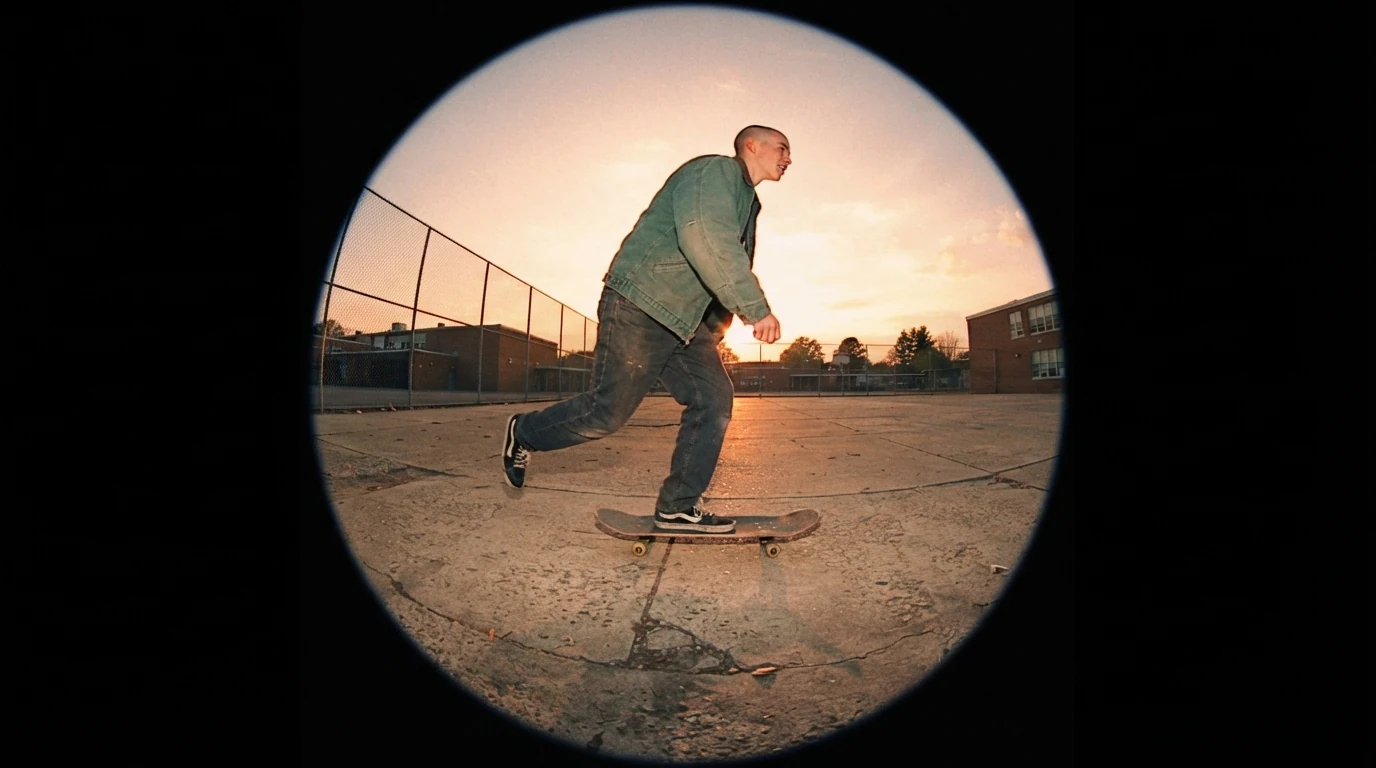
"Round circle inside a black frame" forces the circular type instead of an ordinary wide shot. "30 cm above the pavement" and "sneakers and the board are huge" create the near-far scale jump that makes a fisheye read, and "the fence and the horizon bend into a dome" tells the model exactly which lines to curve.
Open FlashBoardsFull-frame diagonal fisheye, image filled edge to edge, 8 mm lens on Super 35. A long candlelit hallway in an old stone manor house. A woman in her sixties with cropped silver hair, a long scar across her left eyebrow and a charcoal wool coat walks toward the lens, two meters away. Camera at chest height, perfectly centered: the vertical doorframe behind her stays straight while the walls, ceiling beams and floorboards curve outward like the inside of a barrel. Tall windows on the left throw cool daylight, candles on the right add warm pools. Formal, uneasy, slightly absurd mood.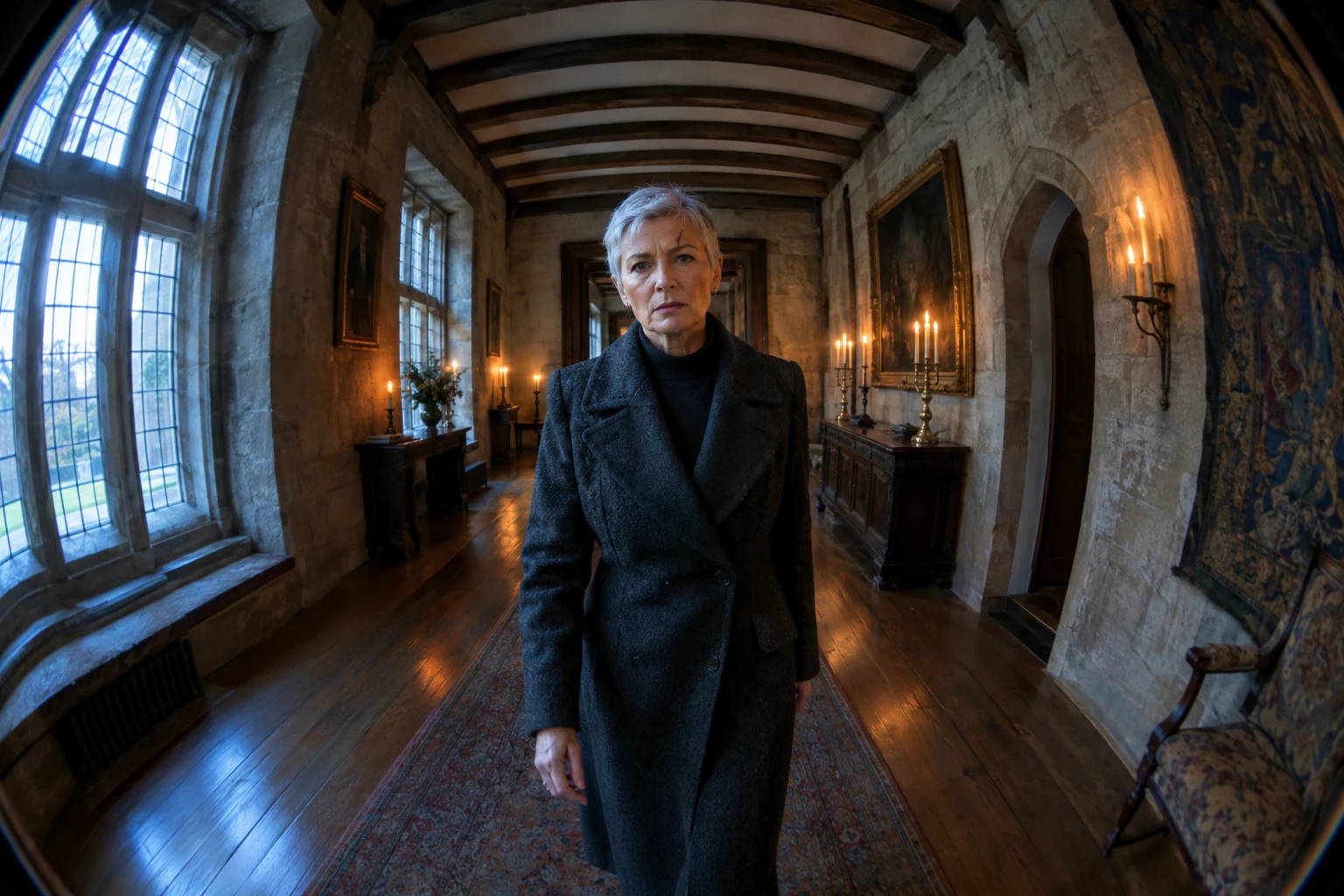
This is the second type: "image filled edge to edge" states the full-frame fisheye positively, so there is no black circle. "Perfectly centered" plus "the vertical doorframe stays straight" uses the fisheye rule that only lines through the center stay straight, which makes the bending walls look optical rather than melted. Two meters of distance keeps her proportions natural while the architecture bends.
Open FlashBoardsCamera: low follow shot at the same 30 cm height, moving forward at the skater's speed and keeping him centered in the round fisheye image, then rising to knee height as he jumps. Action: from the first frame the skater is already pushing hard, the board rolling fast over the concrete. In the middle he crouches and pops an ollie over a painted yellow curb, the board flipping up toward the lens and growing huge in the circle. At the end he lands, rolls away and glances back over his shoulder with a grin. The fence and horizon keep bending around the circular frame the whole time."Already pushing hard" makes the shot alive from the first frame, so the model follows instead of creeping in on a still. The ollie gives the lens something near to exaggerate — the board "growing huge in the circle" — which is where fisheye motion looks best. Restating "keep bending around the circular frame" stops the model from straightening the image once the camera moves.
Open FlashBoardsCommon mistakes
- It comes out as a normal wide shot. "Fisheye" alone often gives a rectilinear 16 mm look. Add the curve explicitly: "horizon bends into a dome", "walls bow outward", "strong barrel distortion", "180-degree field of view".
- Wrong type. Models mix circular and full-frame results. Say "round circle inside a black frame" or "image filled edge to edge" — describe what is there instead of writing what should be absent.
- Everything melts. Without a straight reference line the image looks liquefied. Center the subject and name one line that stays straight through the middle.
- No near object, no fisheye. A subject at five meters just looks small. Put a face, hand, board or shoe within 30 cm of the lens.
- Video straightens the lens. When the camera moves, the distortion can relax into a normal wide shot. Repeat the curved elements in the video prompt and keep the move simple.
- Faces become caricatures. At 15 cm a nose can dominate the frame. Move the lens to 40–60 cm or turn the face slightly for a gentler bulge.
Keep the reference frames, prompts and every generated take side by side — images and video in one canvas.
FAQ
5 questionsWhat is a fisheye lens used for in film?
Filmmakers use a fisheye lens when the frame should feel non-human or unstable: a computer, security camera or door viewer watching someone; a drunk, drugged or paranoid character; a skate or music video with in-your-face energy; or a room that seems to curl around a person. Because the curved lines are always noticed, it works best in short doses or as a deliberate signature style.
What is the fisheye effect?
The fisheye effect is the look an ultra-wide curvilinear lens produces: straight lines bow outward unless they cross the center of the frame, horizons turn into domes or arches, and anything close to the lens looks huge while the background shrinks. It can be shot in camera with a fisheye lens or adapter, or approximated in post by adding barrel distortion to a wide shot.
What focal length is a fisheye lens?
On a full-frame sensor, circular fisheyes are usually around 8 mm and diagonal (full-frame) fisheyes around 15–16 mm. On a Super 35 cinema sensor the diagonal look sits near 8–10 mm, and on smaller sensors it drops lower still. Focal length alone does not make a fisheye, though: a 14 mm rectilinear lens is nearly as short but keeps lines straight.
What is the difference between a circular and a full-frame fisheye?
A circular fisheye projects the whole 180° view as a round picture inside a black frame, so the shot looks like a porthole or peephole. A full-frame, or diagonal, fisheye crops that circle to fill the rectangle, with about 180° across the diagonal. It looks closer to a normal shot until you notice the bending lines, which is why most feature films use it.
Are action cameras fisheye lenses?
Many small action cameras use very short, strongly curvilinear lenses, so their widest modes look close to a full-frame fisheye: curved horizons, bent edges and huge foreground objects. Most also offer a corrected or linear mode that straightens lines by cropping and remapping the image. For a true circular fisheye look you still need a dedicated fisheye lens, an adapter or a 360° camera.
Related terms
4- Wide-Angle LensLenses, Focus & Exposure
A wide-angle lens has a shorter focal length than normal: it takes in more space, exaggerates the distance between near and far, and enlarges whatever is close to the camera — from immersive interiors to unsettling, distorted close-ups.
- Lens DistortionLenses, Focus & Exposure
Lens distortion is the way a lens bends lines that should be straight — outward like a barrel on wide and fisheye lenses, inward like a pincushion on some long lenses; filmmakers either correct it or push it to make a space feel warped and unstable.
- Extreme Close-UpCamera Shots
An extreme close-up isolates a tiny part of a subject — an eye, lips, a finger on a trigger, a watch face — so a single detail fills the frame and takes on enormous weight.
- Altered State EffectPost-Production & VFX
An altered-state effect makes the image behave like a drugged, drunk or feverish mind — warped lenses, smeared motion, doubled exposures, color shifts, rubbery time — so the audience shares the character's perception.
Further reading
Blain Brown, Cinematography: Theory and Practice (Routledge) — chapters on lenses and perspective. Rudolf Kingslake, A History of the Photographic Lens (Academic Press).