 FlashBoards Learn
- Learn
- Lenses, Focus & Exposure
- Split Diopter
Lenses, Focus & Exposure · Film language
Split Diopter
Also called: split diopter shot, split-field diopter, split focus diopter
A split diopter is a half-lens attachment that makes one side of the frame focus close and the other side focus far, so a face inches from the camera and a figure across the room are both sharp. The viewer reads two planes at once, joined by a soft seam that betrays the trick.
- What it does
- Holds a close subject and a distant subject in sharp focus at the same time, with a soft band between them.
- Use it when
- A reaction and its cause, or a watcher and the watched, must be read together in one uncut frame.
- Watch out
- The middle distance stays soft and the seam shows; hide it along a door frame, wall edge or dark area and keep actors on their own side.
- Try this prompt
Split diopter shot, woman's face in extreme close-up on the left and a man in a doorway far behind on the right, both razor sharp, soft blurred seam between them
What is a split diopter?
A diopter is a close-up lens: a single piece of positive glass that lets the camera lens focus nearer than its normal minimum. A split diopter is that glass cut in half. Mounted in front of the lens, it covers only part of the image. Behind the glass, the lens focuses close; through the empty half, it focuses wherever the focus puller set it.
The result is an image with two independent planes of camera focus. A foreground subject a foot or two from the lens is sharp on one side, and a subject several meters away is sharp on the other. Everything in between is soft, and so is a narrow band along the edge of the glass: the seam.
A split diopter does not stretch depth of field; it places two separate, fairly shallow zones of sharpness side by side. Because the eye expects a real lens to blur either the foreground or the background, the shot looks slightly uncanny, and many directors use it for exactly that reason.
It is also called a split-field diopter or split focus diopter. The glass comes in fixed strengths, most commonly +1/2, +1, +2 and +3, in a rotating mount, so the edge can be turned vertical, horizontal or diagonal to match the composition.
How do you recognize a split diopter shot?
Split diopter examples are easy to spot once you know the signs:
- Two sharp subjects at very different distances. A face fills one side of the frame in close-up or tighter, while a small figure on the far side is equally crisp.
- A soft middle. Walls, furniture or people at medium distance are blurred on both halves. Real deep focus would keep them sharp too.
- A seam. A vertical, horizontal or diagonal band where the image smears. Good crews hide it along a door frame, the edge of a head or a dark patch of set; on a flat bright wall it shows as a faint line.
- A frame split in two. One subject crowded to the left, one to the right, little happening in the center.
The tell is strongest when the foreground is an extreme close-up of an eye or a hand and the background subject is full figure. No stop on a normal lens reaches that range, so the viewer senses something unnatural even without knowing the name.
Why do filmmakers use split diopter shots?
The split diopter solves a staging problem and creates a feeling at the same time.
It shows cause and reaction without a cut. A character in the foreground reacts while the thing they react to happens behind them. Where a rack focus moves attention from one plane to the other over time, the split diopter refuses to choose and lets the audience connect the two.
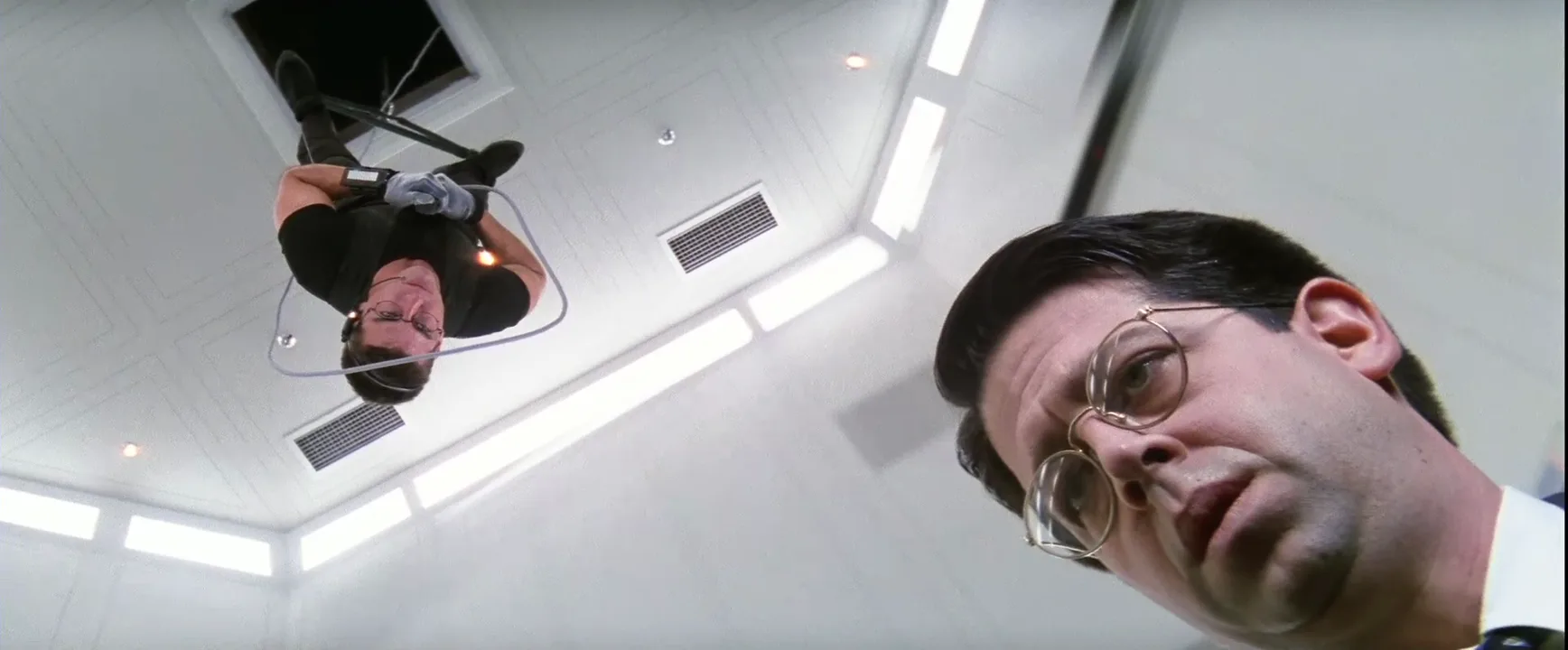
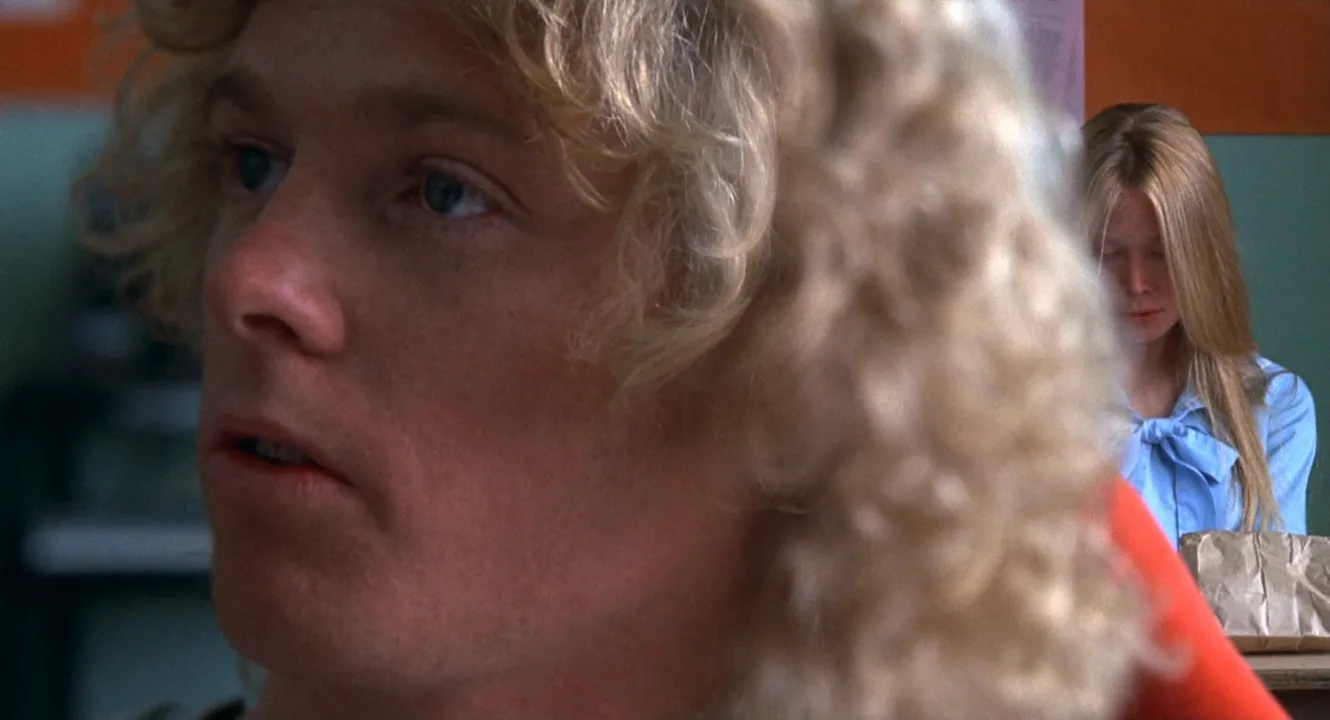
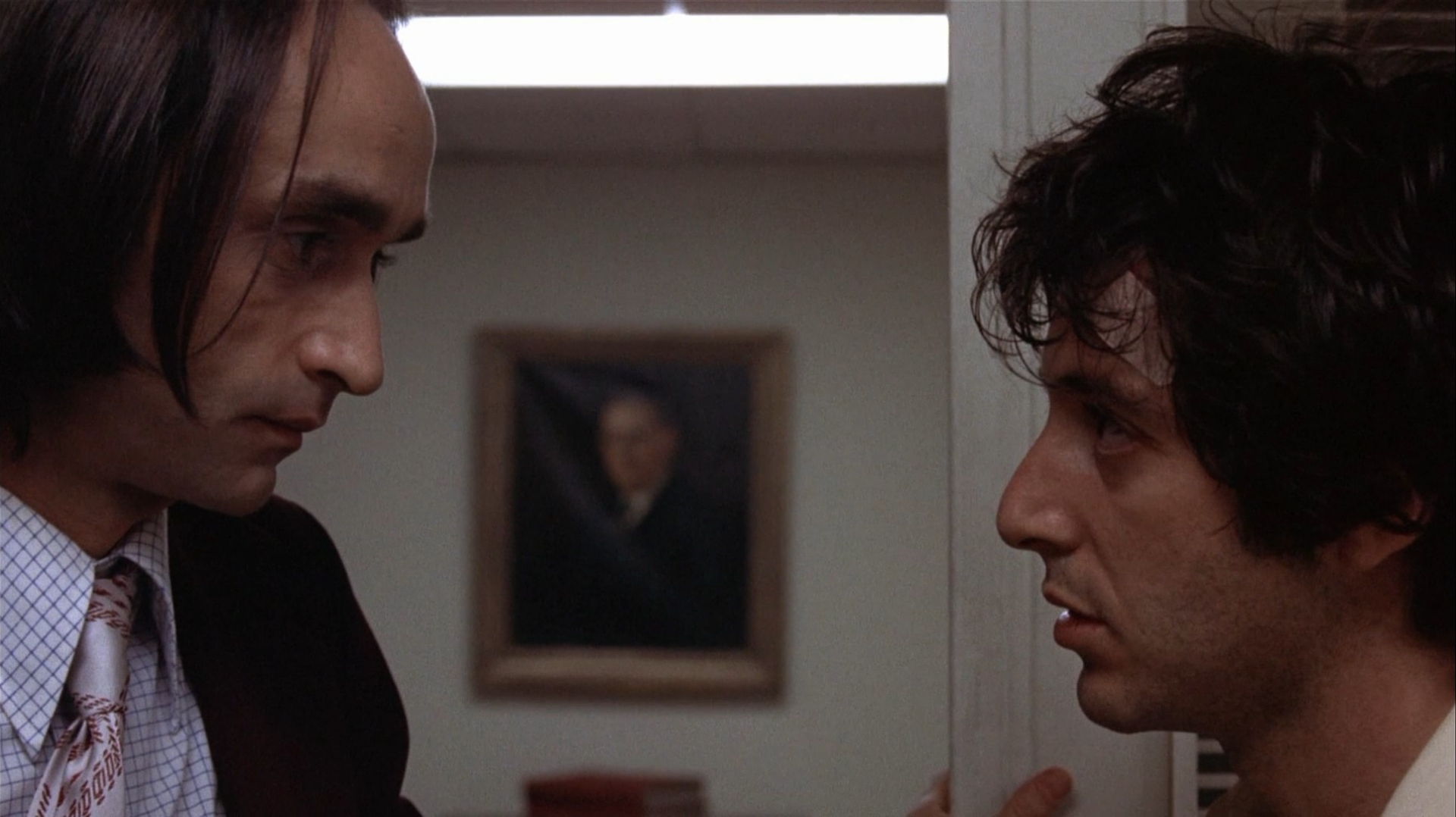
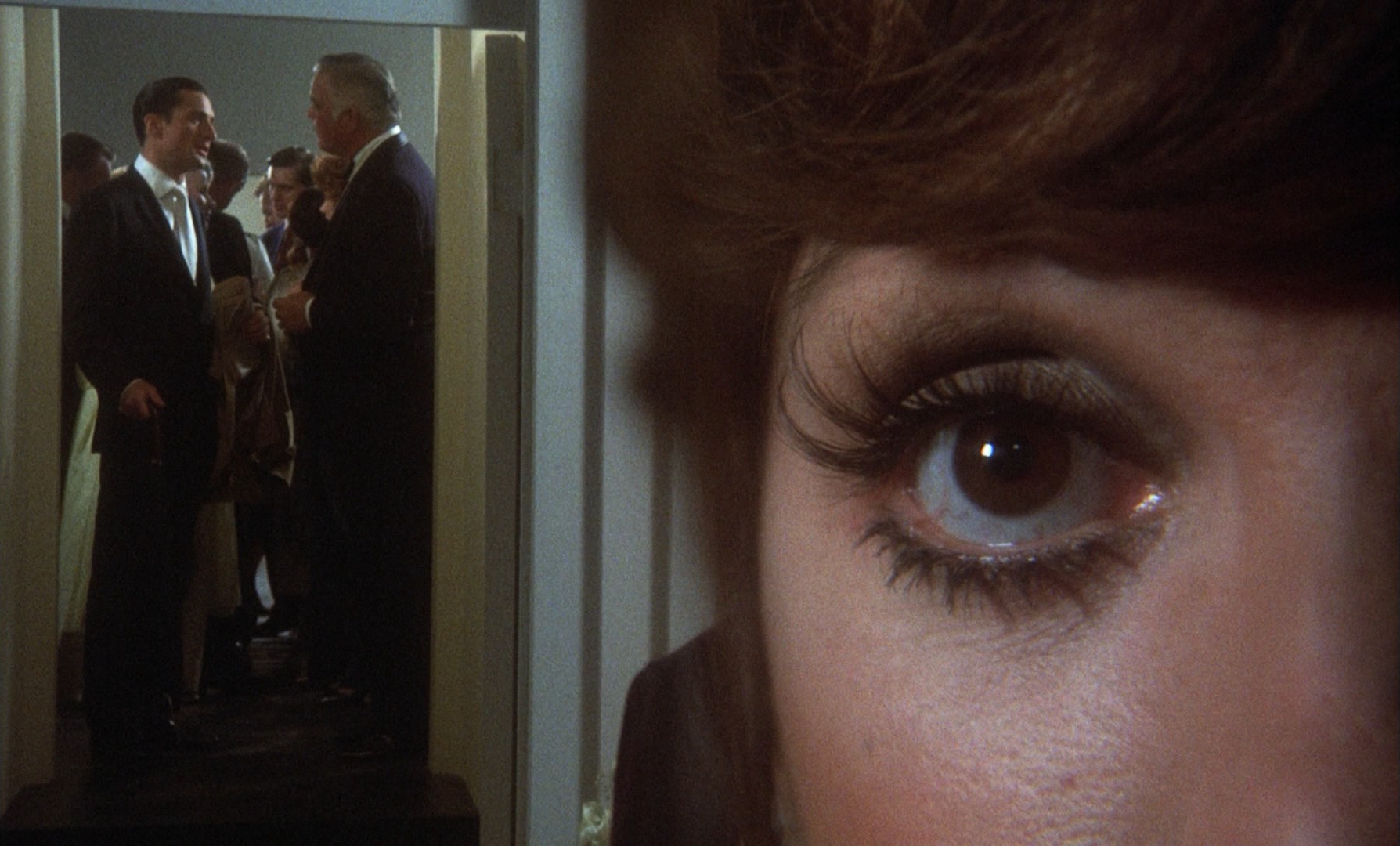
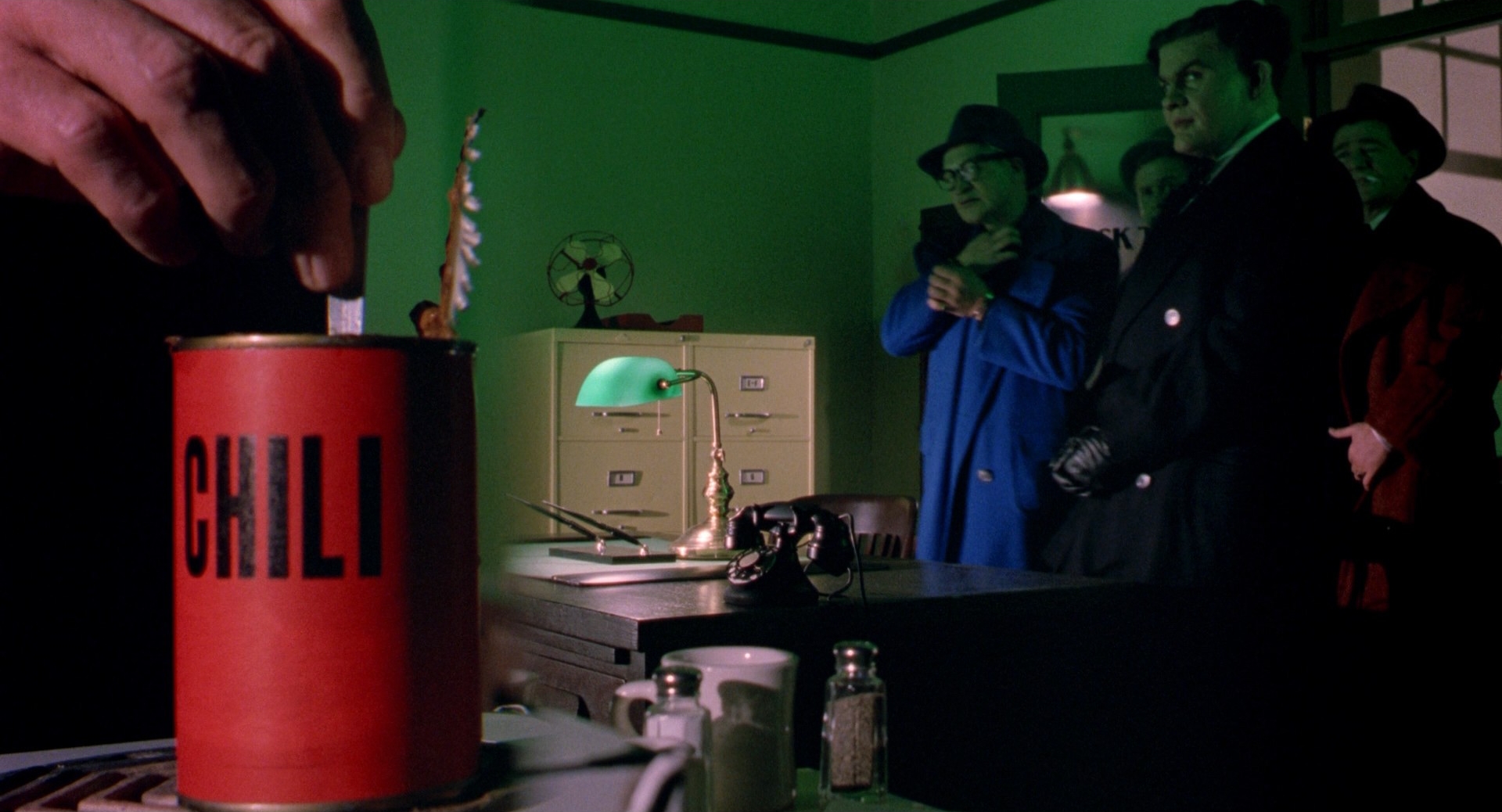
It creates dramatic irony. A foreground character who cannot see the background event lets the audience know more than the people on screen. Brian De Palma built a signature on this: in Carrie (1976), Blow Out (1981), The Untouchables (1987) and Mission: Impossible (1996), the diopter puts a face and a threat, or a watcher and a target, into one frame.
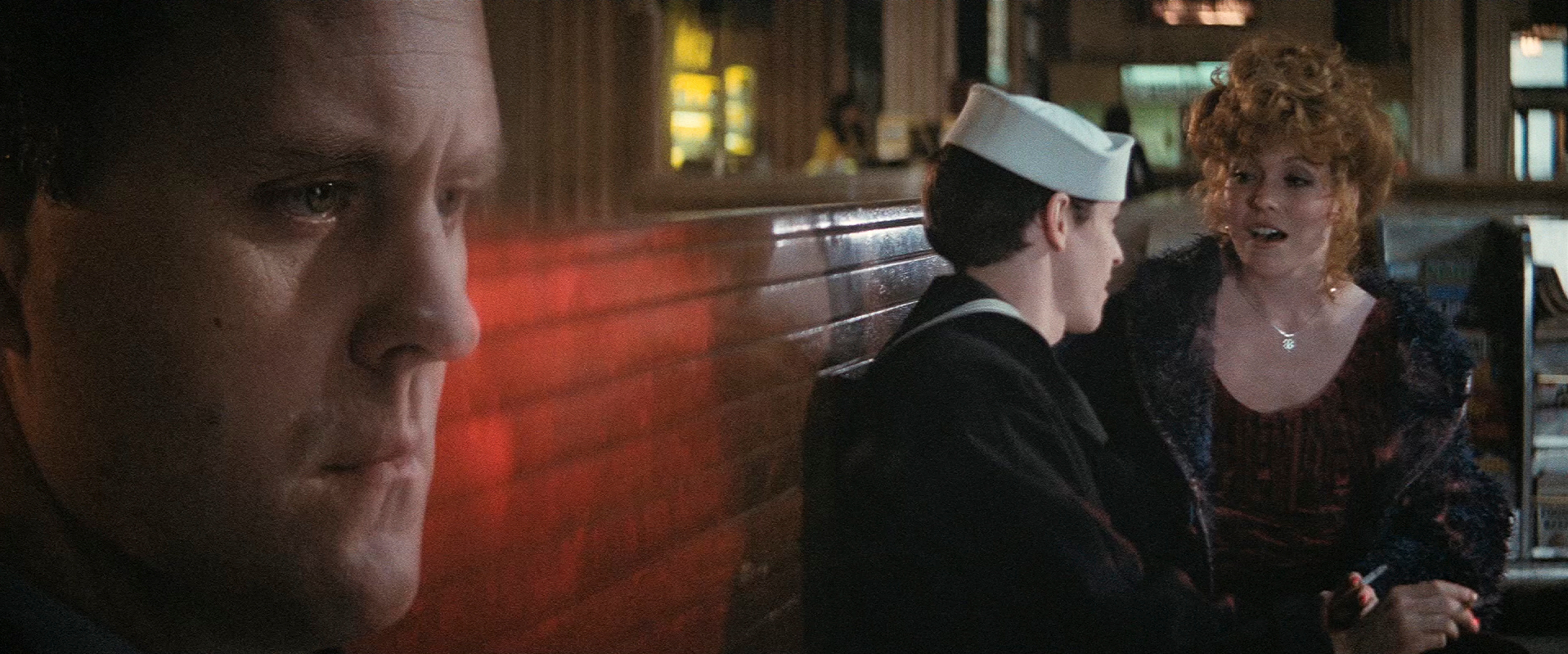
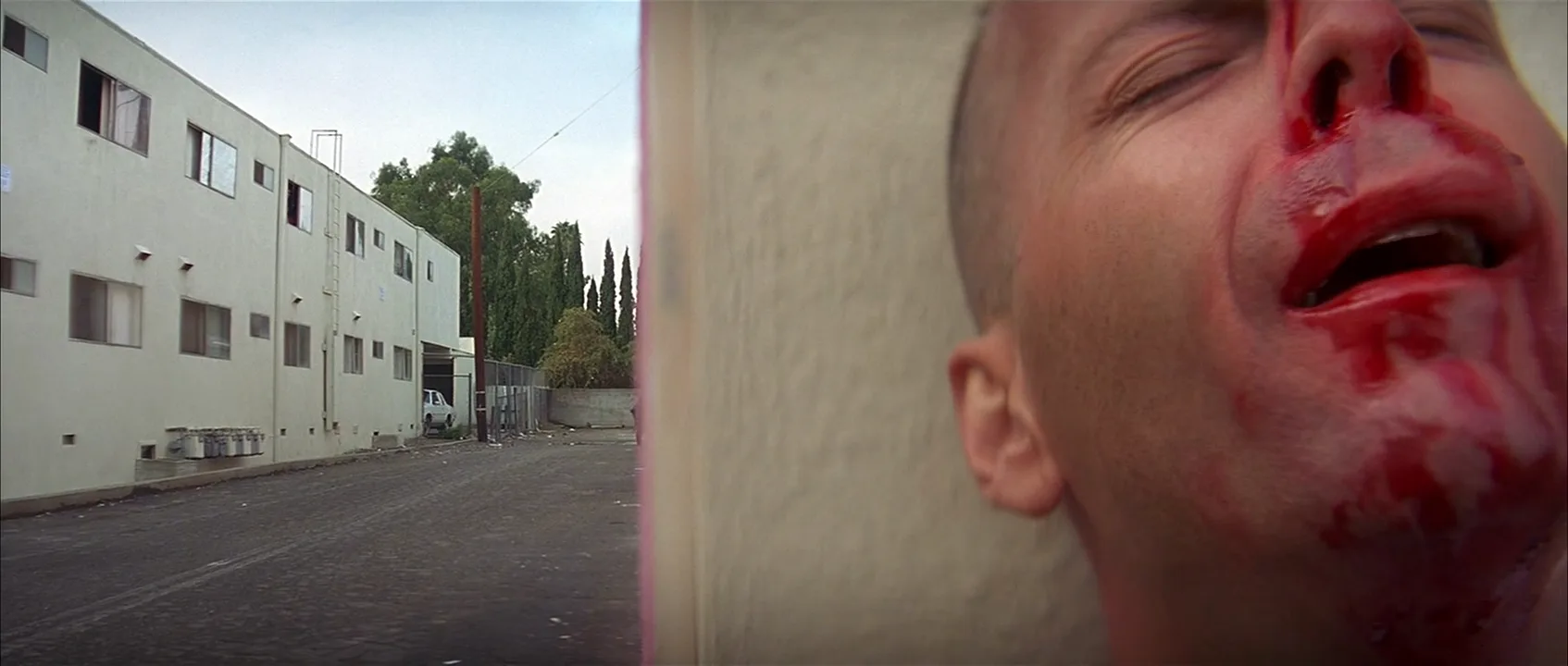
It puts pressure on the image. Both planes are sharp but the space between them is soft, so the frame feels compressed and slightly artificial. That suits thrillers, paranoia and heightened drama. Steven Spielberg used split diopters in Jaws (1975), Martin Scorsese in New York, New York (1977) and The Departed (2006), and Quentin Tarantino for a bloodied close-up in Pulp Fiction (1994).
It adds depth to a two-shot. In dialogue, a split turns a flat two-shot into depth layering: one character large and near, the other small and far, both readable. It is a more stylized cousin of the over-the-shoulder shot, where the near shoulder usually goes soft.
The cost is subtlety. Viewers who notice the seam feel the hand of the filmmaker, which is why some directors use it once and others build a style on it.
How to shoot a split diopter shot
Pick the strength with simple math
A diopter of strength D, on a lens focused at infinity, focuses at 1/D meters: a +1 at about 1 m, a +2 at 50 cm, a +3 at 33 cm. When the lens itself is focused closer, the diopter half focuses closer still. A handy estimate is: near focus = 1 / (D + 1/d), where d is the lens focus distance in meters. With the lens set to 6 m for the background actor and a +2 split, the diopter side is sharp at about 46 cm. Work backwards from where the foreground actor will stand.
Lens and stop
Most split diopter shots are made on normal or moderately wide-angle lenses, roughly 25 to 50 mm in Super 35 terms, because both subjects need to fit in a single frame at very different sizes. A mid aperture such as T4 to T5.6 gives each zone a little depth so the actors have room to move. Check the seam at the actual shooting stop: the width and hardness of the transition band change as you open or close the iris, so what looks hidden at T2.8 on the monitor can show at T8.
Hide the seam
The edge of the glass is out of focus and smears whatever sits behind it. Line it up with something that already has a hard edge or no detail: a door frame, a wall corner, a window mullion, the dark side of a face, the edge of a coat, a black background. Rotate the mount so the seam follows that line; a diagonal edge often fits a staircase or a table better than a vertical one.
Block the actors to their halves
Each actor must stay inside their own zone. A background actor who walks toward the seam crosses into the half focused at 50 cm and turns to mush; a foreground actor who leans back drops out of the diopter's thin zone. Mark both positions. Head turns and gestures work; crossing the frame does not.
Keep the camera still
The seam stays fixed in the frame, but a pan or dolly slides the set and the actors across it. Most split diopter shots are locked off.
Light both planes
Light the near face and the distant figure separately, and keep bright highlights away from the seam: a highlight smeared across the edge is the fastest way to reveal the trick.
Digital alternatives
The same look can be built in post: shoot the frame twice, focused on each subject, and join the plates along a soft matte. A tilt-shift lens is a different tool: it tilts the plane of focus into a diagonal, holding a near object on one side and a far one on the other without a seam, but only along that one slanted plane.
Split diopter vs. deep focus
Both keep a near subject and a far subject sharp, and both let the audience choose where to look. They get there in opposite ways.
Deep focus is an optical fact of the whole frame. A wide lens, a small aperture and plenty of light create one very deep zone of sharpness, so foreground, middle ground and background are all crisp. Actors and camera can move freely through the depth, and the look feels natural.
A split diopter creates two thin zones of sharpness side by side, with softness in between and a seam where they meet. It can hold subjects far closer to the lens than deep focus ever could, down to an extreme close-up of an eye, at a normal stop and in low light. The price: a soft middle, actors pinned to their halves and an image that feels constructed.
A quick test: look at something halfway between the two subjects. If it is sharp, it is deep focus. If it is blurred while both subjects are sharp, it is a split diopter or a digital composite.
Choose deep focus when the space matters and people move through it. Choose the split diopter when two faces, or a face and an object, must collide in one frame. For the opposite, one plane isolated from everything else, use shallow depth of field. All of these belong to the wider toolkit of lenses, focus and exposure.
Split Diopter examples in film
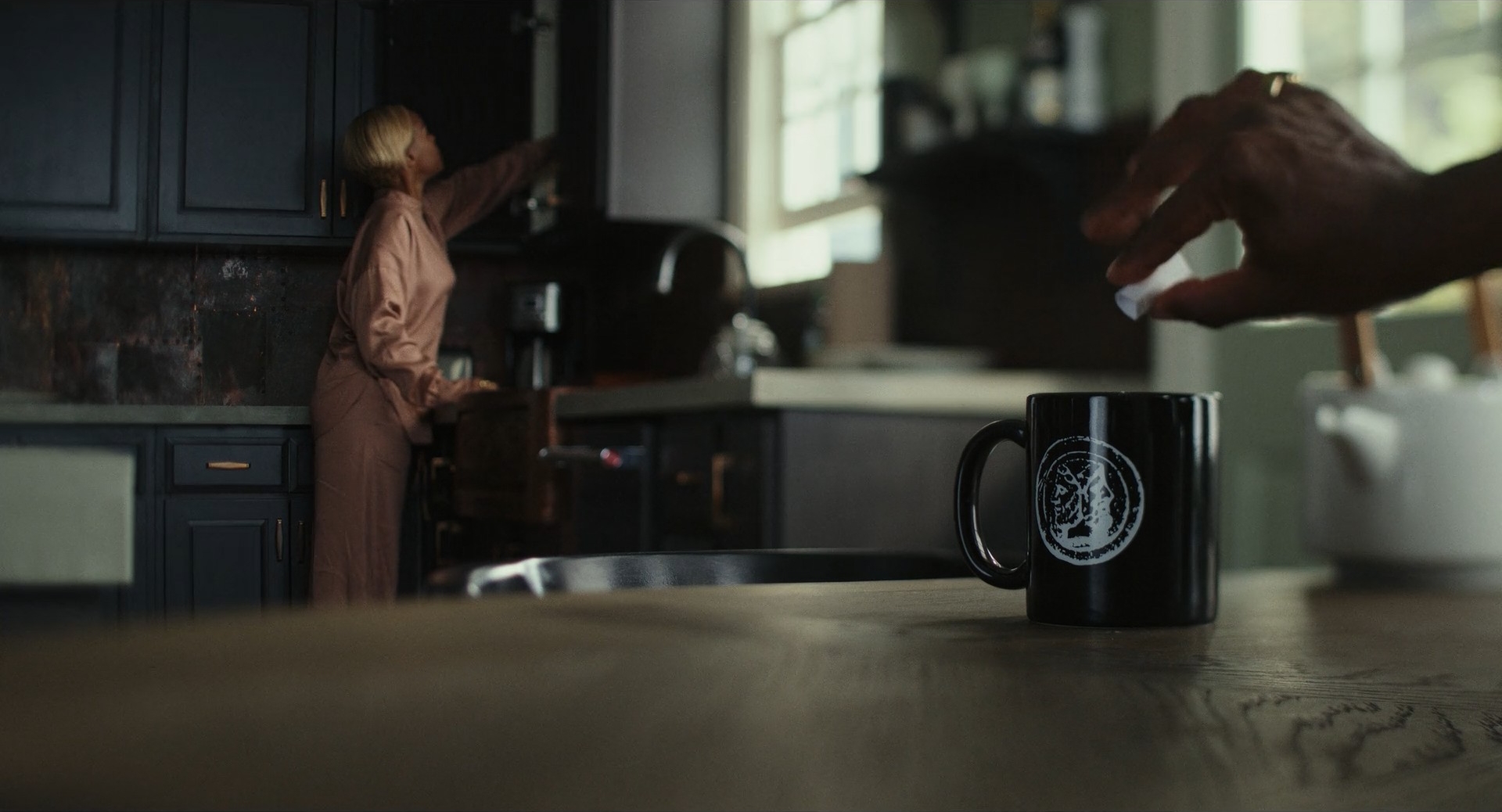
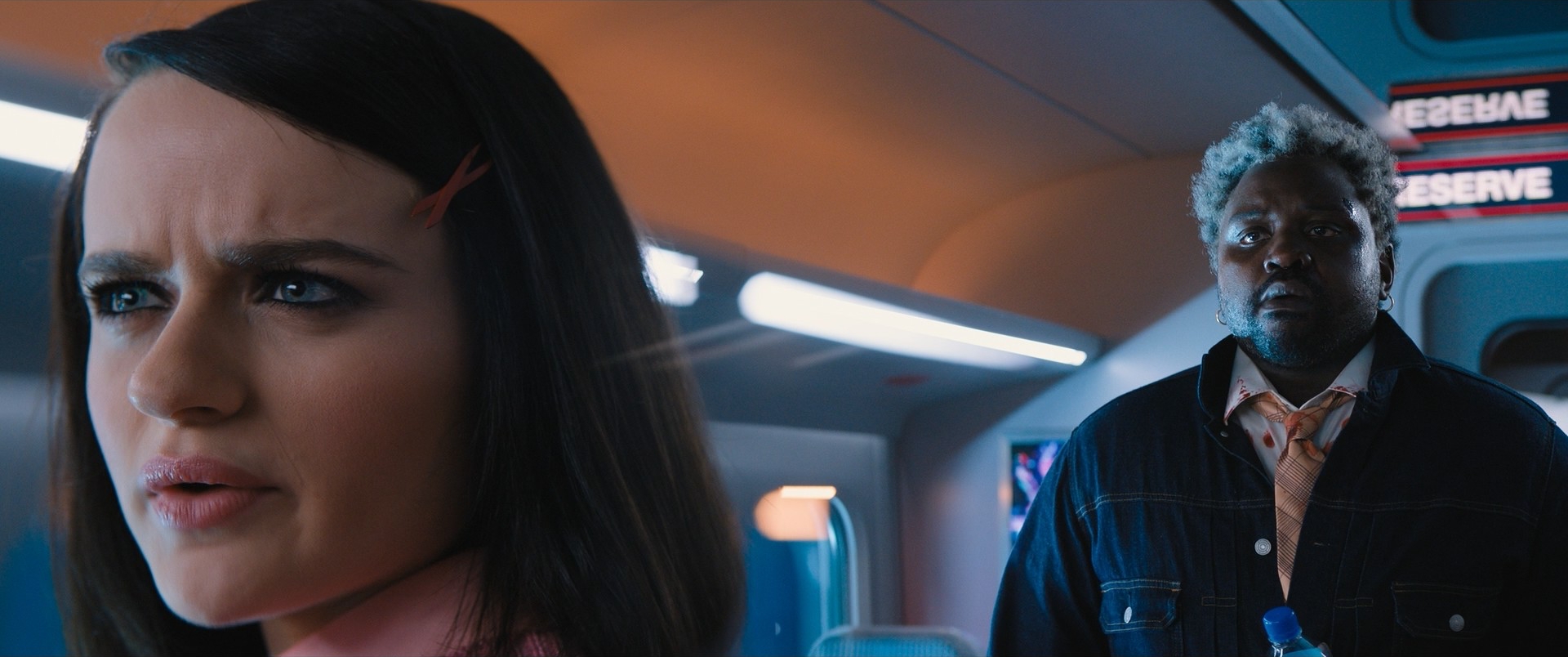
14 framesFourteen split diopter shots from films. Find both sharp subjects, then the soft band between them and what hides it.
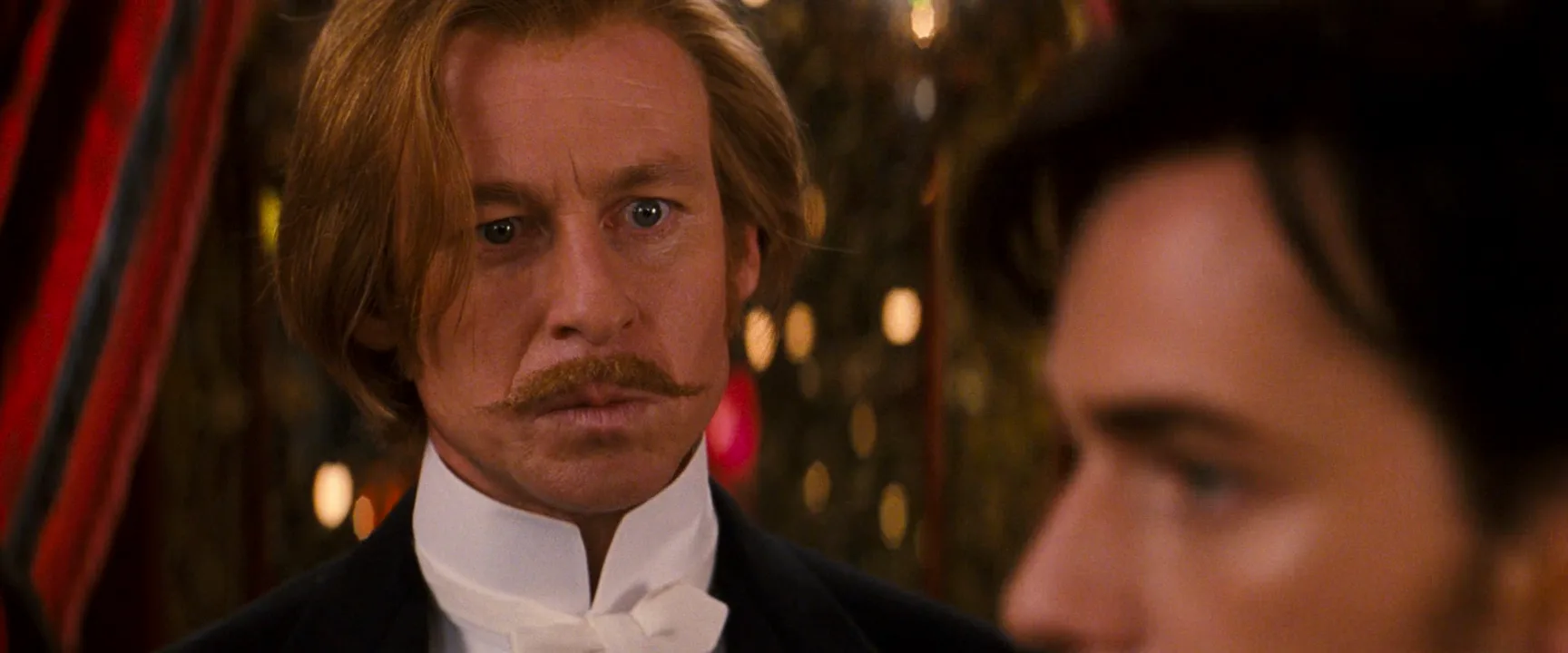
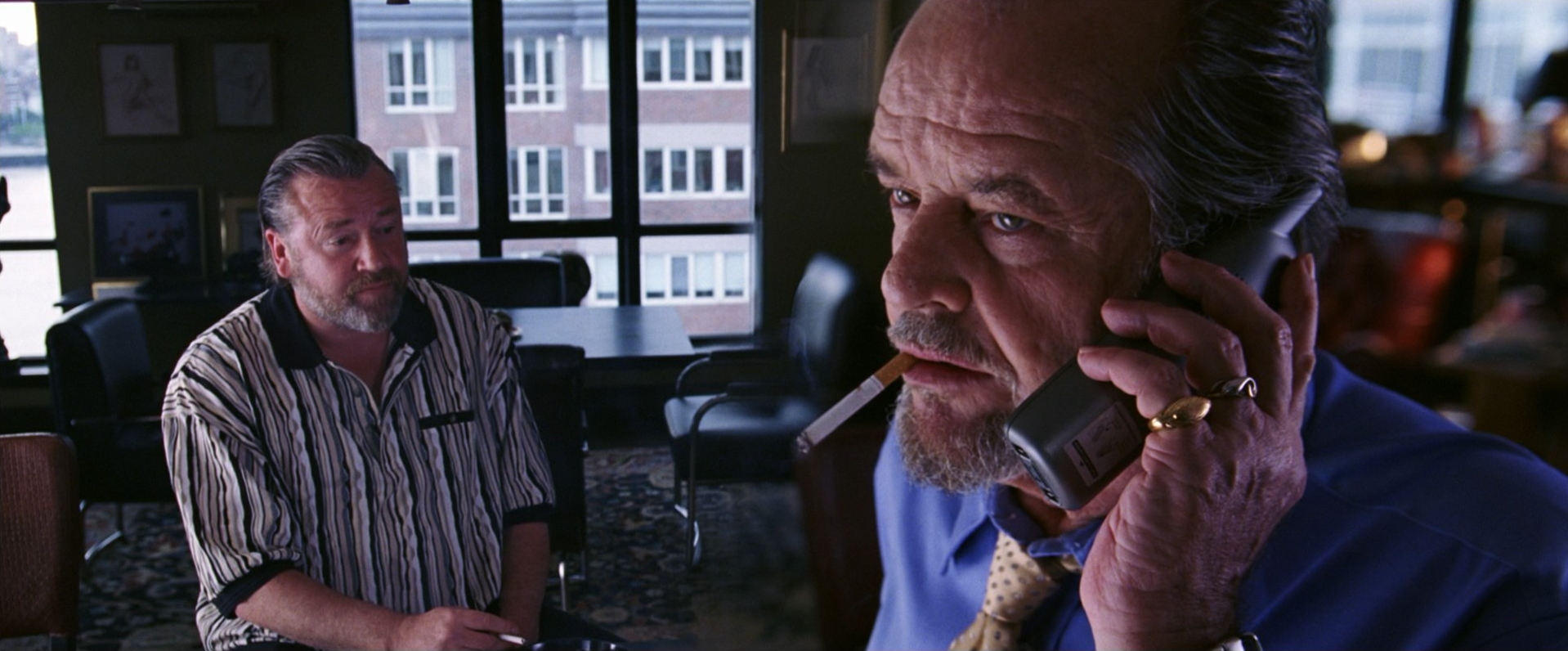
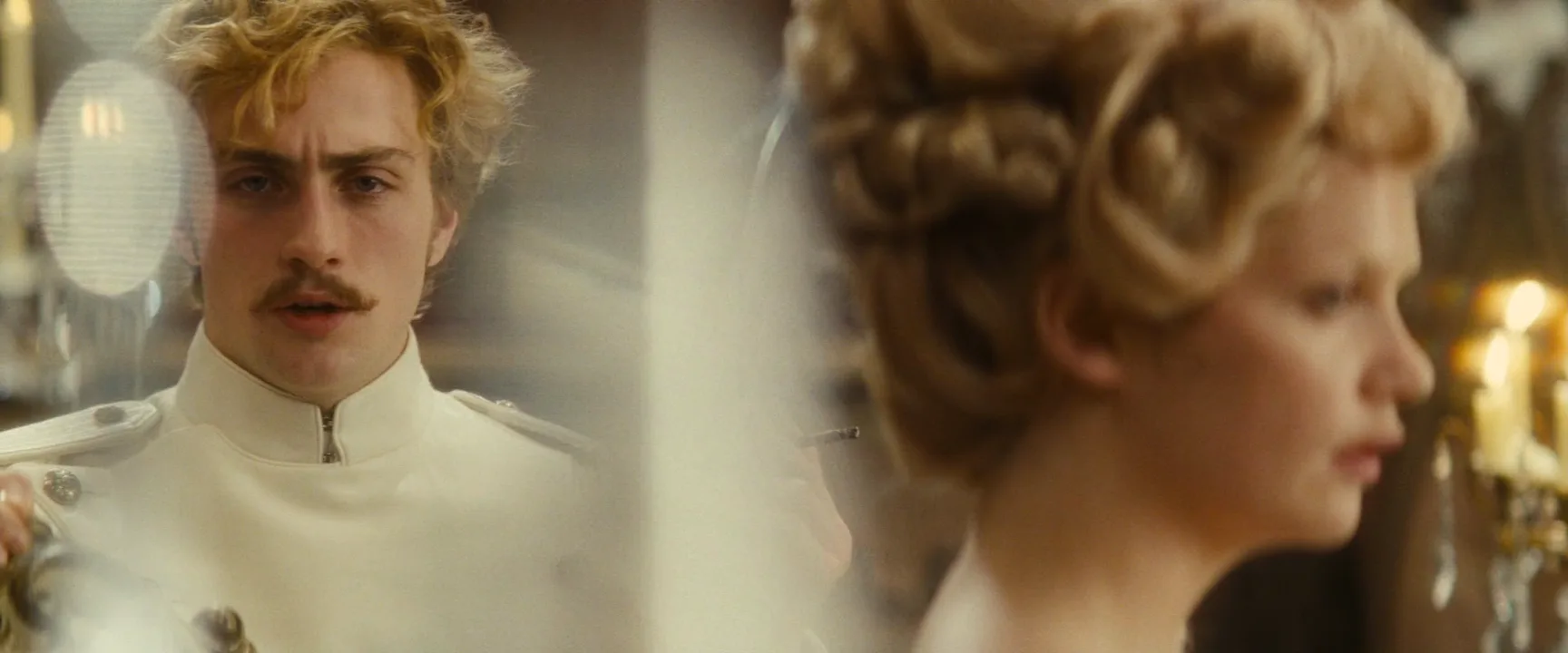
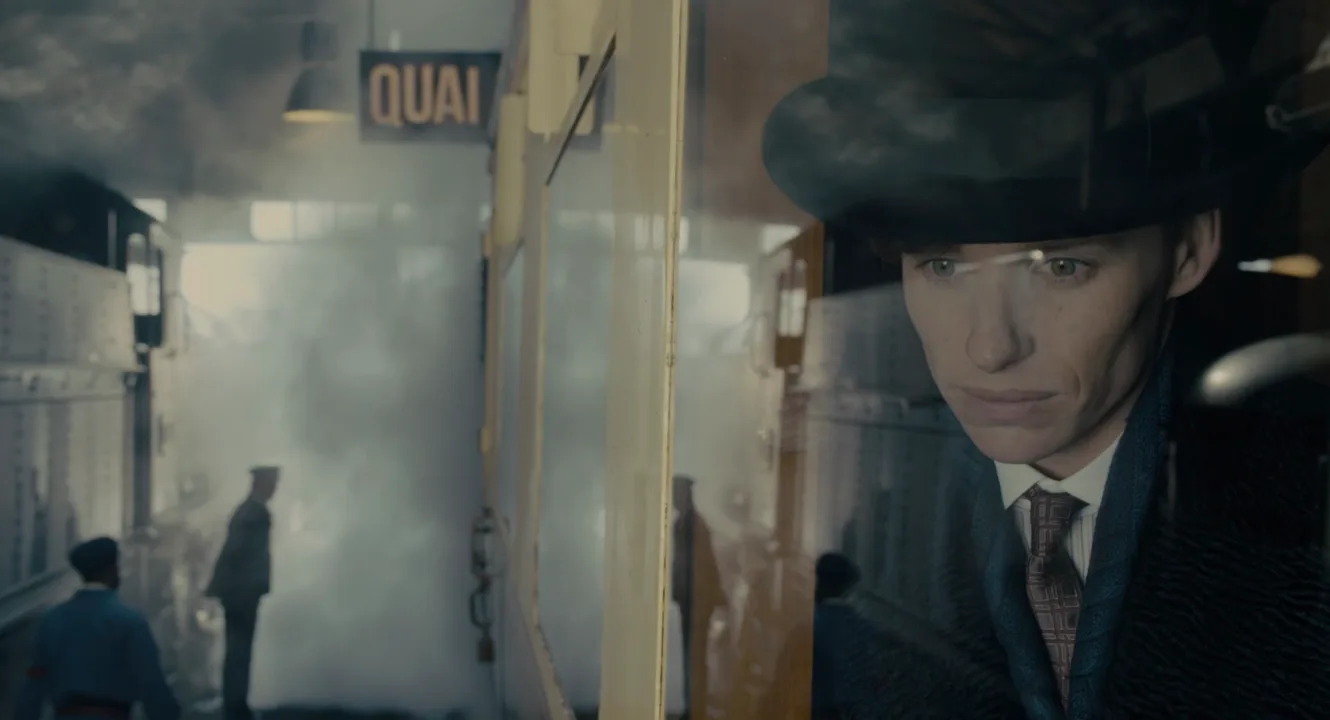
How to create a split diopter with AI
4 promptsImage and video models default to one plane of focus with a blurred background, so a split diopter has to be spelled out: two subjects at named distances, both called sharp, and a soft seam in a named place. Build the start frame with Nano Banana 2 Lite, try a second take with GPT Image 2.5, then animate recipe 1 with MiniMax H3 Max Turbo. Keep the film frames and your takes on one FlashBoards board to compare where each model puts the seam. The fourth prompt re-shoots a real film shot from a text description alone, and the original plays next to the result so you can compare.
Split diopter film still, 1970s thriller look, 35mm lens, camera at seated eye height in a dim apartment kitchen at night. Left half of the frame, very close to the lens: the profile of a woman in her fifties with a silver chin-length bob, a small scar on her chin and a gold hoop earring, eyes turned right, face razor sharp. Right half of the frame, six meters away through an open doorway: a young man with a shaved head, a thin mustache and a green bomber jacket stands at the front door with one hand on the latch, full figure, also razor sharp. The kitchen wall between them is soft and out of focus, with a narrow blurred vertical seam along the dark wooden door frame where the two focus zones meet. Warm lamp light on her face, cool blue light from the hallway on him.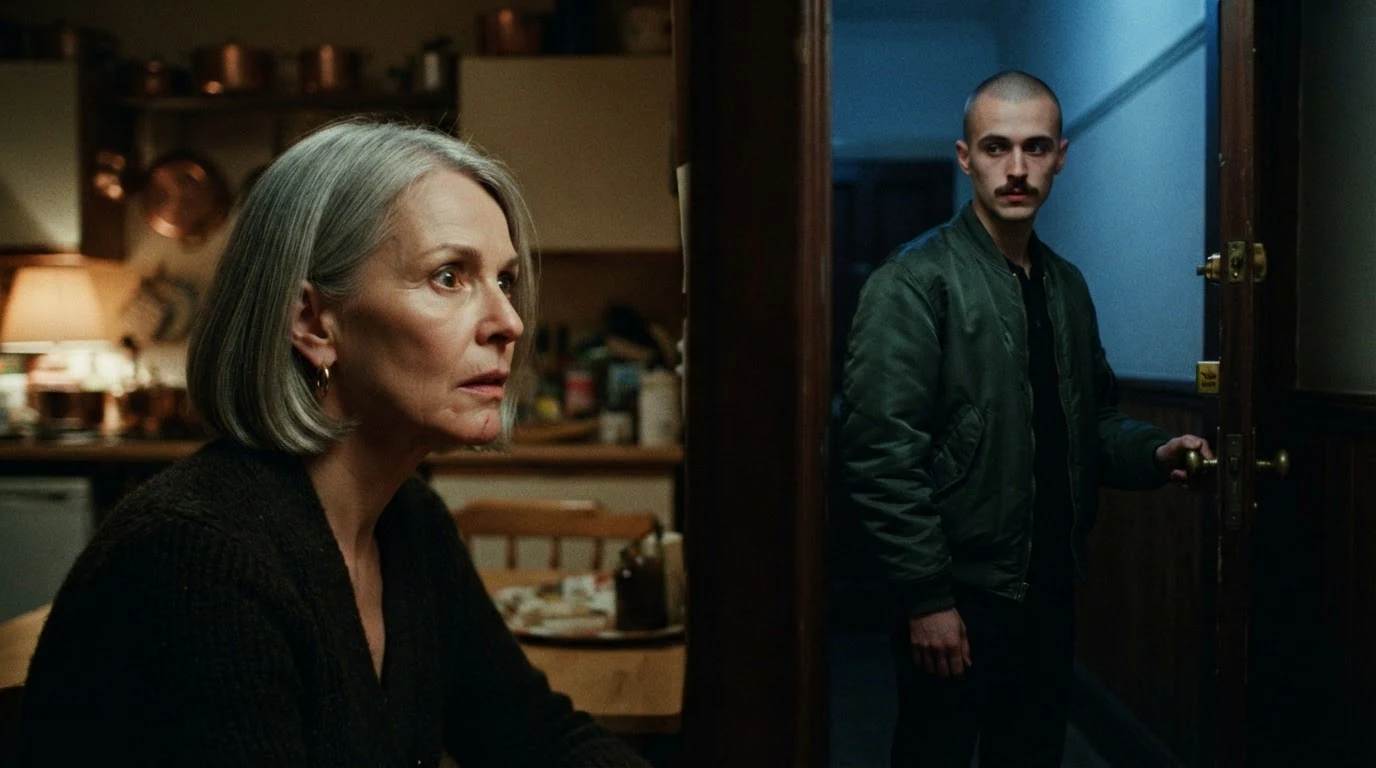
Split diopter names the technique, but the model needs the layout: left half, very close to the lens and right half, six meters away fix the distances, and razor sharp on both subjects overrides the default blurred background. The kitchen wall between them is soft and the seam along the dark wooden door frame describe the tell-tale middle and give the seam a hiding place.
Open FlashBoards21:9 split diopter shot inside an empty night train carriage, 32mm lens at table height. Lower right foreground, a few centimeters from the lens: an open brass pocket watch lying on a wooden table, its engraved lid and hands in extreme close-up, crisp. Upper left background, at the far end of the carriage about eight meters away: a tall woman with cropped red hair, a long black raincoat and a leather satchel steps in through the sliding door and looks down the aisle, full figure, equally crisp. The seats in the middle of the carriage are blurred. A soft diagonal band of blur runs from the top right to the bottom left where the two sharp zones meet. Fluorescent ceiling light, dark windows reflecting the interior.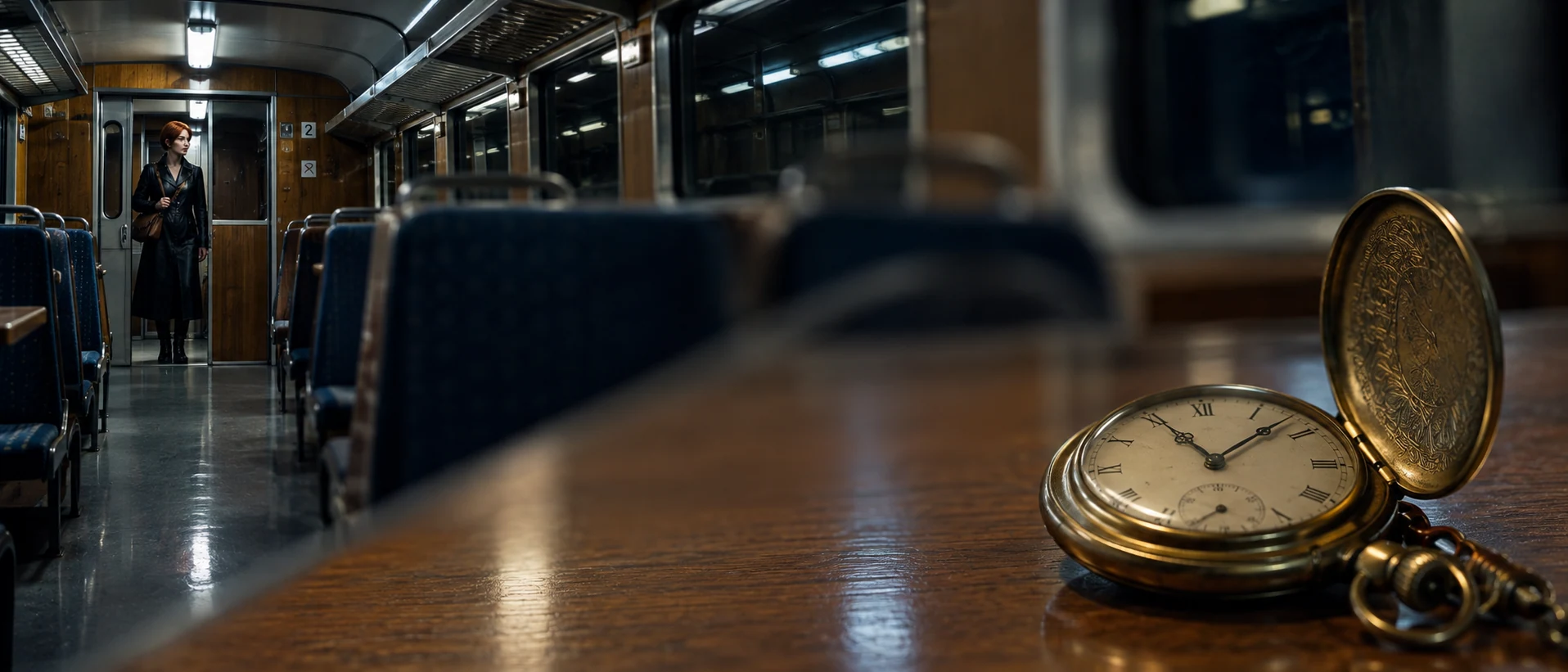
This take pairs an object with a person and turns the seam diagonal, as a rotated diopter would. A few centimeters from the lens puts the watch far closer than any natural stop could hold with the far door, equally crisp keeps the woman sharp, and seats in the middle are blurred stops it from becoming ordinary deep focus.
Open FlashBoardsCamera: locked-off static shot for the whole take, no pan and no push, the split focus stays fixed so the woman on the left and the young man in the doorway on the right both stay sharp while the kitchen wall between them stays soft. Action: from the first frame the young man slides the latch shut with a click and turns to face the kitchen, while the woman's eyes narrow and her jaw tightens. In the middle he stands still in the doorway and slowly pulls off his gloves. At the end the woman turns her head a few degrees toward him without leaving the left side of the frame, and the lamp light catches her scar.A locked-off camera matches how split diopter shots are made: a pan would slide the actors across the seam. Motion starts in both halves in the first frame, each actor moves only inside their own zone, and every detail, from the latch to the scar, already exists in the start frame.
Open FlashBoards{
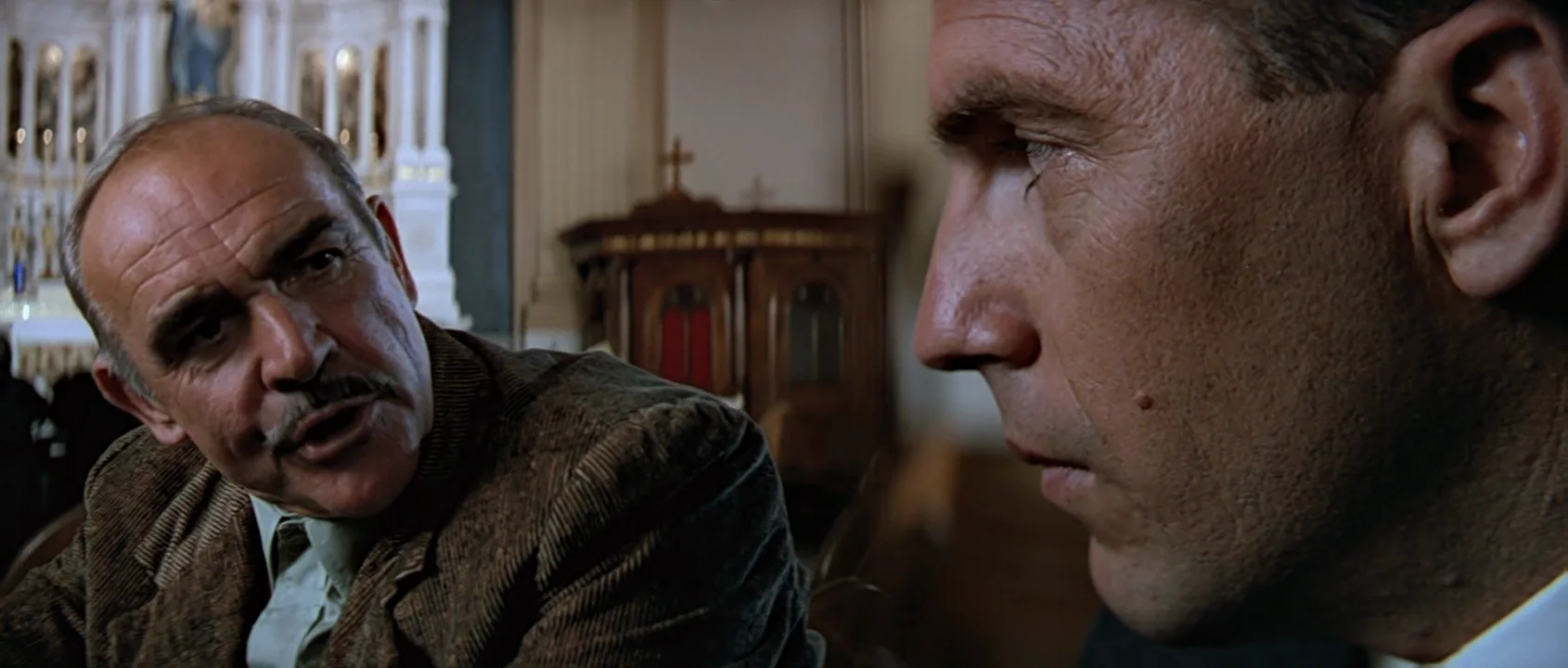
"output": "Full-screen live-action scene from The Untouchables (1987), from its very first frame: one single continuous locked-off shot, no cuts. 1980s 35mm anamorphic film with fine grain, 2.39:1 frame, a quiet Catholic church interior by day; warm low-key light, a palette of brown, amber and ivory. Split diopter composition: a face in extreme close-up on the right and a smaller man three meters behind it on the left are both razor sharp at the same time, while everything between and behind them is soft.",
"characters": {
"S1": {
"name": "Jim Malone, played by Sean Connery",
"look": "heavyset man in his late fifties, bald crown with a short grey fringe over the ears, heavy dark brows, deep forehead lines, thick grey mustache, rumpled brown corduroy jacket over a pale blue-green shirt",
"voice": "low, gravelly, Scottish-tinged, slow and deliberate"
},
"S2": {
"name": "Eliot Ness, played by Kevin Costner",
"look": "clean-shaven man in his early thirties, short neat dark-brown hair, straight nose, a small mole on his cheek, white shirt collar under a dark suit; seen only in profile",
"voice": "silence: does not speak in this shot"
}
},
"shots": [
{
"shot": 1,
"camera": "locked-off static camera that never moves, seated eye level, anamorphic lens with a half split diopter over its right side, focus never shifts. Right half of the frame, a hand's width from the lens: S2's head in extreme close-up profile facing screen left, so large that his forehead is cut by the top edge and his chin and white collar touch the bottom edge, his ear and the back of his head cut by the right edge. Left third of the frame, about three meters behind him and much smaller: S1 seated and leaning forward, framed from mid-chest up, a band of blurred altar about one sixth of the frame height above his bald crown, his head from crown to chin only about 45 percent of the frame height, his shoulders and chest filling the lower left corner; S2's face is more than twice the size of S1's face. Both S1 and S2 are razor sharp with crisp skin texture at the same time; the church between and behind them is out of focus, a soft blur; a narrow soft vertical band runs down the dim brown background just left of S2's nose, where the two focus zones meet. Behind S1 at the upper left, a soft white carved altar with tall lit candles and a small blue-robed statue; in the blurred center background, a dark wooden confessional with red curtained panels and a small cross on top against a cream wall; dark pews low in the frame. Warm hard light from above and screen left: highlights on S1's bald head and brow, the front of S2's face lit warm, his cheek and ear falling into shadow.",
"action": [
"BEGINNING: alive from the first frame, S1 leans forward in the left third with his shoulders hunched toward S2, head cocked, eyes locked on S2's face at screen right, brows raised, and he is already speaking, lips clearly moving. S2 holds still in profile on the right, eyes fixed ahead toward screen left and slightly down, never toward S1, lips pressed shut, jaw set.",
"THEN: S1 finishes his question, closes his mouth and waits, staring hard at S2; S2 does not answer and does not move.",
"THEN: S1 blinks slowly, tilts his head toward screen left and sinks lower and a little closer, his face dropping in the frame; at the same moment S2 turns his head slowly by only a few degrees further toward screen left, so a little more of his ear shows at the right edge, eyes still down and to the left, his head staying in the same place.",
"THEN: S1 begins his warning, brows lowered, eyes locked on S2, lips clearly moving; S2 listens motionless, lips never moving.",
"THEN: in the middle of the line S1 lifts his hand on the screen-left side at chest height into the lower left corner of the frame, index finger pointing across at S2, jabs it toward S2 once and drops it below the bottom edge; the hand stays low at chest height the whole time.",
"END: S1 presses the last words home, closes his mouth and holds his stare on S2; S2 stays frozen in profile, jaw tight, eyes down and to the left; both faces still razor sharp, the church between them still soft."
],
"dialogue": [
{
"speaker": "S1",
"on_screen": true,
"when": "from the first frame, already mid-question, finished before his pause",
"delivery": "quiet, probing, a hard stress on 'prepared'",
"line": "<d>[English] And then what are you prepared to do?</d>"
},
{
"speaker": "S1",
"on_screen": true,
"when": "after his pause and his lean closer, running to just before the end of the shot",
"delivery": "low, grave, fatherly warning, each phrase pressed home",
"line": "<d>[English] If you open the ball on these people, Mr. Ness, you must be prepared to go all the way.</d>"
}
]
}
],
"sound": {
"ambience": "the hush of a large empty church, a faint echo in the high space, the creak of a wooden pew and the rustle of S1's corduroy sleeve",
"speech": "exactly these spoken phrases, each said once, in this order, both by S1; S2 never speaks",
"never_spoken": "no narration and no voice-over: the descriptions, performance notes and step words of this prompt are never spoken aloud",
"music": "a film score under the scene, always below the voices: low, somber sustained strings with a slow, tense pulse",
"subtitles": "none"
}
}Remakes the church split diopter shot from The Untouchables (1987), dir. Brian De Palma, DP Stephen H. Burum, carrying over Ness's profile filling the right half, Malone sharp far behind at left, the soft seam beside Ness's nose, the locked-off frame and Malone's two lines.
The split lives in the camera field: a half split diopter over its right side, S2's profile a hand's width from the lens, S1 about three meters behind him and much smaller, both razor sharp at the same time, and a narrow soft vertical band just left of S2's nose where the seam hides. The first two takes drew Malone almost as large as Ness, which reads as plain deep focus, so this one pins the sizes: S2's face is more than twice the size of S1's face, with blurred altar above his head. Focus never shifts rules out a rack, and Malone's two lines are the film's own.
Common mistakes
- Background turns to bokeh. Models read close-up as shallow focus. Call both subjects razor sharp and give each a distance.
- Everything becomes deep focus. Name the soft zone: the wall between them is out of focus.
- Subjects drift to the center. Pin them with left half and right half, or lower right foreground and upper left background.
- The seam is a hard line. Split screen gives a cut down the middle. Ask for a narrow blurred band along a named edge such as a door frame.
- Video racks focus or moves. Say locked-off static shot and the split focus stays fixed, with small movements inside each half.
Keep the reference frames, prompts and every generated take side by side — images and video in one canvas.
FAQ
6 questionsWhat is a split diopter shot?
A split diopter shot uses a half-lens in front of the camera lens so one part of the frame focuses very close while the rest focuses far away. A face near the camera and a person across the room are both sharp at once, while the space in between stays soft and a blurred seam marks where the glass ends.
Is a split diopter the same as deep focus?
No. Deep focus uses a wide lens and a small aperture to make the whole frame sharp from front to back, so the middle distance is sharp too. A split diopter makes two separate sharp zones with a soft area and a seam between them. It can hold subjects much closer to the lens than deep focus, but actors must stay on their side of the frame.
Why do directors like Brian De Palma use split diopters?
A split diopter lets the audience watch a character and the thing that character is reacting to, or failing to notice, in the same frame without a cut. That builds suspense and dramatic irony. The slightly unnatural look also adds tension. De Palma used it across films such as Carrie, Blow Out and The Untouchables, and it became part of his visual signature.
How do you hide the seam of a split diopter?
Place the edge of the glass along a line that already exists in the frame: a door frame, a wall corner, a window bar, the edge of a head or a dark area, and rotate the mount to follow it. Keep bright highlights away from the edge, block actors so they never cross it, and check the seam at the real shooting stop.
What strength split diopter should I use?
Common strengths are +1/2, +1, +2 and +3. With the lens focused at infinity, the diopter half focuses at about 1 divided by its strength in meters: 1 m for a +1, 50 cm for a +2, 33 cm for a +3. Focusing the lens closer brings the diopter side closer still. Choose the strength from where the foreground subject stands.
Can AI image generators create a split diopter shot?
Yes, if the prompt describes the layout instead of relying on the term alone. Put one subject very close to the lens on one side and the other several meters away on the other side, call both sharp, say the middle is out of focus, and name where the blurred seam falls. In FlashBoards you can compare takes from different models side by side.
Related terms
6- Deep FocusLenses, Focus & Exposure
Deep focus keeps foreground, middle ground and background sharp at the same time, so the director can stage action on several planes at once and let the viewer choose where to look.
- Rack FocusLenses, Focus & Exposure
A rack focus shifts focus during a shot from one subject to another at a different distance, moving the viewer's attention — and often revealing new information — without a cut.
- Depth of FieldLenses, Focus & Exposure
Depth of field is the zone in front of and behind the point of focus that looks acceptably sharp; aperture, focal length, focus distance and format size decide whether it is razor-thin or stretches to the horizon.
- Depth LayeringComposition & Framing
Depth layering builds a shot in distinct planes — foreground, midground and background — each holding something meaningful, so the flat screen gains volume and several actions or ideas can be read at once.
- Over-the-Shoulder ShotCamera Shots
An over-the-shoulder shot looks at one character past the back of another's shoulder and head, keeping both in frame so a conversation feels connected and spatially anchored.
- Camera FocusLenses, Focus & Exposure
Focus is where the lens places its plane of sharpness; on set it is set and adjusted during the take by the focus puller (1st AC), and deciding what is sharp is one of the strongest ways to direct the viewer's attention.
Further reading
Brown, Blain. Cinematography: Theory and Practice (Focal Press). The American Cinematographer Manual (ASC Press), sections on diopters and close-up lenses.