 FlashBoards Learn
- Learn
- Lenses, Focus & Exposure
- Rack Focus
Lenses, Focus & Exposure · Film language
Rack Focus
Also called: focus pull, racking focus, pull focus, focus shift
A rack focus shifts sharpness during a shot from one subject to another at a different distance, so the viewer's attention jumps from the foreground to the background, or back, without a cut. The blur that moves across the frame tells the audience where to look and often reveals something they didn't know was there.
- What it does
- Moves the audience's attention between two planes of the frame inside one shot, in the order you choose.
- Use it when
- A second person, object or threat matters as much as the first and the connection between them should play without a cut.
- Watch out
- Racks with no motivation feel like a nervous camera; on a deep-focus lens there is nothing to rack.
- Try this prompt
Static tripod shot, 85mm at T2: focus racks from a brass key sharp in the foreground to a man's face in the doorway four meters behind, the key melting into blur
What is a rack focus?
A rack focus is a change of focus made on camera, during the take, that the audience is meant to see. At the start of the shot one plane is sharp, say a face close to the lens, and a second plane is soft. The focus puller turns the focus ring, the sharp zone travels through the scene, and the shot ends with the second plane sharp and the first dissolved into blur.
Two conditions make it work. First, the subjects sit at clearly different distances from the camera, which is why rack focus lives in shots built in layers (foreground, midground and background). Second, the depth of field is shallow enough that only one of those layers can be sharp at a time. On a wide lens stopped down to f/11 everything is already in focus and a rack is invisible.
It is a lens technique, not a camera move. The frame usually stays exactly where it is, and nothing changes but the plane of sharpness. One static setup does the work of a shot, a cut and a reaction. It belongs to the family of camera focus decisions covered across the lenses and focus hub, and it is the moving version of the choice every shallow depth of field frame makes.
Why do filmmakers use a rack focus?
The eye goes to what is sharp. A rack focus exploits that reflex to direct the viewer's eye with more precision than blocking or light alone.
- Reveal. Something has been sitting in the blur all along: a figure in a doorway, a weapon on a table, a face in the crowd. When focus lands on it, the audience discovers it at the same instant as the character, or before. In The Graduate (1967), focus shifts from Elaine to her mother standing behind her, and Elaine understands who Benjamin's affair was with in a single beat, without a word.
- Connection. Racking between two people in one frame links them: a speaker and the listener who reacts, a character and the person watching them. The In the Mood for Love frame below keeps both lovers in shot and lets focus decide whose face we read.
- Cause and effect. Rack from an object to a face, or from a face to an object, and you have an insert shot and a reaction in one take. The wall clock and the man in the hat in the Taking of Pelham One Two Three frame below show the pairing.
Against a cut, the rack keeps real space and real time intact. The audience watches attention travel instead of being told where it went.
How to shoot a rack focus
Build the depth first. Put the two subjects at clearly different distances: something at 0.6–1.5 m from the lens and something at 3–6 m works on most lenses. The larger the ratio between the two distances, the more dramatic the rack.
Pick a lens and stop that make the difference visible. Longer focal lengths and wider apertures shrink depth of field. An 85mm at T2 focused at 2 m on a Super 35 sensor holds only about 5–6 cm in focus, so a background at 4 m is thoroughly soft. A 50mm at T2.8 at 3 m holds about half a meter. A telephoto lens gives the most pronounced racks; a 24mm at T5.6 barely racks at all. Open the aperture and control exposure with ND filters rather than closing down.
Measure and mark. The 1st AC (focus puller) measures the distance to each subject with a tape or a laser rangefinder and writes both marks on the lens ring or on the white marking disk of the follow focus. Actors hit floor marks so those distances stay true take to take.
Time it to a cue. A rack should be motivated: a line of dialogue, a door opening, a glance, a sound. Rehearse it with the actors so the move starts on the cue, not before. Speed carries meaning. A 1–3 second rack reads as a natural shift of attention; a snap of a few frames reads as a jolt; a slow drift over 5 seconds or more feels dreamy or ominous.
Mind the lens. Many lenses change image size slightly as focus moves (focus breathing), so the frame seems to push or pull during the rack. Cinema primes are designed to breathe less.
Light both planes. The background subject has to be exposed and lit for its moment in focus, not treated as bokeh. Check the end frame on its own: it should hold as a composed shot.
Racking focus, pulling focus and follow focus: what's the difference?
Racking focus and rack focus mean the same thing. "Rack focus" names the shot, "racking focus" the action ("we rack to her on the line"). Crews also say focus pull, pull focus or focus shift. The word "rack" is usually traced to the rack-and-pinion gear that moved the lens on early cameras.
Pulling focus is the broader job. Any shot where the camera-to-subject distance changes needs focus pulled, usually invisibly.
Follow focus is that invisible version: keeping a moving actor sharp as they walk toward the lens or the camera tracks with them. The term also names the geared device mounted beside the lens that the focus puller turns.
A rack focus is the pull made visible: focus leaves one subject on purpose and lands on another. In a single dolly shot you may have both: follow focus on the actor during the move, then a deliberate rack to a detail behind them at the end.
Common types of rack focus
- Foreground to background. The classic reveal. A near face or object is sharp, then focus travels past it to someone arriving, watching or waiting deeper in the frame.
- Background to foreground. Something enters the near plane: a hand, a gun, a glass set down. The rack pulls the audience's attention forward, often abruptly.
- Object to face. An insert and a reaction in one move: the letter, then the person reading it; the ringing phone, then the person deciding whether to answer.
- Between two characters. In an over-the-shoulder shot or a two shot staged in depth, focus racks from speaker to listener, letting the edit rest while the scene keeps shifting.
- Rack in or out of blur. Starting a scene completely soft and racking into focus (or ending on total blur) works as a soft transition, often for waking, fainting or memory.
Rack focus vs. split diopter
Both techniques solve the same problem, a near subject and a far subject in one frame, in opposite ways.
- A rack focus keeps only one plane sharp at a time and moves between them. The audience reads the two subjects in sequence, and the order is part of the meaning.
- A split diopter is a half-lens attachment that lets one side of the frame focus close and the other far, so both subjects are sharp at once, with a soft seam where the two halves meet. Brian De Palma made it a signature in films such as Blow Out (1981).
- Deep focus does it with optics and light: a wide lens and a small aperture hold everything from near to far sharp, as Gregg Toland did for Citizen Kane (1941).
Choose the rack when the discovery matters. Choose the split diopter or deep focus when both people must be read in the same moment and the tension lives in the distance between them.
Rack Focus in motion
10 clipsEach clip below is one continuous shot built around a focus pull (two pulls in Murder in the First and Munich). Watch the blur rather than the actors: see which plane is sharp in the first second, when the softness starts to travel, and what the newly sharp plane reveals.
How to create a rack focus with AI
4 promptsImage models can draw either end of a rack focus, as long as the prompt names which plane is sharp and how far the other one sits behind it. A video model then has to change only the focus, which it will do only if the prompt locks the camera and describes the blur moving. Below, Nano Banana 2 Lite builds the start frame with focus on a foreground object, GPT Image 2.5 draws the landing frame of a rack between two characters, and MiniMax H3 Max Turbo animates the first frame into the pull. In FlashBoards, keep the film references, both stills and the video side by side on one board. The fourth prompt re-shoots a real film shot from a text description alone, and the original plays next to the result so you can compare.
Cinematic film still, 85mm lens at T2, camera at bar-counter height: in the foreground, about 60 cm from the lens, a brass motel room key on a red plastic tag lies on a scratched wooden bar counter, in crisp sharp focus. Four meters behind it, soft and out of focus, a man in his fifties with a gray walrus mustache, a bald crown and a faded denim work shirt stands in the open doorway of an empty roadside bar, backlit by a pink neon sign. Shallow depth of field, the background reduced to soft shapes, warm tungsten practical lamps, 35mm film grain.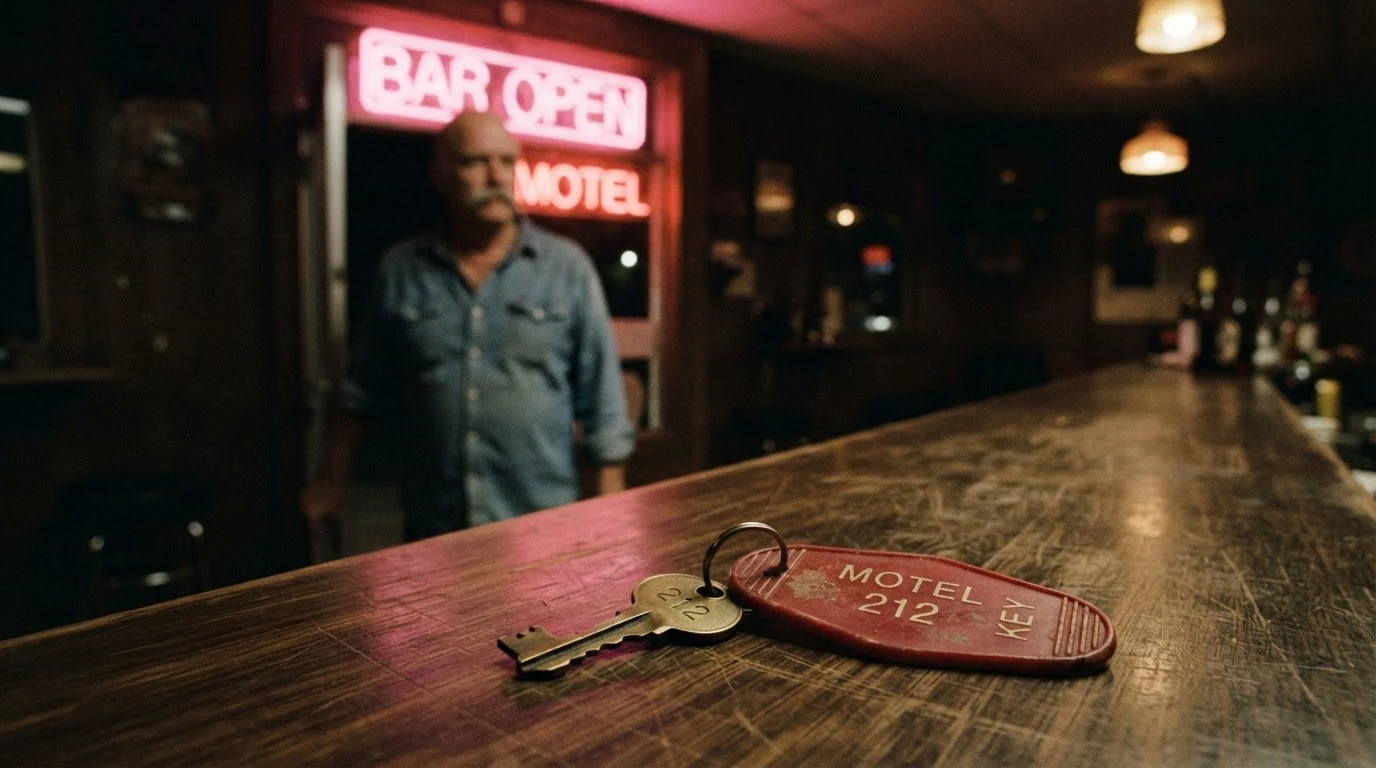
60 cm from the lens and four meters behind it give the model two distinct distances, and 85mm at T2 plus shallow depth of field tells it only one can be sharp. The man is fully described even though he is blurred, so the video model already knows the face it will bring into focus.
Open FlashBoardsCinematic anamorphic film still, over-the-shoulder shot in a hospital corridor at night: the back of the head and shoulder of a young man with a shaved head and a green bomber jacket fill the left third of the frame, close to the lens and completely soft. Two meters beyond him, in sharp focus, a woman in her sixties with short silver hair, a hearing aid and a navy cardigan over nurse's scrubs holds a clipboard to her chest and looks at him. 75mm lens at T2, the focus plane on her eyes, oval out-of-focus highlights from the ceiling lights, cool fluorescent light, quiet tension.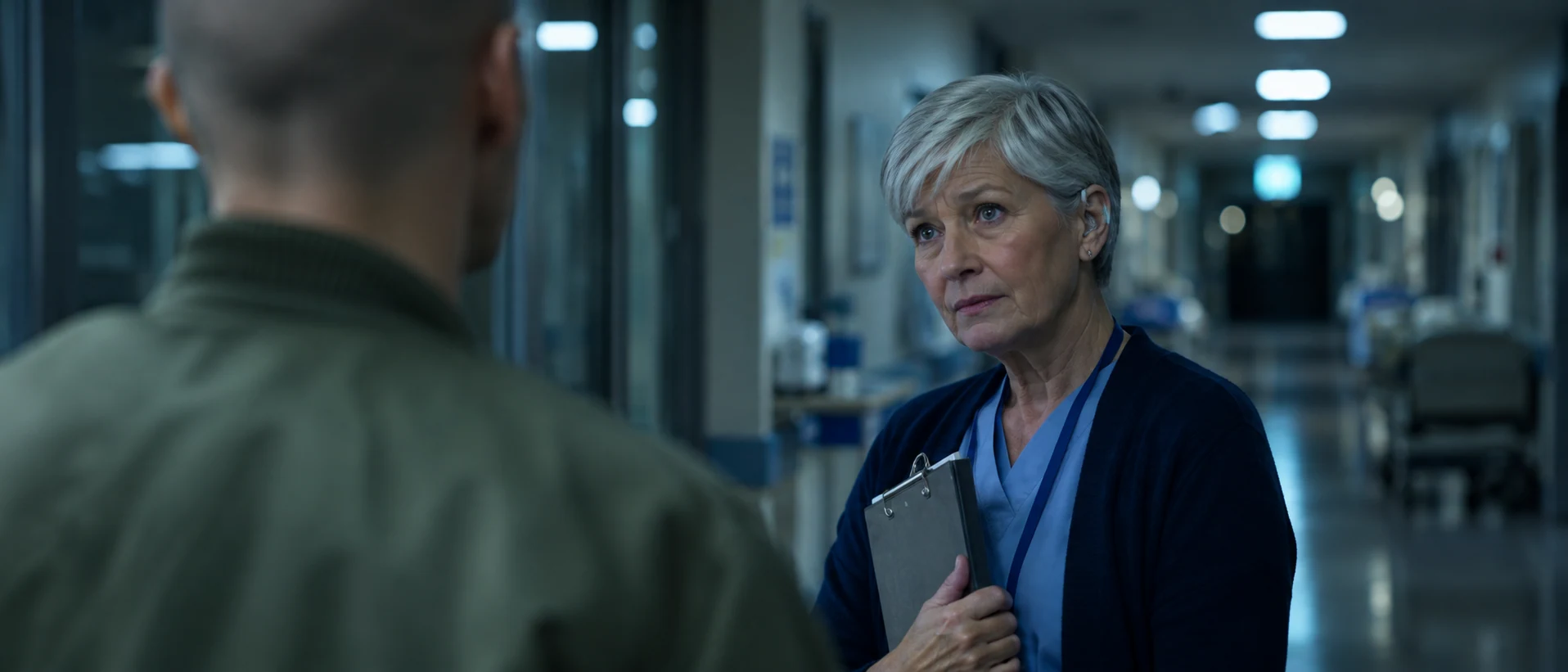
This is the landing frame of a rack between two characters: the foreground shoulder is soft and the far face is sharp. The focus plane on her eyes is the phrase that pins sharpness to one plane; without it, models tend to render both people crisp. Anamorphic 21:9 adds the oval highlights that make the blur read as optics.
Open FlashBoardsCamera: a static tripod shot, the frame stays completely still; only the focus changes. A slow rack focus moves from the brass key on the counter to the man in the doorway, taking about two seconds: the key softens into a warm golden blur while his face and mustache turn sharp. Action: As the shot begins, the man is already stepping through the doorway, one hand pushing the door wide. As he comes into focus he stops and looks straight at the key on the counter. At the end he lets the door swing shut behind him and stands still, his face sharp, the key a soft shape in the foreground.Static tripod shot and only the focus changes stop the model from pushing in, the move it defaults to. The key softens and his face turns sharp describe the rack as a visible result rather than a camera term, and taking about two seconds sets the speed. His step through the door keeps the shot alive from the first frame and gives the rack its cue.
Open FlashBoards{
"output": "Full-screen live-action scene from Conspiracy Theory (1997) from its very first frame: one continuous locked-off shot, no cuts. 1990s 35mm anamorphic scope frame with fine grain; night interior against a dark blue-teal wall; a cool blue light from frame left rims the left side of each face, a low warm key light from the front, deep shadows, very shallow depth of field.",
"characters": {
"S1": {
"name": "Alice Sutton, played by Julia Roberts",
"look": "woman around thirty, shoulder-length wavy auburn hair parted in the middle, pale freckled skin, a small gold stud earring, a dark gray-green tweed coat",
"voice": "clear, low, guarded"
},
"S2": {
"name": "Agent Lowry, played by Cylk Cozart",
"look": "Black man around forty, close-cropped black hair, thin mustache and short stubble, dark suit jacket over a white shirt with thin gray stripes",
"voice": "deep, calm, unhurried"
}
},
"shots": [
{
"shot": 1,
"camera": "locked-off static camera at eye level, long anamorphic lens wide open; a two-shot in depth: S2 in the near right foreground as a big close-up filling the right two fifths of the frame, the top of his head cut by the frame edge, his head in three-quarter view turned toward frame left and slightly lowered; S1 about two meters behind him in the left third of the frame, chest-up, facing the lens; the framing never moves; the only camera change is one fast rack focus from S1 in the background to S2 in the foreground partway through the shot",
"action": [
"BEGINNING: alive from the first frame, S1 is in crisp focus, looking just right of the lens at S2 and already speaking; S2 is a dark soft blur in the right foreground, head lowered toward frame left, completely still.",
"THEN: S1 finishes and closes her lips, holding her gaze on S2, her face still, no nod; S2 stays a still blur.",
"THEN: S1 asks her short question, brows lifting slightly, eyes steady on S2, then presses her lips together and waits.",
"THEN: a fast rack focus: S1's face melts into a soft blur of auburn hair while S2's face in the foreground snaps crisp, skin texture, stubble and the blue rim on his cheek now sharp; he blinks and lifts his eyes toward frame left.",
"THEN: S2 speaks, lips clearly moving, head still, eyes lowered toward frame left; S1 stays a soft still shape behind him, still facing him.",
"THEN: S2 pauses with his mouth closed, eyes down toward frame left.",
"END: S2 speaks again and is still speaking at the last frame; his face stays sharp and S1 stays a soft blur; the frame has not moved at all."
],
"dialogue": [
{
"speaker": "S1",
"on_screen": true,
"when": "from the first frame, while she is in focus",
"delivery": "quiet, a little defensive",
"line": "<d>[English] Nothing. I just wanted to make sure.</d>"
},
{
"speaker": "S1",
"on_screen": true,
"when": "after a short pause, before the focus moves",
"delivery": "direct, wary",
"line": "<d>[English] Who are you guys?</d>"
},
{
"speaker": "S2",
"on_screen": true,
"when": "right after the focus lands on him, never before",
"delivery": "low, calm, measured",
"line": "<d>[English] If the intelligence world was a family...</d>"
},
{
"speaker": "S2",
"on_screen": true,
"when": "after a short pause, running to the last frame",
"delivery": "low, dry, unhurried",
"line": "<d>[English] ... think of us as the uncle no one talks about.</d>"
}
]
}
],
"sound": {
"ambience": "quiet room tone of a closed room at night, a low electric hum, the faint rustle of clothes",
"speech": "exactly these spoken phrases, each said once, in this order",
"never_spoken": "no narration and no voice-over: the descriptions, performance notes and step words of this prompt are never spoken aloud",
"music": "a film score under the scene, always below the voices: low uneasy strings with a soft, slow synth pulse",
"subtitles": "none"
}
}Remakes the locked-off two-shot of Alice Sutton and Agent Lowry from Conspiracy Theory (1997), dir. Richard Donner, DP John Schwartzman: her sharp in the background while she asks who they are, the fast rack onto his face in the right foreground, and his answer from the film, under a low score.
The camera field carries the whole technique: a locked-off frame, both planes placed in depth (him in the near right foreground, her two meters behind on the left) and one fast rack focus as the only change. The film's own lines split the shot: she speaks while she is sharp, and his answer is cued right after the focus lands on him, so the dialogue times the pull.
Common mistakes
- Everything is sharp. Image models default to deep focus. Name the lens and stop (85mm at T2), give distances for both planes and say which one is sharp and which is soft.
- Both planes blurry. Too much blur language and the model softens everything. Put crisp sharp focus on the subject that should be sharp, and soft only on the other plane.
- A push-in instead of a rack. Video models often read focus on the man as move toward the man. Lock the camera (static tripod shot, the frame stays still) and describe only the sharpness changing.
- The rack happens too early or never. State the order and speed in plain words (a slow rack from the key to the man, taking about two seconds) and tie it to an action cue like a door opening.
- A new face appears when focus lands. If the blurred figure is not described in the start frame, the model invents one as it sharpens. Describe the background person fully in recipe 1.
- The wrong plane blurs. Some takes swap the planes. Generate several and keep the correct end frame next to them on the board as a check.
Keep the reference frames, prompts and every generated take side by side — images and video in one canvas.
FAQ
6 questionsWhat is a rack focus shot?
A rack focus shot changes focus during the take from one subject to another at a different distance from the camera. One plane starts sharp while the other is blurred, then the focus puller turns the focus ring so the blur travels across the frame and the second subject becomes sharp. It moves the audience's attention inside a single shot, without a cut, and often reveals something that was hidden in the blur.
Is racking focus the same as a focus pull?
Mostly yes. Racking focus, rack focus, focus pull and pull focus all describe moving focus from one subject to another during a shot. Strictly, pulling focus is the focus puller's whole job, including invisible adjustments that keep a moving actor sharp (follow focus). A rack focus is the version the audience is meant to notice: focus deliberately leaves one subject and lands on another.
What lens is best for a rack focus?
Any lens can rack, but the effect is strongest with a longer focal length and a wide aperture, because both shrink depth of field. An 85mm to 135mm lens at T1.4 to T2.8 gives a pronounced shift between subjects a few meters apart. Cinema lenses help because they have long, smooth focus throws, marked distance scales and little focus breathing, so the frame doesn't visibly zoom during the pull.
Can you do a rack focus with autofocus or a phone?
Yes. Many mirrorless cameras rack between two points when you tap the screen, and face-tracking autofocus will shift to a new face that enters the frame. The weakness is control: set the autofocus transition speed to slow, rehearse the timing, and lock exposure so brightness doesn't pump during the pull.
What are famous rack focus examples?
A widely cited example is The Graduate (1967), where focus shifts from Elaine to her mother behind her at the moment Elaine realizes the truth about Benjamin's affair. Wong Kar-wai's In the Mood for Love (2000) stages its two leads in tight, layered frames where focus picks one face and lets the other blur. Thrillers use racks constantly for reveals, from The Taking of Pelham One Two Three (1974) to The Bourne Ultimatum (2007).
How do you make a rack focus with AI video?
Generate a start frame where one plane is sharp and the other clearly soft, with the lens, stop and both distances named in the prompt. Then animate it with an image-to-video model and write the rack as a result: the camera stays static, the foreground softens while the background face turns sharp, over about two seconds, cued by an action. Generate several takes, since models sometimes push in instead.
Related terms
6- Split DiopterLenses, Focus & Exposure
A split diopter is a half-lens attachment that lets one side of the frame focus close and the other far away, so a face in the foreground and a figure in the background are both sharp — with a tell-tale soft seam between them.
- Camera FocusLenses, Focus & Exposure
Focus is where the lens places its plane of sharpness; on set it is set and adjusted during the take by the focus puller (1st AC), and deciding what is sharp is one of the strongest ways to direct the viewer's attention.
- Shallow Depth of FieldLenses, Focus & Exposure
Shallow depth of field keeps only a thin slice of the scene sharp — often just the eyes — while everything nearer and farther dissolves into blur, isolating the subject and steering attention.
- Depth of FieldLenses, Focus & Exposure
Depth of field is the zone in front of and behind the point of focus that looks acceptably sharp; aperture, focal length, focus distance and format size decide whether it is razor-thin or stretches to the horizon.
- Depth LayeringComposition & Framing
Depth layering builds a shot in distinct planes — foreground, midground and background — each holding something meaningful, so the flat screen gains volume and several actions or ideas can be read at once.
- Over-the-Shoulder ShotCamera Shots
An over-the-shoulder shot looks at one character past the back of another's shoulder and head, keeping both in frame so a conversation feels connected and spatially anchored.
Further reading
Steven D. Katz, Film Directing Shot by Shot (Michael Wiese Productions). · Blain Brown, Cinematography: Theory and Practice (Routledge). · American Cinematographer Manual (ASC Press), sections on depth of field and focus.